
Laboratory heating and stirring devices are fundamental to the synthesis of protonic ceramic electrolytes because they guarantee the uniformity of the precursor solution. By precisely regulating temperature and agitation, these tools ensure a complete reaction between metal ions and chelating agents, which is strictly necessary to produce high-quality ceramic powders.
Precise thermal and mechanical control is the gateway to high-performance electrolytes. It transforms a mixture of raw chemicals into a homogenous, nanometer-scale powder with the exact stoichiometry required for maximum proton conductivity.
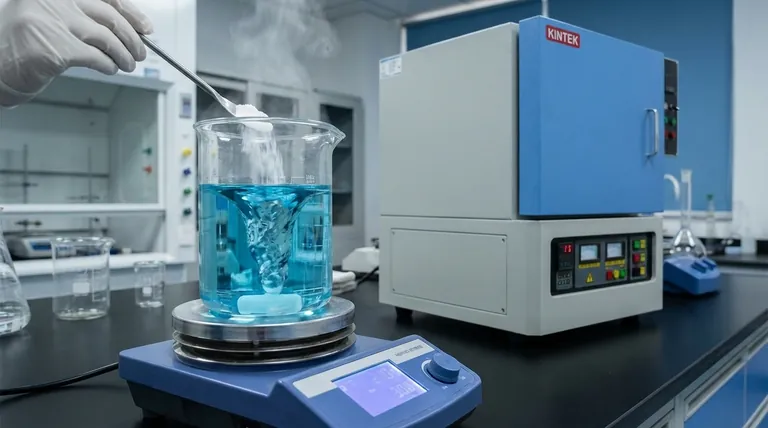
The Role of Precision Control in Synthesis
Ensuring Solution Homogeneity
In methods like Pechini or sol-gel, the quality of the final ceramic is determined at the liquid stage. Heating and stirring devices maintain a high degree of uniformity throughout the solution.
Without constant, controlled agitation, concentration gradients can form. This lack of homogeneity leads to inconsistent material properties in the final product.
Facilitating the Chelation Reaction
The core of these synthesis methods is the reaction between metal ions and chelating agents. This process requires specific thermal conditions to proceed efficiently.
Heating devices provide the energy needed to drive this complexation. Simultaneous stirring ensures that the reactants encounter one another frequently and evenly, facilitating a thorough reaction.
Impact on Powder Characteristics
Achieving Accurate Stoichiometry
The primary goal of using these devices is to lock in the correct chemical composition. By maintaining a uniform environment, you ensure that the final powder possesses accurate stoichiometry.
If the solution is not heated and stirred uniformly, components may separate or precipitate unevenly. This results in phases that do not match the desired chemical formula.
Controlling Particle Size and Activity
Proper processing directly influences the physical structure of the ceramic powder. Controlled synthesis results in nanometer-scale ceramic powders with a fine particle size.
These fine particles possess high activity, which is crucial for the subsequent sintering steps. Coarser, uneven particles often lead to poor densification and structural defects.
The Link to Electrolyte Performance
Enhancing Proton Conductivity
The ultimate justification for using these devices is the performance of the final electrolyte. The synthesis conditions dictate the material's ability to conduct protons.
By ensuring fine particle size and precise stoichiometry, you create the structural conditions necessary for enhancing proton conductivity. A poorly synthesized powder will invariably lead to an electrolyte with high resistance and low efficiency.
Common Pitfalls in Processing
Inconsistent Temperature Profiles
A common error is relying on equipment that cannot maintain a stable temperature across the entire vessel. Thermal gradients can cause parts of the solution to gel or precipitate prematurely.
This inconsistency leads to localized variations in composition. The resulting powder will be chemically heterogeneous, degrading performance.
Inadequate Agitation Rates
Stirring too slowly or using improper mixing geometry can leave "dead zones" in the reaction vessel. This prevents the chelating agents from interacting fully with the metal ions.
Consequently, unreacted species may remain in the solution. This impurity prevents the formation of the pure crystalline phase required for optimal conduction.
Making the Right Choice for Your Goal
To maximize the quality of your protonic ceramic electrolytes, you must align your processing equipment with your specific material requirements.
- If your primary focus is Phase Purity: Ensure your device offers precise temperature regulation to guarantee accurate stoichiometry and prevent secondary phase formation.
- If your primary focus is Sintering Activity: Prioritize vigorous and uniform stirring to produce the fine, nanometer-scale particle sizes needed for dense microstructures.
Control your synthesis parameters with precision, and you will unlock the full potential of your ceramic electrolyte.
Summary Table:
| Synthesis Factor | Role of Heating & Stirring | Impact on Final Powder |
|---|---|---|
| Homogeneity | Eliminates concentration gradients via constant agitation | Uniform material properties |
| Chelation | Provides thermal energy for metal-ion complexation | Complete chemical reaction |
| Stoichiometry | Maintains uniform environment during liquid phase | Precise chemical composition |
| Particle Size | Prevents uneven precipitation and agglomeration | Nanometer-scale, high-activity powder |
| Conductivity | Creates optimal structural conditions | Enhanced proton conductivity |
Elevate Your Materials Synthesis with KINTEK
Precision in the lab translates to performance in the field. Backed by expert R&D and world-class manufacturing, KINTEK provides the high-performance heating and stirring solutions necessary for advanced Pechini and sol-gel processes.
Whether you require Muffle, Tube, Rotary, Vacuum, or CVD systems, our laboratory high-temp furnaces are fully customizable to meet the unique stoichiometric and thermal demands of your research. Don't let inconsistent temperature profiles or inadequate agitation compromise your electrolyte's proton conductivity.
Ready to achieve superior phase purity and sintering activity?
References
- Hizkia Manuel Vieri, Sun Hee Choi. Electrochemical Synthesis of Ammonia via Nitrogen Reduction and Oxygen Evolution Reactions—A Comprehensive Review on Electrolyte-Supported Cells. DOI: 10.3390/en17020441
This article is also based on technical information from Kintek Furnace Knowledge Base .
Related Products
- High Temperature Muffle Oven Furnace for Laboratory Debinding and Pre Sintering
- Small Vacuum Heat Treat and Tungsten Wire Sintering Furnace
- Laboratory Quartz Tube Furnace RTP Heating Tubular Furnace
- 1200℃ Muffle Oven Furnace for Laboratory
- 1800℃ High Temperature Muffle Oven Furnace for Laboratory
People Also Ask
- What thermal phenomena occur during polymer binder burnout in ceramic green bodies? Lab Furnace Guide
- What role does a high-temperature muffle furnace play in STFO synthesis? Achieve Pure Perovskite Results
- Why is controlled heat treatment in a muffle furnace necessary for calcined clay? Achieve Optimal Pozzolanic Activity
- How does a high-temperature muffle furnace facilitate the formation of LaNbxAl1−xO3+δ perovskite structures? Key Roles
- What role does a high-temperature muffle furnace play in the multi-stage synthesis of Li0.5MnFe1.5O4? Key to Pure Spinel



















