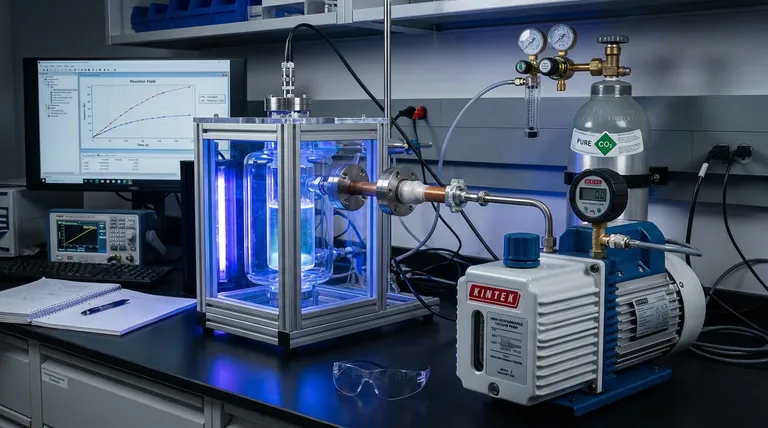
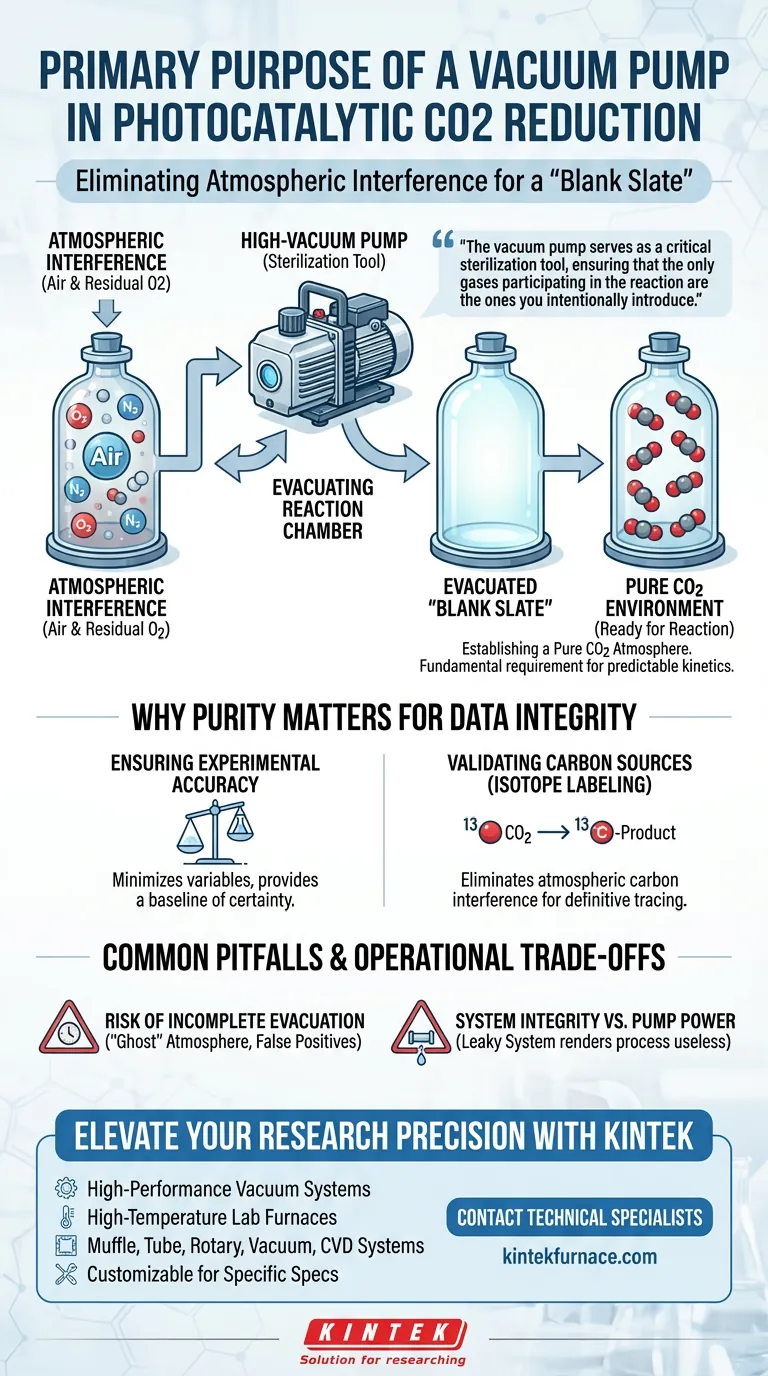
The primary purpose of a vacuum pump in photocatalytic CO2 reduction is to eliminate atmospheric interference by thoroughly evacuating the reaction chamber. By connecting a high-vacuum pump to the system's exhaust, researchers remove air and residual oxygen to create a "blank slate" before the reaction begins. This step is a prerequisite for establishing a pure CO2 environment.
In scientific experimentation, the validity of your results is defined by the purity of your inputs. The vacuum pump serves as a critical sterilization tool, ensuring that the only gases participating in the reaction are the ones you intentionally introduce.
Creating a Controlled Reaction Environment
Eliminating Residual Oxygen
The presence of oxygen is detrimental to reduction experiments. A high-vacuum pump functions to strip away the ambient air that naturally fills the reaction vessel.
By removing this residual oxygen, you prevent it from competing with CO2 for electrons or oxidizing the reduction products, which would skew the chemical outcomes.
Establishing a Pure CO2 Atmosphere
Once the air is evacuated, the chamber is refilled with the reactant gas. The vacuum process ensures that the environment transitions from a mix of atmospheric gases to a pure CO2 environment.
This purity is not merely a preference; it is a fundamental requirement for the reaction kinetics to proceed as predicted without external variables.
Why Purity Matters for Data Integrity
Ensuring Experimental Accuracy
The reliability of photocatalytic data hinges on knowing exactly what is inside the reactor. Any remaining atmospheric gases introduce variables that make it difficult to determine the true efficiency of the photocatalyst.
The vacuum pump minimizes these variables, providing a baseline of certainty for the experimental results.
Validating Carbon Sources via Isotope Labeling
One of the most specific applications mentioned in technical literature is carbon source isotope labeling. To prove that a fuel product (like methane or methanol) was generated from the introduced CO2 and not organic contaminants, researchers use isotopically labeled CO2 (e.g., $^{13}CO_2$).
If the system is not thoroughly evacuated, atmospheric carbon could contaminate the results. The vacuum pump eliminates this interference, allowing researchers to definitively trace the carbon path.
Common Pitfalls and Operational Trade-offs
The Risk of Incomplete Evacuation
A common error is underestimating the time or vacuum strength required. If the pump does not achieve a sufficient vacuum level, trace amounts of air remain.
This "ghost" atmosphere can lead to false positives or inconsistent yields between different experimental runs.
System Integrity vs. Pump Power
A powerful vacuum pump cannot compensate for a leaky system. The application of high vacuum puts stress on seals and joints.
Operators must ensure the reaction system is hermetically sealed; otherwise, the pump will continuously draw in outside air, rendering the purification process useless.
Ensuring Experimental Success
To maximize the reliability of your photocatalytic data, consider your specific experimental goals:
- If your primary focus is basic yield efficiency: Ensure the vacuum pump is capable of reaching pressures low enough to prevent oxygen from scavenging the photogenerated electrons.
- If your primary focus is mechanistic proof (Isotope Labeling): Prioritize a high-vacuum pump with a rigorous evacuation protocol to guarantee that absolutely no atmospheric carbon interferes with your isotopic tracing.
The vacuum pump is not just an accessory; it is the foundation of experimental reproducibility.
Summary Table:
| Feature | Role in CO2 Reduction | Impact on Experimental Success |
|---|---|---|
| Atmospheric Removal | Eliminates O2 and N2 from the chamber | Prevents electron scavenging and oxidative interference |
| Atmosphere Control | Facilitates transition to pure CO2 environment | Ensures reaction kinetics proceed without external variables |
| Data Integrity | Enables accurate Carbon Source Isotope Labeling | Confirms fuel products originate solely from introduced CO2 |
| Reproducibility | Establishes a consistent, clean baseline | Minimizes false positives and experimental variability |
Elevate Your Research Precision with KINTEK
Don't let atmospheric impurities compromise your photocatalytic data. KINTEK provides high-performance vacuum systems and high-temperature laboratory furnaces designed for the rigorous demands of CO2 reduction and material synthesis.
Backed by expert R&D and manufacturing, we offer Muffle, Tube, Rotary, Vacuum, and CVD systems, all fully customizable to meet your unique laboratory specifications. Our technology ensures the hermetic integrity and precise control required for definitive isotope labeling and kinetic studies.
Ready to optimize your experimental setup? Contact our technical specialists today to discover how KINTEK can enhance your lab's efficiency and data reliability.
Visual Guide
References
- Facilitated Charge Transfer Endowed by Zn–O Bridge of Phthalocyanine‐Based Hollow Tandem S‐Scheme Heterojunction for Photocatalytic Fuel Production. DOI: 10.1002/sstr.202500166
This article is also based on technical information from Kintek Furnace Knowledge Base .
Related Products
- Vacuum Hot Press Furnace Machine Heated Vacuum Press
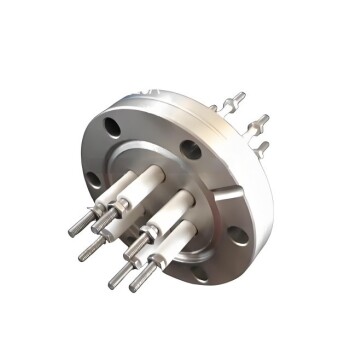
- CF KF Flange Vacuum Electrode Feedthrough Lead Sealing Assembly for Vacuum Systems
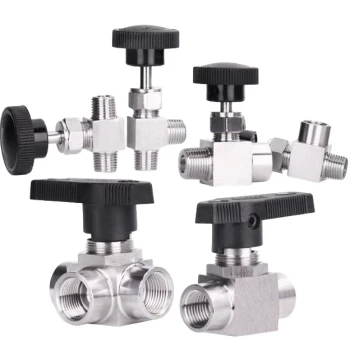
- 304 316 Stainless Steel High Vacuum Ball Stop Valve for Vacuum Systems
- Vacuum Hot Press Furnace Machine for Lamination and Heating
- Vacuum Hot Press Furnace Machine Heated Vacuum Press Tube Furnace
People Also Ask
- What are the primary components of a vacuum hot press furnace? Master the Core Systems for Precise Material Processing
- What safety features are incorporated in vacuum hot press furnaces? Ensure Operator and Equipment Protection
- What are the benefits of the vacuum environment system in a vacuum hot press furnace? Unlock High-Density Sintering
- What types of heating elements are used in vacuum hot press furnaces? Optimize for High-Temp Performance
- What are the core advantages of using a vacuum hot press furnace? Achieve Near-Forged Density for Ti-6Al-4V Alloys