Vacuum-sealed quartz tubes are strictly required in the melting process of tin selenide (SnSe) to create a controlled, isolated environment that prevents the rapid oxidation of raw materials while containing volatile components. This setup utilizes the high thermal stability of quartz to withstand reaction temperatures of 1273 K without chemically interacting with the sample or degrading over long processing times.
Core Takeaway The vacuum-sealed quartz tube serves a dual purpose: it acts as a barrier against atmospheric oxygen and moisture to ensure chemical purity, and it serves as a pressure vessel to retain volatile Selenium, preserving the correct stoichiometry of the final compound.
The Critical Role of the Vacuum Environment
Preventing Oxidation and Contamination
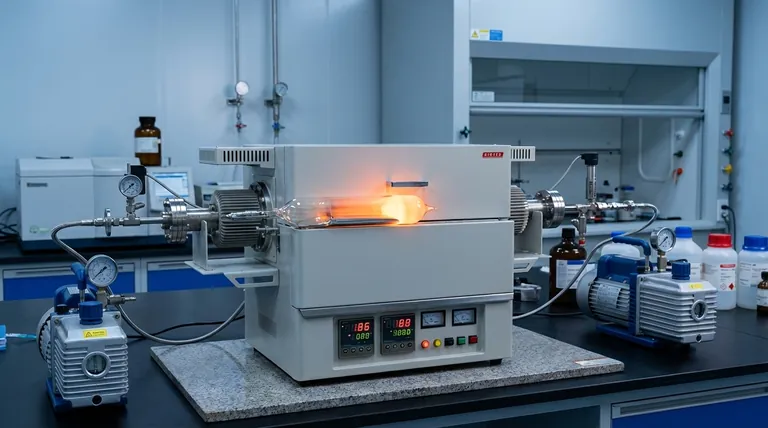
The primary function of the vacuum seal is to eliminate atmospheric variables. By establishing a vacuum (typically around 1-3 Pa or 10 mTorr), you remove oxygen and moisture from the reaction zone.
Both Tin and Selenium are susceptible to oxidation at high temperatures. Without a vacuum, oxygen would react with the metals, resulting in impurity phases that degrade the material's electronic properties.
Reducing Crystal Defects
Beyond simple oxidation, the presence of atmospheric impurities can induce crystal defects. Removing these contaminants provides a pure background, which is a prerequisite for synthesizing high-performance structures, such as ferroelectric AC-stacked SnSe.
Containing Volatile Components
Selenium is highly volatile at the melting temperatures required for this reaction. If the vessel were open or unsealed, Selenium vapor would escape, altering the ratio of Tin to Selenium (stoichiometry).
The sealed quartz tube traps these vapors within the reaction volume. This ensures that the solid-state reaction proceeds within a closed system, maintaining the intended chemical composition.
Why Quartz is the Material of Choice
Thermal Stability at 1273 K
The synthesis of SnSe requires high-temperature reactions, often reaching 1273 K. Quartz is selected because it maintains structural integrity at these extreme temperatures, whereas standard glass would melt or deform.
Chemical Inertness
Quartz offers excellent chemical corrosion resistance. During melting processes that can last several hours, it is vital that the vessel does not react with the Tin or Selenium melt.
Quartz ensures the material composition remains undisturbed, acting as a neutral container rather than a reactive participant.
Understanding the Trade-offs
Fragility and Mechanical Stress
While quartz is thermally stable, it is brittle. Great care must be taken when sealing the tubes; improper handling or thermal shock can cause micro-cracks that compromise the vacuum.
Internal Pressure Risks
Because the tube is sealed, the vaporization of Selenium creates internal pressure. If the temperature ramps up too quickly, the vapor pressure of the Selenium can exceed the mechanical strength of the quartz, leading to an explosion of the ampoule.
Making the Right Choice for Your Goal
To ensure the success of your SnSe synthesis, align your process controls with your specific material objectives:
- If your primary focus is high-performance electronic properties: Prioritize achieving a high vacuum (10 mTorr or lower) to minimize impurity-induced crystal defects.
- If your primary focus is stoichiometric accuracy: Ensure the quartz seal is robust and the tube volume is minimized to limit the space available for Selenium to exist as a vapor rather than a solid/liquid.
The vacuum-sealed quartz tube is not just a container; it is an active control mechanism for purity and stoichiometry.
Summary Table:
| Feature | Key Benefit | Technical Necessity |
|---|---|---|
| Vacuum Seal | Oxidation Prevention | Removes O2/moisture to stop impurity phases |
| Quartz Material | High Thermal Stability | Withstands 1273 K without deformation |
| Closed System | Stoichiometry Control | Traps volatile Selenium vapor within the vessel |
| Inert Surface | Chemical Purity | Prevents reactions between the melt and container |
Elevate Your Material Synthesis with KINTEK
Achieving the precise environment required for SnSe melting demands high-performance equipment. Backed by expert R&D and manufacturing, KINTEK provides high-precision Vacuum, Tube, and CVD systems specifically engineered for high-temperature stability and atmosphere control.
Whether you are synthesizing advanced thermoelectrics or exploring new semiconductor alloys, our customizable lab high-temperature furnaces—including Muffle, Rotary, and Vacuum systems—are built to handle your unique processing needs.
Contact KINTEK today to discuss your customized furnace solution
Visual Guide

References
- Andrew Golabek, Holger Kleinke. Large Improvements in the Thermoelectric Properties of SnSe by Fast Cooling. DOI: 10.3390/ma18020358
This article is also based on technical information from Kintek Furnace Knowledge Base .
Related Products
- High Pressure Laboratory Vacuum Tube Furnace
- Vacuum Sealed Continuous Working Rotary Tube Furnace Rotating Tube Furnace
- Vertical Laboratory Quartz Tube Furnace Tubular Furnace
- Laboratory Quartz Tube Furnace RTP Heating Tubular Furnace
- CF KF Flange Vacuum Electrode Feedthrough Lead Sealing Assembly for Vacuum Systems
People Also Ask
- What role does a high vacuum tube furnace play in Co-Al sintering? Master High-Purity Porous Material Synthesis
- What are the different types of tube furnaces available? Find the Perfect Fit for Your Lab's Needs
- What is the role of a vacuum tube furnace during the final thermal treatment stage of Fe3O4@CSAC catalysts?
- What are the main advantages of vacuum tube furnaces in the market? Achieve Purity and Precision in Material Processing
- What conditions does a tube furnace provide for post-ion-implantation? Achieve Precise Microstructural Repair