Knowledge What role does a mass flow controller (MFC) play in plasma-based aluminum reduction? Precision Control for High Yields
Author avatar

Tech Team · Kintek Furnace

Updated 1 day ago

What role does a mass flow controller (MFC) play in plasma-based aluminum reduction? Precision Control for High Yields


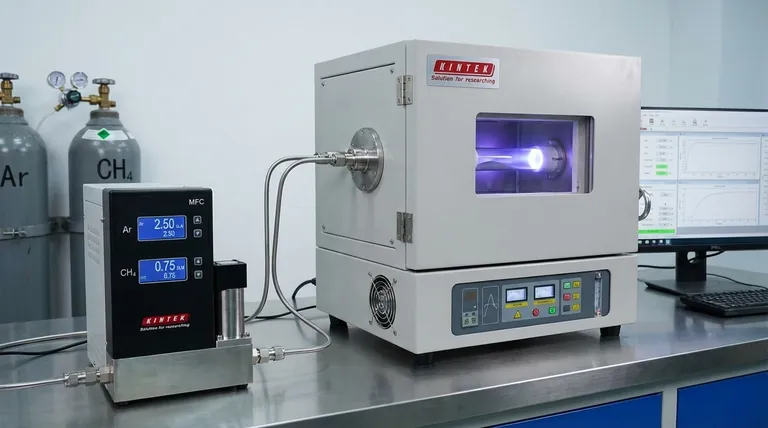
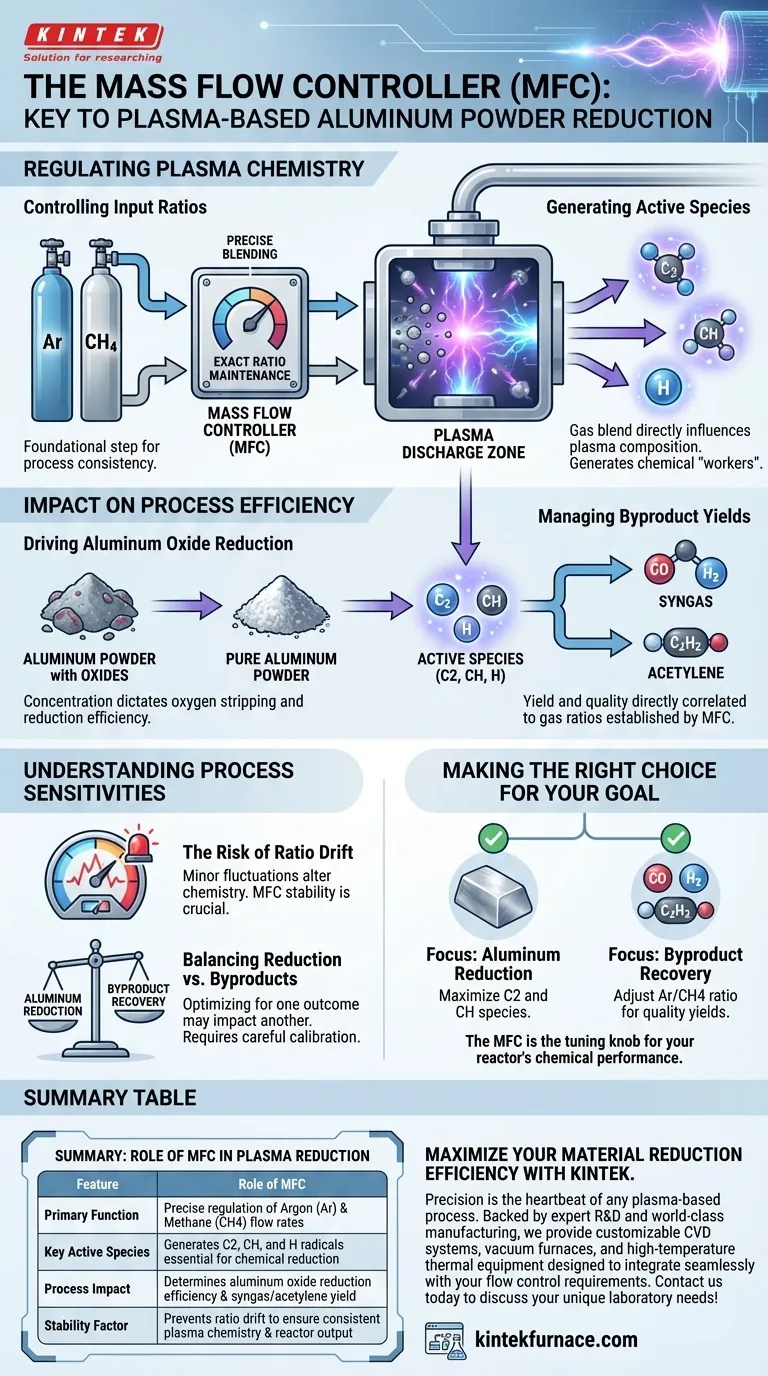
In the plasma-based reduction of aluminum powder, the Mass Flow Controller (MFC) serves as the critical regulator of the reaction environment. Its primary function is to maintain precise flow rates and specific ratios of input gases, specifically argon (Ar) and methane (CH4), entering the system.

The MFC does more than just move gas; it dictates the chemistry of the plasma. By strictly controlling input ratios, the MFC determines the concentration of active species, which drives both the efficiency of aluminum oxide reduction and the yield of valuable byproducts.
What role does a mass flow controller (MFC) play in plasma-based aluminum reduction? Precision Control for High Yields

Regulating the Plasma Chemistry

The reduction of aluminum powder is a highly sensitive chemical process. The MFC ensures that the conditions within the plasma discharge zone remain optimal for reaction.

Controlling Input Ratios

The MFC is responsible for the precise blending of the carrier gas, argon (Ar), and the reactive gas, methane (CH4).

Maintaining the exact ratio between these two gases is the foundational step of the entire process.

Generating Active Species

The specific blend of gases regulated by the MFC directly influences the composition of the plasma.

Proper flow control facilitates the generation of critical active species, including C2, CH, and H. These species are the chemical "workers" that actually perform the reduction.

Impact on Process Efficiency

The settings applied to the Mass Flow Controller have a downstream effect on the final output of the reactor. The relationship is linear: flow control dictates plasma composition, which dictates results.

Driving Aluminum Oxide Reduction

The concentration of active species (C2, CH, H) determines how effectively oxygen is stripped from the aluminum powder.

If the MFC maintains optimal reactant levels, the reduction efficiency of aluminum oxide is maximized.

Managing Byproduct Yields

The process produces secondary outputs, specifically syngas and acetylene.

The yield and quality of these byproducts are directly correlated to the gas ratios established by the MFC.

Understanding Process Sensitivities

While the MFC enables precision, it also highlights the vulnerability of the process. Understanding the trade-offs of flow control is essential for consistent results.

The Risk of Ratio Drift

Because the process relies on specific active species (C2, CH, H), even minor fluctuations in gas flow can alter the plasma chemistry.

If the MFC fails to maintain strict stability, the concentration of these species will drop, leading to incomplete reduction of the aluminum oxide.

Balancing Reduction vs. Byproducts

Optimizing for one outcome may impact another.

A flow ratio designed to maximize syngas production might differ slightly from the ratio needed for maximum acetylene yield, requiring careful calibration of the MFC based on your primary goal.

Making the Right Choice for Your Goal

To maximize the effectiveness of your plasma-based reduction system, you must align your MFC settings with your specific objectives.

  • If your primary focus is Aluminum Reduction: Calibrate the MFC to maximize the concentration of C2 and CH species, as these directly drive the removal of oxides.
  • If your primary focus is Byproduct Recovery: Adjust the Argon/Methane ratio to favor the formation of species that recombine into high-quality syngas or acetylene.

The Mass Flow Controller is not just a valve; it is the tuning knob for the entire chemical performance of your reactor.

Summary Table:

Feature Role of MFC in Plasma Reduction
Primary Function Precise regulation of Argon (Ar) and Methane (CH4) flow rates
Key Active Species Generates C2, CH, and H radicals essential for chemical reduction
Process Impact Determines aluminum oxide reduction efficiency and syngas/acetylene yield
Stability Factor Prevents ratio drift to ensure consistent plasma chemistry and reactor output

Maximize Your Material Reduction Efficiency with KINTEK

Precision is the heartbeat of any plasma-based process. At KINTEK, we understand that even minor fluctuations in gas flow can compromise your results. Backed by expert R&D and world-class manufacturing, we provide high-performance laboratory solutions, including customizable CVD systems, vacuum furnaces, and high-temperature thermal equipment designed to integrate seamlessly with your flow control requirements.

Whether you are optimizing aluminum reduction or targeting specific byproduct yields, our team is ready to build the custom high-temp system your research demands. Contact us today to discuss your unique laboratory needs and explore our range of customizable furnace systems!

Visual Guide
What role does a mass flow controller (MFC) play in plasma-based aluminum reduction? Precision Control for High Yields Visual Guide

References

  1. Alexander Logunov, Sergey S. Suvorov. Plasma–Chemical Low-Temperature Reduction of Aluminum with Methane Activated in Microwave Plasma Discharge. DOI: 10.3390/met15050514

This article is also based on technical information from Kintek Furnace Knowledge Base .

Related Products

People Also Ask

Related Products

1200℃ Controlled Inert Nitrogen Atmosphere Furnace

1200℃ Controlled Inert Nitrogen Atmosphere Furnace

KINTEK 1200℃ Controlled Atmosphere Furnace: Precision heating with gas control for labs. Ideal for sintering, annealing, and material research. Customizable sizes available.

Multi Zone Laboratory Quartz Tube Furnace Tubular Furnace

Multi Zone Laboratory Quartz Tube Furnace Tubular Furnace

KINTEK Multi-Zone Tube Furnace: Precise 1700℃ heating with 1-10 zones for advanced material research. Customizable, vacuum-ready, and safety-certified.

Vacuum Induction Melting Furnace and Arc Melting Furnace

Vacuum Induction Melting Furnace and Arc Melting Furnace

Explore KINTEK's Vacuum Induction Melting Furnace for high-purity metal processing up to 2000℃. Customizable solutions for aerospace, alloys, and more. Contact us today!

Vacuum Heat Treat Furnace with Ceramic Fiber Liner

Vacuum Heat Treat Furnace with Ceramic Fiber Liner

KINTEK's Vacuum Furnace with Ceramic Fiber Lining offers precise high-temperature processing up to 1700°C, ensuring uniform heat distribution and energy efficiency. Ideal for labs and production.

Stainless Steel Quick Release Vacuum Chain Three Section Clamp

Stainless Steel Quick Release Vacuum Chain Three Section Clamp

Stainless steel quick release vacuum clamps ensure leak-free connections for high vacuum systems. Durable, corrosion-resistant, and easy to install.

Vacuum Sealed Continuous Working Rotary Tube Furnace Rotating Tube Furnace

Vacuum Sealed Continuous Working Rotary Tube Furnace Rotating Tube Furnace

Precision rotary tube furnace for continuous vacuum processing. Ideal for calcination, sintering, and heat treatment. Customizable up to 1600℃.

1800℃ High Temperature Muffle Oven Furnace for Laboratory

1800℃ High Temperature Muffle Oven Furnace for Laboratory

KINTEK Muffle Furnaces: Precision 1800°C heating for labs. Energy-efficient, customizable, with PID control. Ideal for sintering, annealing, and research.

1400℃ High Temperature Laboratory Tube Furnace with Quartz and Alumina Tube

1400℃ High Temperature Laboratory Tube Furnace with Quartz and Alumina Tube

KINTEK's Tube Furnace with Alumina Tube: Precision high-temperature processing up to 2000°C for labs. Ideal for material synthesis, CVD, and sintering. Customizable options available.

Vacuum Hot Press Furnace Machine for Lamination and Heating

Vacuum Hot Press Furnace Machine for Lamination and Heating

KINTEK Vacuum Lamination Press: Precision bonding for wafer, thin-film & LCP applications. 500°C max temp, 20-ton pressure, CE certified. Custom solutions available.

Vacuum Hot Press Furnace Machine Heated Vacuum Press Tube Furnace

Vacuum Hot Press Furnace Machine Heated Vacuum Press Tube Furnace

Discover KINTEK's advanced Vacuum Tube Hot Press Furnace for precise high-temperature sintering, hot pressing, and material bonding. Customizable solutions for labs.

Multi Heating Zones CVD Tube Furnace Machine for Chemical Vapor Deposition Equipment

Multi Heating Zones CVD Tube Furnace Machine for Chemical Vapor Deposition Equipment

KINTEK's Multi-Zone CVD Tube Furnaces offer precision temperature control for advanced thin film deposition. Ideal for research and production, customizable for your lab needs.

915MHz MPCVD Diamond Machine Microwave Plasma Chemical Vapor Deposition System Reactor

915MHz MPCVD Diamond Machine Microwave Plasma Chemical Vapor Deposition System Reactor

KINTEK MPCVD Diamond Machine: High-quality diamond synthesis with advanced MPCVD technology. Faster growth, superior purity, customizable options. Boost production now!

Ultra High Vacuum CF Flange Stainless Steel Sapphire Glass Observation Sight Window

Ultra High Vacuum CF Flange Stainless Steel Sapphire Glass Observation Sight Window

CF sapphire viewing window for ultra-high vacuum systems. Durable, clear, and precise for semiconductor and aerospace applications. Explore specs now!

Magnesium Extraction and Purification Condensing Tube Furnace

Magnesium Extraction and Purification Condensing Tube Furnace

Magnesium purification tube furnace for high-purity metal production. Achieve ≤10Pa vacuum, dual-zone heating. Ideal for aerospace, electronics, and lab research.

Ultra High Vacuum CF Observation Window Flange with High Borosilicate Glass Sight Glass

Ultra High Vacuum CF Observation Window Flange with High Borosilicate Glass Sight Glass

CF Ultra-High Vacuum Observation Window Flange with high borosilicate glass for precise UHV applications. Durable, clear, and customizable.

Controlled Inert Nitrogen Hydrogen Atmosphere Furnace

Controlled Inert Nitrogen Hydrogen Atmosphere Furnace

Discover KINTEK's Hydrogen Atmosphere Furnace for precise sintering & annealing in controlled environments. Up to 1600°C, safety features, customizable.

Ultra-High Vacuum Flange Aviation Plug Glass Sintered Airtight Circular Connector for KF ISO CF

Ultra-High Vacuum Flange Aviation Plug Glass Sintered Airtight Circular Connector for KF ISO CF

Ultra-High Vacuum Flange Aviation Plug Connector for aerospace & labs. KF/ISO/CF compatible, 10⁻⁹ mbar airtight, MIL-STD certified. Durable & customizable.

304 316 Stainless Steel High Vacuum Ball Stop Valve for Vacuum Systems

304 316 Stainless Steel High Vacuum Ball Stop Valve for Vacuum Systems

KINTEK's 304/316 stainless steel vacuum ball valves and stop valves ensure high-performance sealing for industrial and scientific applications. Explore durable, corrosion-resistant solutions.

High Temperature Muffle Oven Furnace for Laboratory Debinding and Pre Sintering

High Temperature Muffle Oven Furnace for Laboratory Debinding and Pre Sintering

KT-MD Debinding & Pre-Sintering Furnace for ceramics - precise temperature control, energy-efficient design, customizable sizes. Boost your lab efficiency today!

Laboratory Muffle Oven Furnace with Bottom Lifting

Laboratory Muffle Oven Furnace with Bottom Lifting

Boost lab efficiency with KT-BL Bottom Lifting Furnace: precise 1600℃ control, superior uniformity, and enhanced productivity for material science and R&D.


Leave Your Message