
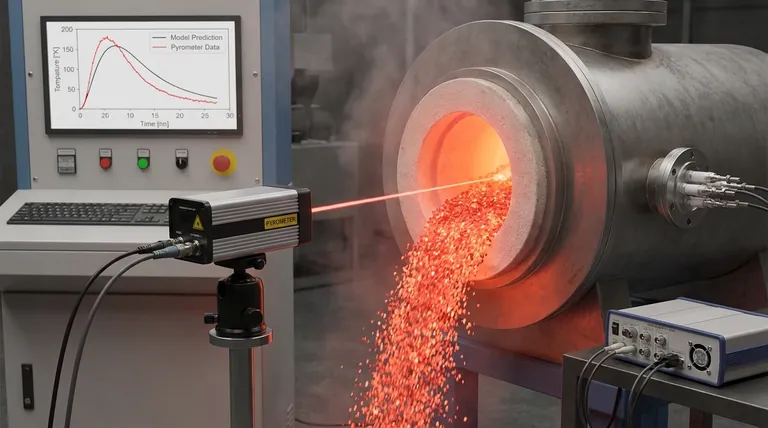
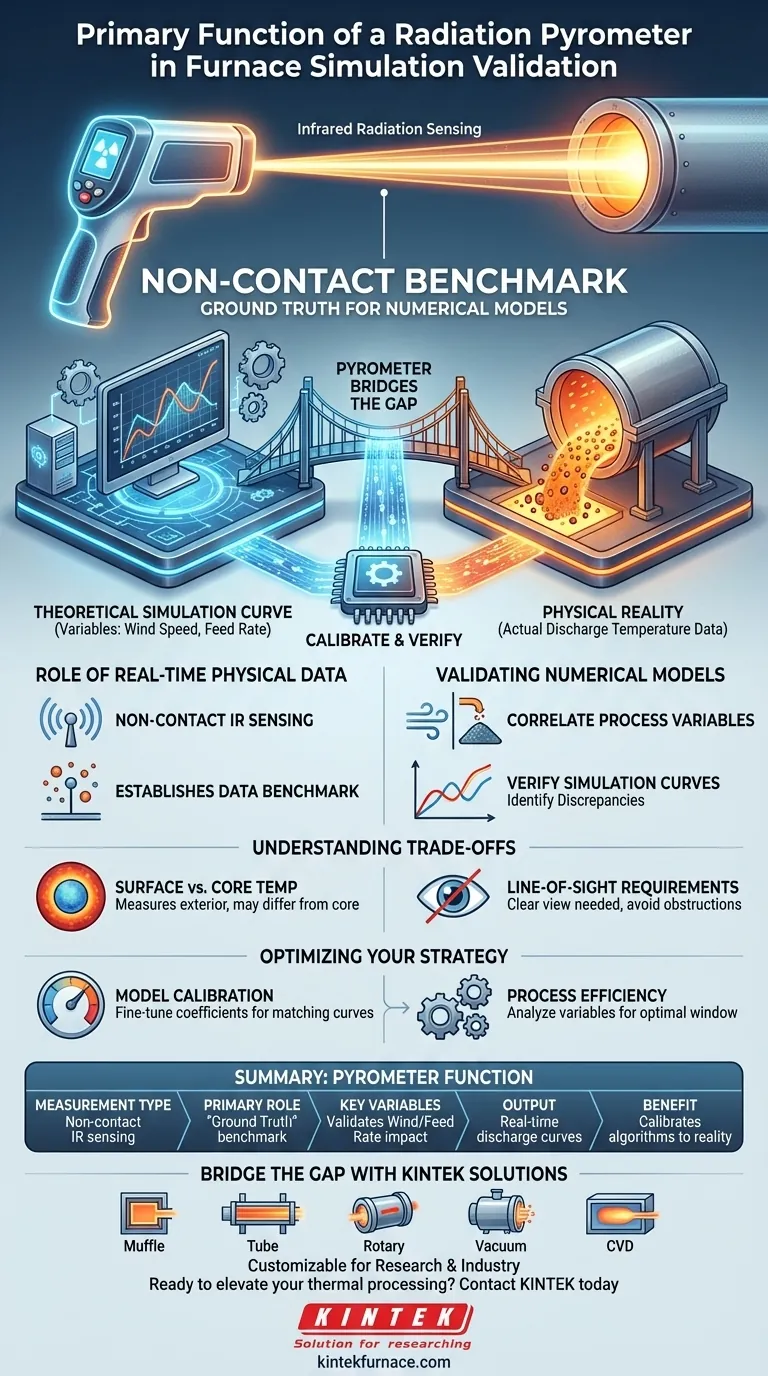
The primary function of a radiation pyrometer is to provide a precise, non-contact benchmark for validating theoretical furnace models. By capturing infrared radiation from large particles as they exit the system, the device generates real-time discharge temperature data that acts as the "ground truth" for verifying numerical simulations.
Numerical simulations are only theoretical until proven by physical data. The radiation pyrometer bridges this gap by providing precise discharge temperature readings, allowing engineers to calibrate simulation curves against actual performance under varying conditions.
The Role of Real-Time Physical Data
Non-Contact Infrared Sensing
The pyrometer operates by detecting infrared radiation emitted directly from the surfaces of large particles. Because the measurement is non-contact, it allows for accurate temperature capture without physically interfering with the moving material or the experimental setup.
Establishing a Data Benchmark
The data collected serves as an absolute reference point. It provides a tangible metric that simulation engineers can use to test the fidelity of their mathematical models.
Validating Numerical Models
Correlating Process Variables
Simulations often predict how temperature will fluctuate based on specific inputs. The pyrometer validates these predictions specifically regarding variables such as wind speed and feed rate.
Verifying Simulation Curves
The device allows for the creation of discharge temperature variation curves based on reality. By overlaying these real-world curves with simulated ones, engineers can immediately identify discrepancies in their algorithms.
Ensuring Process Reliability
When the pyrometer data matches the simulation, the reliability of the simulated process parameters is confirmed. This ensures that the digital model can be trusted for future predictive adjustments.
Understanding the Trade-offs
Surface vs. Core Temperature
The reference notes that the pyrometer captures radiation from "particle surfaces." It is important to remember that this measures the exterior temperature, which may differ slightly from the core temperature of a large particle depending on thermal conductivity.
Line-of-Sight Requirements
Because the device relies on capturing infrared radiation, it requires a clear line of sight to the discharged particles. Obstructions or heavy particulate density in the air gap could potentially influence the reading accuracy.
Optimizing Your Validation Strategy
To ensure your furnace simulations are robust and reliable, use the pyrometer data strategically.
- If your primary focus is Model Calibration: Use the pyrometer's discharge data to fine-tune the coefficients in your numerical simulation until the curves match.
- If your primary focus is Process Efficiency: Analyze the relationship between wind speed/feed rate and temperature to identify the optimal operating window validated by the pyrometer.
Trusting the pyrometer as your empirical baseline ensures your simulations transition from theoretical mathematics to reliable engineering tools.
Summary Table:
| Feature | Function in Simulation Validation |
|---|---|
| Measurement Type | Non-contact infrared sensing of particle surfaces |
| Primary Role | Provides "ground truth" benchmark for numerical models |
| Key Variables | Validates impact of wind speed and feed rate on temperature |
| Output | Real-time discharge temperature variation curves |
| Benefit | Calibrates theoretical algorithms against physical reality |
Bridge the Gap Between Theory and Reality with KINTEK
Don't let your furnace processes rely on unverified mathematics. Backed by expert R&D and manufacturing, KINTEK offers a comprehensive range of Muffle, Tube, Rotary, Vacuum, and CVD systems, all customizable for your unique research and industrial needs. Whether you are validating complex numerical simulations or optimizing high-temp production, our precision lab furnaces provide the stability and control required for empirical excellence.
Ready to elevate your thermal processing? Contact KINTEK today to discuss how our customizable high-temperature solutions can enhance your laboratory's efficiency and accuracy.
Visual Guide
References
- Kum-Song Ku, Bok-Chol Song. Numerical Simulation for Heat Transfer of Fluid-Granular Multiphase Flow in a Preheating Furnace. DOI: 10.37256/sce.6220257173
This article is also based on technical information from Kintek Furnace Knowledge Base .
Related Products
- Laboratory Quartz Tube Furnace RTP Heating Tubular Furnace
- Multi Heating Zones CVD Tube Furnace Machine for Chemical Vapor Deposition Equipment
- Multi Zone Laboratory Quartz Tube Furnace Tubular Furnace
- High Temperature Muffle Oven Furnace for Laboratory Debinding and Pre Sintering
- Electric Rotary Kiln Pyrolysis Furnace Plant Machine Small Rotary Kiln Calciner
People Also Ask
- What physical conditions does a laboratory Tube Furnace provide for SOEC? Precision Heat for Solid Oxide Characterization
- What are the main features and functions of a laboratory tube furnace? Unlock Precise High-Temp Control for Your Lab
- What role does a laboratory tube furnace play in geological and mineralogical research? Unlock Earth's Secrets with Precision
- Why is a laboratory tube furnace necessary for BiVO4/RGO synthesis? Achieve Precise Nano-Structure Control
- Why is control of heating rate and gas flow in a lab tube furnace critical for EM wave absorption materials?



















