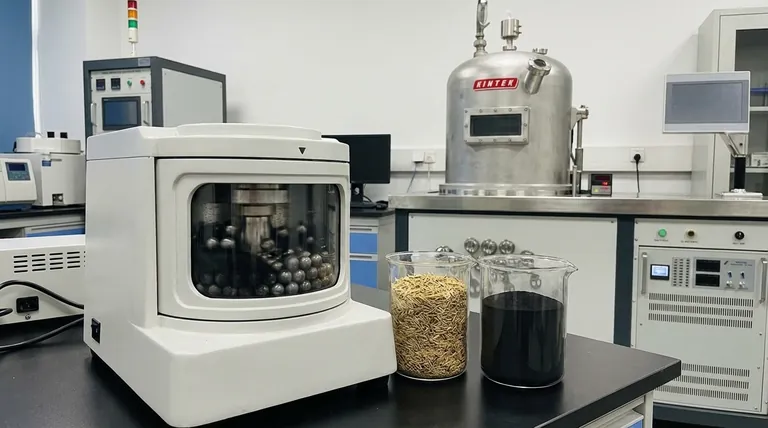
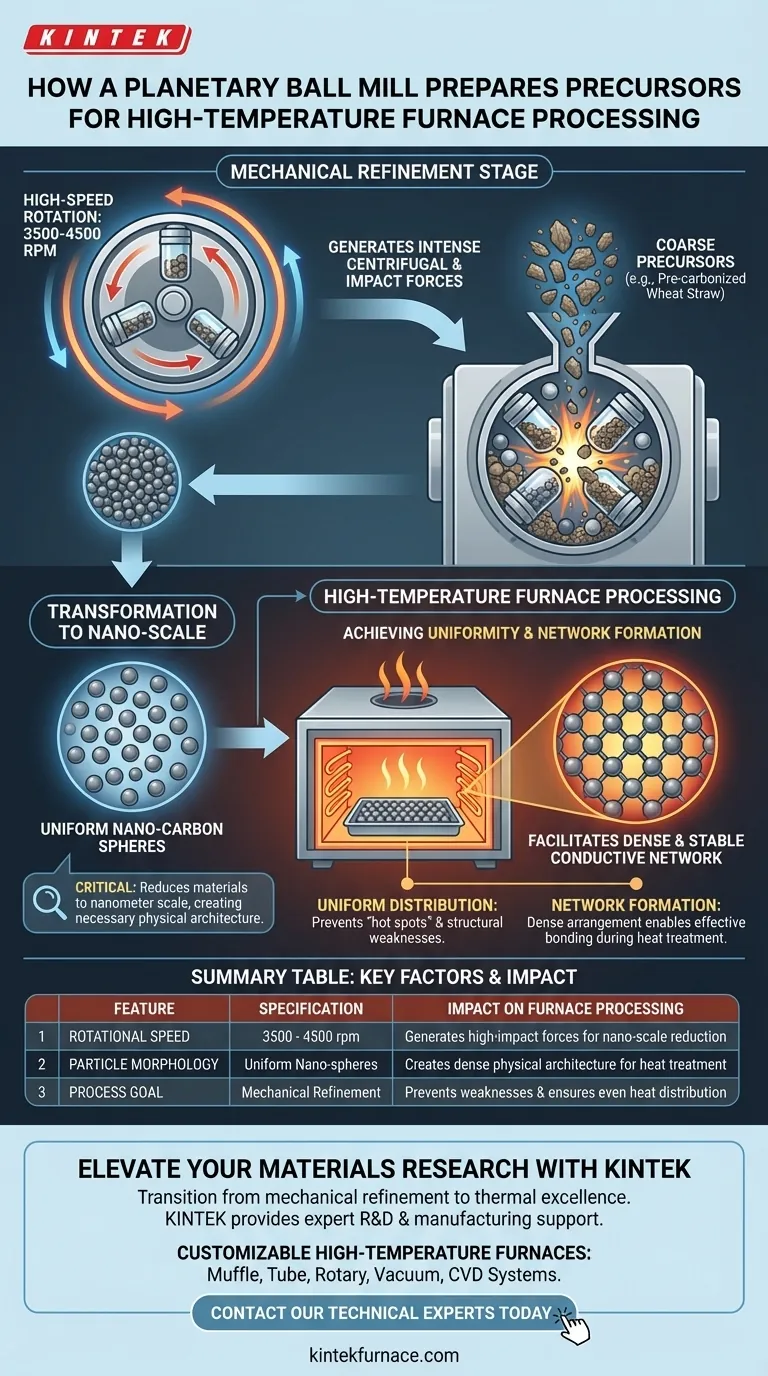
A planetary ball mill acts as a critical mechanical refinement stage by utilizing high-speed rotation to grind pre-carbonized precursors prior to thermal treatment. By operating between 3500 and 4500 rpm, the device generates intense centrifugal and impact forces that reduce materials, such as pre-carbonized wheat straw, down to the nanometer scale.
By transforming coarse particles into uniformly distributed nano-spheres, the planetary ball mill creates the physical architecture necessary for a dense and stable conductive network to form during subsequent high-temperature furnace processing.
The Mechanics of Precursor Refinement
Generating High-Impact Forces
The planetary ball mill does not simply mix materials; it subjects them to extreme kinetic energy.
Through rotation speeds of 3500 to 4500 rpm, the device creates powerful centrifugal forces. These forces drive grinding media to impact the precursor material with high frequency and intensity.
Reducing to the Nanoscale
The primary objective of this mechanical stress is significant particle size reduction.
In the context of pre-carbonized wheat straw, the milling process breaks down the bulk material into nano carbon spheres. This transformation from micro-scale to nano-scale is essential for the material's final properties.
Preparing for Thermal Processing
Achieving Uniform Distribution
High-temperature processing requires a consistent starting material to ensure even heat distribution and reaction.
The ball mill ensures that the nano-sized particles are uniformly distributed throughout the mixture. This homogeneity prevents "hot spots" or structural weaknesses during the furnace phase.
Facilitating Network Formation
The physical state of the precursor dictates the success of the final conductive network.
By refining the precursor into a dense arrangement of nano-spheres, the mill allows the material to bond effectively during heat treatment. This results in a dense and stable conductive network that would be impossible to achieve with coarser, irregular particles.
Critical Considerations and Trade-offs
The Necessity of RPM Precision
While high speed is necessary, the specific range of 3500–4500 rpm is calculated, not arbitrary.
Falling below this range may fail to generate the impact force required to reach the nanometer scale. Conversely, deviating significantly could alter the morphology of the spheres, compromising the stability of the conductive network.
Material Specificity
The process described is highly specific to the nature of the precursor, such as pre-carbonized wheat straw.
The milling parameters are tuned to fracture this specific carbon structure into spheres. Applying identical settings to a different material without adjustment may not yield the same uniform nano-spheres or conductive properties.
Optimizing Your Process Strategy
To ensure your high-temperature processing yields the best results, you must verify the output of your milling stage.
- If your primary focus is Conductivity: Ensure your milling duration and RPM are sufficient to achieve a fully uniform distribution of particles, as clumping will break the conductive path.
- If your primary focus is Structural Density: Verify that the precursor has been reduced to true nano-scale spheres, as larger particles will result in a porous, unstable final product.
The planetary ball mill is not just a grinder; it is the architect of the material's microscopic skeleton.
Summary Table:
| Feature | Specification/Detail | Impact on Furnace Processing |
|---|---|---|
| Rotational Speed | 3500 - 4500 rpm | Generates high-impact forces for nano-scale reduction |
| Particle Morphology | Uniform Nano-spheres | Creates dense physical architecture for heat treatment |
| Material Output | Nanometer-scale carbon | Enables formation of stable conductive networks |
| Process Goal | Mechanical Refinement | Prevents structural weaknesses & ensures even heat distribution |
Elevate Your Materials Research with KINTEK
Transitioning from mechanical refinement to thermal excellence requires precision at every step. KINTEK provides the expert R&D and manufacturing support you need to bridge the gap between precursor preparation and final synthesis.
Whether you require Muffle, Tube, Rotary, Vacuum, or CVD systems, our lab high-temperature furnaces are fully customizable to handle your nano-scale precursors with unmatched thermal uniformity. Don't let inconsistent heat compromise your conductive networks—partner with KINTEK for solutions tailored to your unique research needs.
Contact Our Technical Experts Today
Visual Guide
References
- Junchao Ren, Qingfa Zhang. All‐Biomass Nanocomposite Films via Facile and Sustainable Design Procedure for Thermal Management and Electromagnetic Interference Shielding. DOI: 10.1002/advs.202510372
This article is also based on technical information from Kintek Furnace Knowledge Base .
Related Products
- Electric Rotary Kiln Small Rotary Furnace Biomass Pyrolysis Plant Rotating Furnace
- Electric Rotary Kiln Continuous Working Small Rotary Furnace Kiln for Pyrolysis Plant Heating
- Electric Rotary Kiln Pyrolysis Furnace Plant Machine Small Rotary Kiln Calciner
- High Temperature Muffle Oven Furnace for Laboratory Debinding and Pre Sintering
- Electric Rotary Kiln Small Rotary Furnace for Activated Carbon Regeneration
People Also Ask
- What are the key components of a rotary kiln electric furnace? Unlock Efficient Thermal Processing
- What are the main applications of a rotary kiln electric furnace? Achieve Uniform Heat Treatment for Powders
- What is the significance of the refractory lining in a rotary kiln electric furnace? Unlock Efficiency and Longevity
- What are the key components of a rotary kiln's construction? Discover the Essential Parts for Efficient Industrial Processing
- What role does the rotary kiln serve in coal-based DRI production? Unlock Cost-Effective Ironmaking Efficiency