A controlled low-pressure environment is the primary condition provided by a vacuum chamber during the single-step vapor deposition process. This environment is essential to minimize the interference of impurity gases, preventing them from reacting with the nanomaterials during synthesis.
By maintaining a vacuum, the system ensures that vaporized nanomaterials condense directly into the base fluid film without surface contamination, leading to nanofluids with high purity and excellent dispersion characteristics.
Preventing Gas Interference
Minimizing Impurity Gases
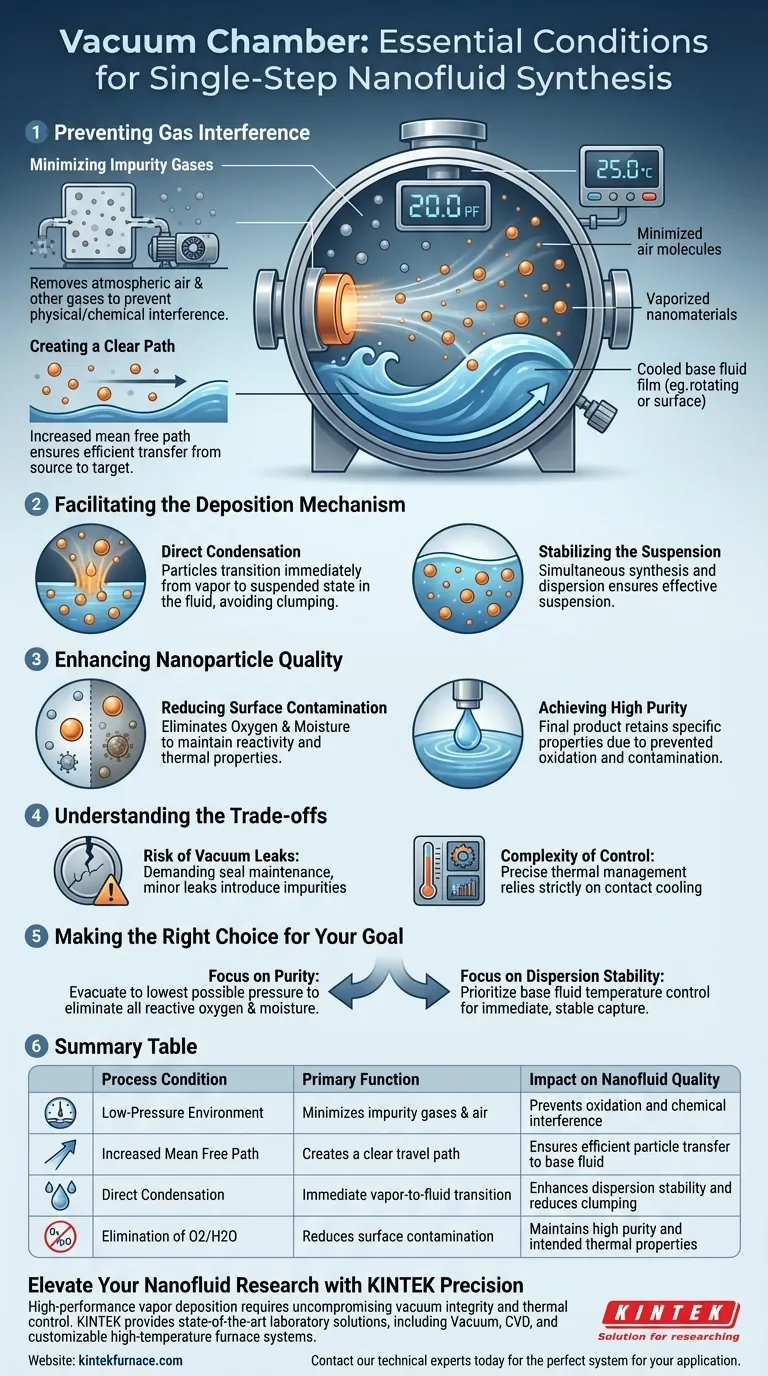
The most critical role of the vacuum chamber is to remove atmospheric air and other gases from the deposition zone.
If these impurity gases were present, they would physically and chemically interfere with the vaporized materials.
Creating a Clear Path
In a vacuum, the mean free path of particles increases significantly.
This allows the vaporized nanomaterials to travel from the source to the target (the base fluid) without colliding with air molecules, ensuring efficient transfer.
Facilitating the Deposition Mechanism
Direct Condensation
The vacuum condition enables the vaporized nanomaterials to condense directly into the base fluid.
Instead of solidifying in the air and then being mixed (which often leads to clumping), the particles transition immediately from vapor to a suspended state within the fluid film.
Stabilizing the Suspension
Because the particles enter the fluid immediately upon formation, they remain suspended more effectively.
This simultaneous synthesis and dispersion is the hallmark of the single-step method, relying entirely on the vacuum to facilitate the interaction.
Enhancing Nanoparticle Quality
Reducing Surface Contamination
The vacuum environment significantly reduces surface contamination on the nanoparticles.
Oxygen and moisture are primary contaminants that degrade nanoparticle reactivity and thermal properties; the vacuum eliminates their presence during the critical formation phase.
Achieving High Purity
The result of this controlled environment is the production of high-purity nanofluids.
By preventing oxidation and contamination, the final product retains the specific physical and chemical properties intended for the application.
Understanding the Trade-offs
The Risk of Vacuum Leaks
While the vacuum is essential, maintaining a perfect seal is technically demanding. Even a minor leak introduces impurities that can ruin the dispersion immediately.
Complexity of Control
Operating in a vacuum adds complexity to the thermal management of the base fluid. Without air to aid in convective cooling, precise temperature control of the fluid film becomes strictly reliant on the equipment's contact cooling mechanisms.
Making the Right Choice for Your Goal
To maximize the effectiveness of the vapor deposition process, focus on these priorities:
- If your primary focus is Purity: Ensure the vacuum chamber is evacuated to the lowest possible pressure to eliminate all traces of reactive oxygen and moisture.
- If your primary focus is Dispersion Stability: Prioritize the control of the base fluid film temperature within the vacuum to ensure immediate and stable capturing of the condensing vapor.
The vacuum chamber is not just a container; it is an active process parameter that defines the purity and performance of your final nanofluid.
Summary Table:
| Process Condition | Primary Function | Impact on Nanofluid Quality |
|---|---|---|
| Low-Pressure Environment | Minimizes impurity gases & air | Prevents oxidation and chemical interference |
| Increased Mean Free Path | Creates a clear travel path | Ensures efficient particle transfer to base fluid |
| Direct Condensation | Immediate vapor-to-fluid transition | Enhances dispersion stability and reduces clumping |
| Elimination of O2/H2O | Reduces surface contamination | Maintains high purity and intended thermal properties |
Elevate Your Nanofluid Research with KINTEK Precision
High-performance vapor deposition requires uncompromising vacuum integrity and thermal control. KINTEK provides state-of-the-art laboratory solutions, including Vacuum, CVD, and customizable high-temperature furnace systems, specifically engineered to meet the rigorous demands of advanced nanomaterial synthesis.
Backed by expert R&D and world-class manufacturing, our equipment ensures the high-purity environment your research deserves. Whether you need precise atmosphere control or specialized chamber configurations, our team is ready to support your unique lab requirements.
Ready to optimize your synthesis process? Contact our technical experts today to find the perfect system for your application.
Visual Guide
References
- Devireddy Sandhya, Vasudeva Rao Veeredhi. An exclusive review on TiO2-based nanofluids with applications to automotive industry. DOI: 10.7862/rm.2025.16
This article is also based on technical information from Kintek Furnace Knowledge Base .
Related Products
- Split Chamber CVD Tube Furnace with Vacuum Station CVD Machine
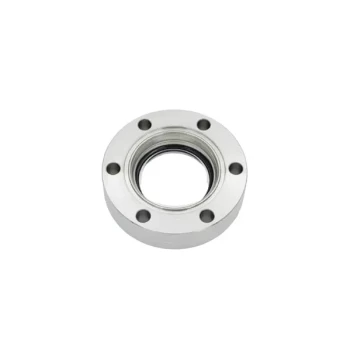
- Ultra High Vacuum Observation Window Stainless Steel Flange Sapphire Glass Sight Glass for KF
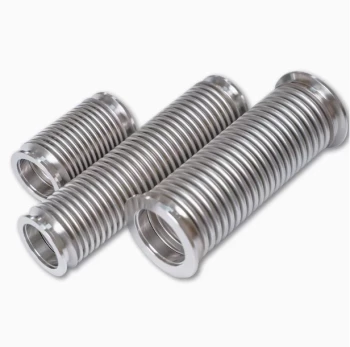
- High Performance Vacuum Bellows for Efficient Connection and Stable Vacuum in Systems
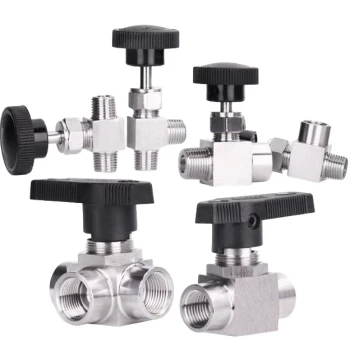
- 304 316 Stainless Steel High Vacuum Ball Stop Valve for Vacuum Systems
- Vacuum Hot Press Furnace Machine for Lamination and Heating
People Also Ask
- What role does a Tube Furnace play in the CVD growth of carbon nanotubes? Achieve High-Purity CNT Synthesis
- What are the operational and maintenance requirements for a CVD tube furnace? Ensure Precision for Thin Film Deposition
- What are the advantages of using a CVD tube furnace for preparing gate dielectrics? Achieve High-Quality Thin Films for Transistors
- How does a CVD tube furnace achieve high purity in gate media preparation? Master Precision Control for Flawless Films
- Why are CVD tube furnace sintering systems indispensable for 2D material research and production? Unlock Atomic-Scale Precision