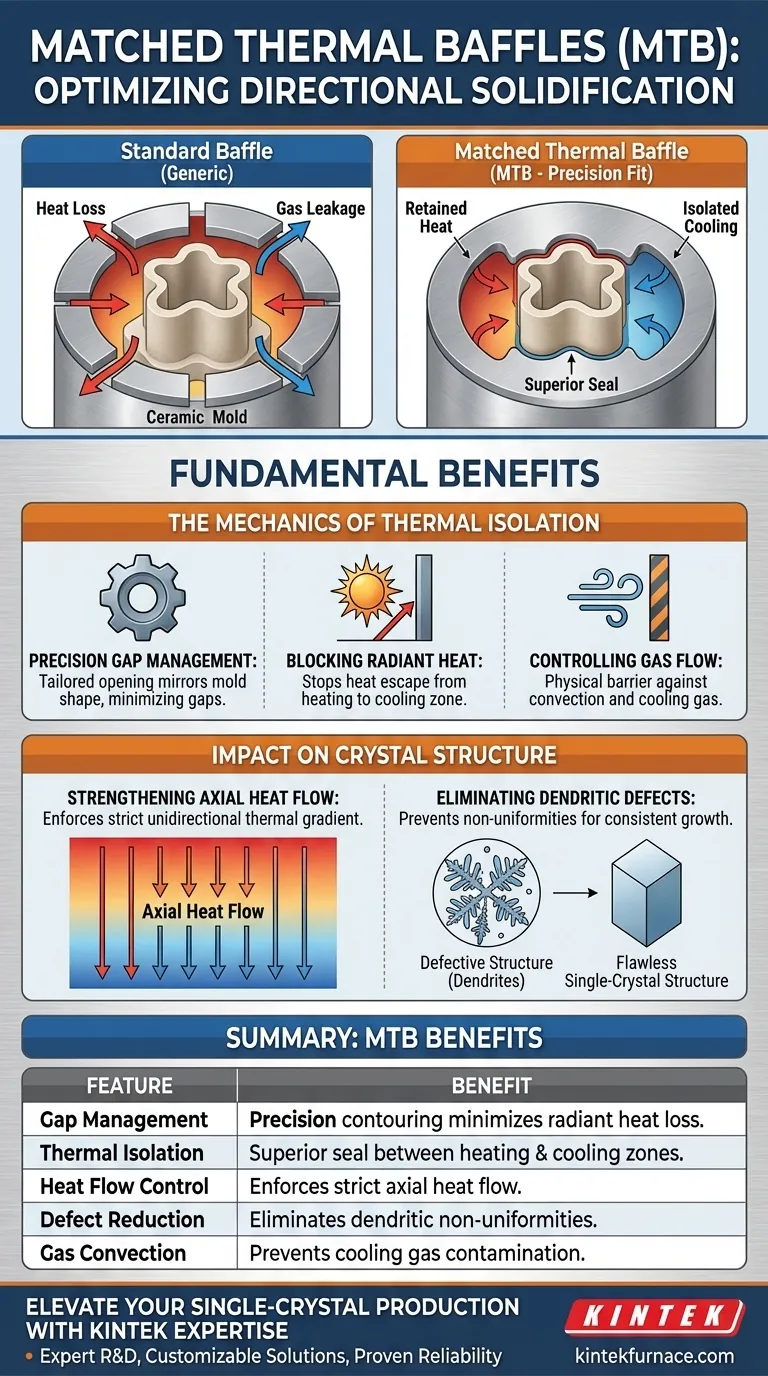
Matched Thermal Baffles (MTB) fundamentally enhance directional solidification by tailoring the baffle opening to contour precisely to the complex shape of the ceramic mold. This high-precision fit creates a superior seal between the furnace's heating and cooling zones, drastically reducing heat loss through the gaps. The result is a more stable thermal environment that enforces strict axial heat flow, which is critical for preventing structural defects in single-crystal components.
By minimizing the physical gap between the baffle and the mold, MTBs maximize thermal isolation. This intensification of the axial temperature gradient is the primary mechanism for eliminating atypical dendritic non-uniformities and ensuring consistent crystal growth.
The Mechanics of Thermal Isolation
Precision Gap Management
Standard baffles often leave gaps when accommodating complex mold geometries. Matched Thermal Baffles solve this by adjusting their opening profiles to closely mirror the external shape of the ceramic mold.
This tight tolerance minimizes the open area between the heating and cooling chambers.
Blocking Radiant Heat Transfer
The primary function of this tighter seal is to prevent radiant heat loss.
By closing the physical gaps, the baffle stops heat from escaping the heating chamber into the cooling zone, maintaining the high temperatures required for the melt while protecting the solidified structure below.
Controlling Gas Flow
Beyond radiant heat, the precise fit acts as a physical barrier against convection.
It prevents cooling gas from flowing upward into the heating zone. This isolation ensures that the cooling medium acts only on the solidified portion of the casting, preventing thermal contamination of the liquid melt.
Impact on Crystal Structure
Strengthening Axial Heat Flow
The goal of directional solidification is to force heat to move in one specific direction: longitudinally along the blade.
MTBs enhance the directionality of this axial heat flow. By isolating the temperature fields, the process ensures that the cooling front moves vertically without lateral thermal interference.
Eliminating Dendritic Defects
When heat flow becomes non-uniform, the internal structure of the metal can develop irregularities.
The improved isolation provided by MTBs helps eliminate atypical dendritic non-uniformities. This results in a homogeneous cross-section, which is essential for the mechanical integrity of single-crystal blades.
Understanding the Operational Requirements
The Necessity of Precision
The effectiveness of an MTB relies entirely on the accuracy of the profile match.
Because the baffle must fit "complex external shapes," the engineering tolerance is critical. A mismatch can either lead to heat leakage (reducing effectiveness) or mechanical interference with the mold.
Specificity vs. Flexibility
Using MTBs implies a move away from generic tooling.
Since the baffle is matched to the specific contour of a mold, it is inherently less flexible than a standard circular opening. This requires a dedicated approach to baffle design for each unique component geometry.
Making the Right Choice for Your Process
## Optimizing for Single-Crystal Integrity
- If your primary focus is defect reduction: Implement MTBs to eliminate atypical dendritic non-uniformities by enforcing a stricter axial temperature gradient.
- If your primary focus is thermal efficiency: Use the precise profiling of MTBs to minimize radiant heat loss and prevent cooling gas recirculation into the hot zone.
True directional solidification requires not just heat, but the precise control of where that heat goes; MTBs provide the geometry required to enforce that control.
Summary Table:
| Feature | Benefit of Matched Thermal Baffles (MTB) |
|---|---|
| Gap Management | Precision contouring to mold shape minimizes radiant heat loss. |
| Thermal Isolation | Creates a superior seal between heating and cooling furnace zones. |
| Heat Flow Control | Enforces strict axial heat flow for uniform crystal growth. |
| Defect Reduction | Eliminates atypical dendritic non-uniformities in single-crystal parts. |
| Gas Convection | Prevents cooling gas from contaminating the heating chamber. |
Elevate Your Single-Crystal Production with KINTEK Expertise
Precision in directional solidification requires absolute control over thermal gradients. At KINTEK, we provide the advanced laboratory and industrial high-temperature solutions necessary to achieve flawless material structures.
Why partner with KINTEK?
- Expert R&D and Manufacturing: Our systems are engineered for the most demanding thermal processes.
- Customizable Solutions: From Muffle and Tube furnaces to advanced Vacuum and CVD systems, we tailor our technology to your specific mold geometries and process requirements.
- Proven Reliability: Ensure consistent axial heat flow and eliminate structural defects with our high-precision equipment.
Ready to optimize your thermal isolation and enhance casting integrity? Contact our technical experts today to discuss your custom furnace needs!
Visual Guide
References
- Effect of Temperature Profile Curvature on the Formation of Atypical Inhomogeneity of Dendritic Microstructure Across the Width of a Single Crystal Blade. DOI: 10.1007/s11661-025-07909-y
This article is also based on technical information from Kintek Furnace Knowledge Base .
Related Products
- Multi Heating Zones CVD Tube Furnace Machine for Chemical Vapor Deposition Equipment
- Multi Zone Laboratory Quartz Tube Furnace Tubular Furnace
- High Temperature Muffle Oven Furnace for Laboratory Debinding and Pre Sintering
- Vertical Laboratory Quartz Tube Furnace Tubular Furnace
- Split Multi Heating Zone Rotary Tube Furnace Rotating Tube Furnace
People Also Ask
- What is the function of a multi-zone tube furnace in CVD synthesis? Master 2D In2Se3 Nanosheet Precision
- What environmental protection applications utilize multi zone tube furnaces? Unlock Precision in Waste Treatment and Green Tech
- What role do multi zone tube furnaces play in new energy research? Unlock Precise Thermal Control for Innovation
- What temperature-related capabilities make multi zone tube furnaces valuable for research? Unlock Precision Thermal Control
- Why are multi zone tube furnaces particularly useful for nanomaterial research? Unlock Precise Thermal Control for Advanced Synthesis