
The cleaning and thermal treatment protocol is a critical two-step process designed to establish atomic-level cleanliness on Magnesium Oxide (MgO) substrates. By combining ultrasonic solvent cleaning with high-temperature heating, you remove organic contaminants, adsorbed moisture, and residual oxides that would otherwise disrupt the crystalline structure of the interface.
Core Takeaway: Successful epitaxy relies entirely on the quality of the substrate surface. This protocol is not merely about "cleaning"; it is about exposing the pristine MgO(111) crystal lattice to provide an ideal template for the nucleation of high-quality Scandium Nitride (ScN) thin films.
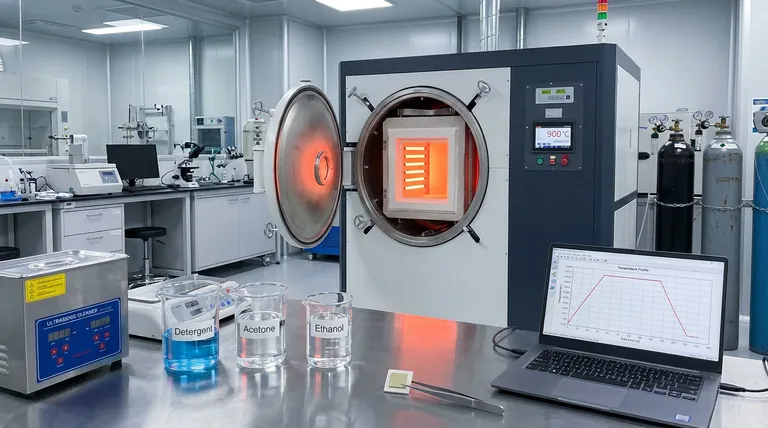
The Two-Stage Preparation Protocol
This process is divided into a chemical cleaning phase and a thermal treatment phase. Each addresses a specific type of surface contamination.
Stage 1: Ultrasonic Chemical Cleaning
The initial phase involves mechanical and chemical action to strip away surface organics. The substrate undergoes ultrasonic cleaning using a specific sequence of solvents: detergent, acetone, and ethanol.
This step is essential for removing oils, dust, and loose organic particles accumulated during storage or handling.
Stage 2: High-Temperature Vacuum Heating
Following chemical cleaning, the substrate is placed in a vacuum chamber and heated to 900 °C. This thermal step drives off contaminants that solvents cannot remove.
Specifically, this high heat removes adsorbed moisture and residual oxides that are chemically bonded to the surface.
Why This Matters for ScN Epitaxy
The ultimate goal of this protocol is to facilitate heteroepitaxial growth. If the substrate is not prepared correctly, the deposited film will fail to align with the substrate's crystal structure.
Achieving Atomic-Level Cleanliness
Epitaxial growth requires that the depositing atoms "see" the substrate atoms directly. Even a monolayer of oxide or carbon can act as a barrier, decoupling the film from the substrate.
The 900 °C vacuum treatment ensures the surface achieves atomic-level cleanliness, removing barriers to lattice matching.
Creating Ideal Nucleation Conditions
For ScN thin films, specifically on the MgO(111) plane, the initial nucleation sites define the quality of the entire film.
A pristine surface minimizes defects at the interface. This ensures that the ScN film replicates the crystalline order of the MgO template, leading to a high-quality single-crystal film.
Common Pitfalls and Considerations
It is vital to distinguish between general substrate cleaning and the specific requirements for ScN on MgO.
Vacuum vs. Air Annealing
While some substrates (like sapphire) may benefit from air annealing to induce atomic rearrangement, this protocol explicitly calls for vacuum conditions.
Heating MgO in a vacuum prevents re-oxidation of the surface while thermally desorbing contaminants. Attempting this step in a non-vacuum environment could alter surface chemistry unfavorably for ScN growth.
The Risk of Residual Oxides
Failure to reach the target temperature of 900 °C often results in incomplete removal of residual oxides.
If oxides remain, they create "dead spots" on the substrate. This forces the ScN film to grow with a polycrystalline or amorphous structure rather than the desired epitaxial structure.
How to Apply This to Your Project
When preparing for ScN deposition, tailor your approach based on your film quality requirements:
- If your primary focus is high-fidelity single-crystal growth: Strictly adhere to the 900 °C vacuum heating step to ensure the removal of all residual oxides for perfect lattice alignment.
- If your primary focus is removing bulk contaminants: Ensure the ultrasonic sequence (detergent, acetone, ethanol) is performed thoroughly, as thermal treatment alone cannot remove heavy organic residue.
Adherence to this rigorous protocol transforms the MgO substrate from a simple support structure into an active, high-quality template for crystalline growth.
Summary Table:
| Preparation Stage | Action/Method | Target Contaminants | Purpose for ScN Growth |
|---|---|---|---|
| Stage 1: Chemical | Ultrasonic (Detergent, Acetone, Ethanol) | Oils, dust, and bulk organics | Strip surface debris and handling residues |
| Stage 2: Thermal | 900 °C Vacuum Heating | Adsorbed moisture & residual oxides | Achieve atomic-level cleanliness for lattice matching |
| Final Result | Pristine MgO(111) Surface | Zero carbon/oxide monolayers | Ideal nucleation sites for single-crystal epitaxy |
Maximize Your Research Precision with KINTEK
High-quality thin film growth begins with the right environment. KINTEK provides industry-leading Muffle, Tube, Vacuum, and CVD systems designed to meet the rigorous thermal demands of substrate preparation and epitaxy. Whether you need precise 900°C vacuum processing or a fully customized high-temp furnace for your unique R&D needs, our expert manufacturing team is here to support your laboratory's success.
Ready to elevate your material science results?
Contact KINTEK Today to Discuss Your Custom Solution
References
- Charlotte Poterie, J. F. Barbot. Electrical properties of ScN thin films controlled by defect engineering using oxygen ion implantation. DOI: 10.1063/5.0230961
This article is also based on technical information from Kintek Furnace Knowledge Base .
Related Products
- High Pressure Laboratory Vacuum Tube Furnace
- Vacuum Hot Press Furnace Machine Heated Vacuum Press Tube Furnace
- 1200℃ Split Tube Furnace Laboratory Quartz Tube Furnace with Quartz Tube
- 1400℃ High Temperature Laboratory Tube Furnace with Alumina Tube
- Molybdenum Vacuum Heat Treat Furnace
People Also Ask
- What role does a high vacuum tube furnace play in Co-Al sintering? Master High-Purity Porous Material Synthesis
- What are the different types of tube furnaces available? Find the Perfect Fit for Your Lab's Needs
- What are the main advantages of vacuum tube furnaces in the market? Achieve Purity and Precision in Material Processing
- What is the role of a vacuum tube furnace during the final thermal treatment stage of Fe3O4@CSAC catalysts?
- What conditions does a tube furnace provide for post-ion-implantation? Achieve Precise Microstructural Repair



















