
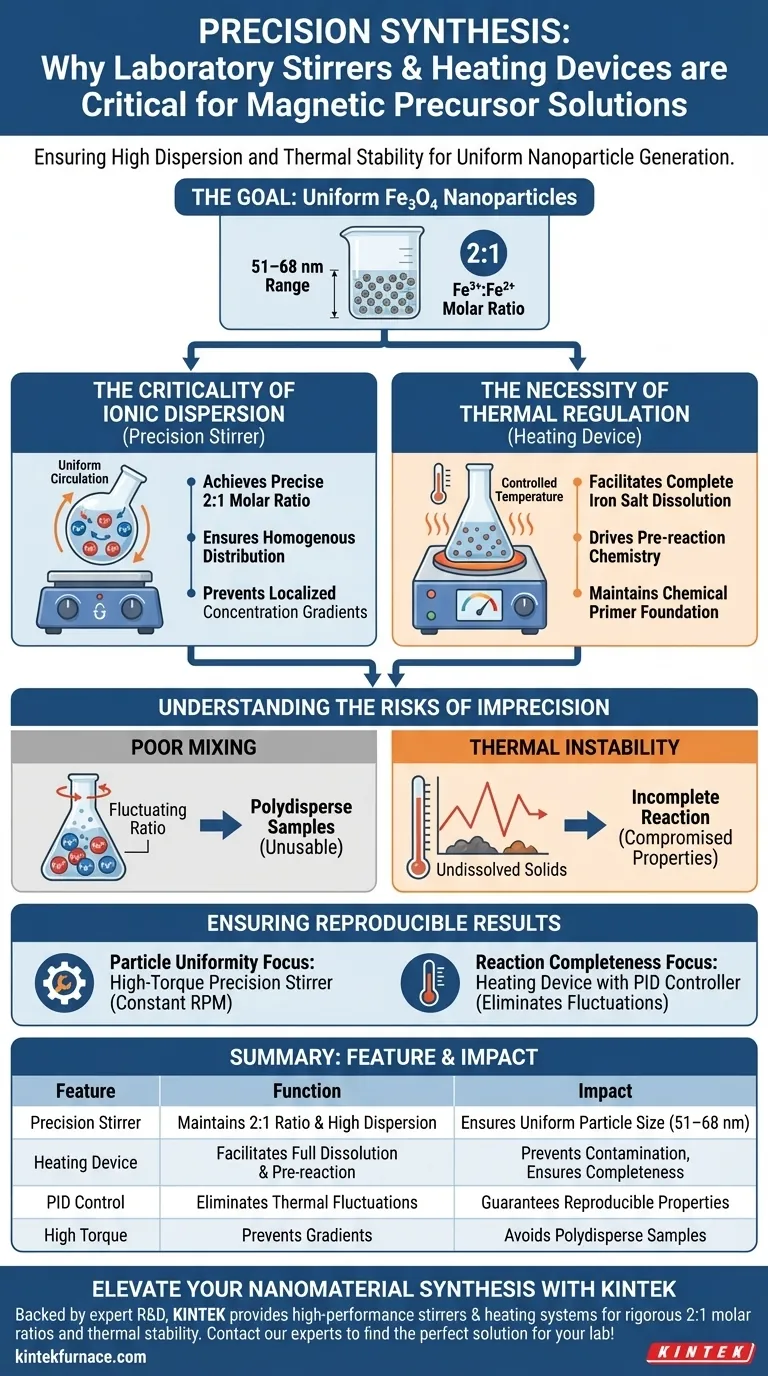
Laboratory precision stirrers and heating devices act as the critical control mechanisms for synthesizing magnetic precursor solutions. They function in tandem to ensure the high dispersion of ferric (Fe3+) and ferrous (Fe2+) ions while maintaining the precise thermal environment required for full molecular dissolution. Without this strict regulation, the chemical foundation necessary for uniform nanoparticle generation cannot be established.
Success in synthesizing magnetic nanoparticles is defined by uniformity. Precision equipment ensures the specific 2:1 molar ratio and thermal stability required to produce Fe3O4 nanoparticles with consistent sizes ranging from 51 to 68 nm.
The Criticality of Ionic Dispersion
Achieving the Correct Molar Ratio
For magnetic precursor solutions, simply adding ingredients is insufficient. You must achieve a precise 2:1 molar ratio of ferric ions (Fe3+) to ferrous ions (Fe2+).
Precision stirrers circulate the aqueous solution to ensure these ions are distributed evenly throughout the vessel.
High-Level Dispersion
The goal of stirring is to prevent localized concentration gradients.
High dispersion ensures that every part of the solution interacts uniformly. This homogeneity is the prerequisite for the ammonia precipitation method used to generate the final particles.
The Necessity of Thermal Regulation
Facilitating Complete Dissolution
Iron salt molecules require specific thermal energy levels to dissolve fully into the solution.
Heating devices provide the constant, controlled temperature needed to break down these salts. This prevents undissolved solids from contaminating the precursor phase.
Driving the Pre-reaction
Beyond simple dissolution, heat drives the necessary pre-reaction chemistry.
By maintaining a specific temperature, the device ensures the solution is chemically primed. This creates the "foundation" mentioned in scientific literature for the successful formation of Fe3O4 nanoparticles.
Understanding the Risks of Imprecision
The Consequence of Poor Mixing
If the stirring is inconsistent, the 2:1 molar ratio will fluctuate within the container.
This leads to significant variations in particle size. Instead of a tight range (51–68 nm), you may produce polydisperse samples that are unusable for precision applications.
The Impact of Thermal Instability
If the heating device fluctuates or fails to maintain the set point, the iron salts may not fully dissolve.
This results in an incomplete reaction. The final magnetic properties of the nanoparticles will likely be compromised due to a flawed structural foundation.
Ensuring Reproducible Results
To maximize the quality of your magnetic precursor solutions, align your equipment choices with your specific synthesis goals:
- If your primary focus is Particle Uniformity: Prioritize a high-torque precision stirrer that maintains constant RPM to guarantee the homogenous dispersion of the 2:1 ionic ratio.
- If your primary focus is Reaction Completeness: Ensure your heating device has a PID controller to eliminate thermal fluctuations that could inhibit full salt dissolution.
Precision in the precursor stage is the only way to guarantee predictability in the final magnetic nanomaterial.
Summary Table:
| Feature | Function in Synthesis | Impact on Final Nanoparticles |
|---|---|---|
| Precision Stirrer | Maintains 2:1 Fe3+/Fe2+ molar ratio & high dispersion | Ensures uniform particle size (51–68 nm) |
| Heating Device | Facilitates full salt dissolution & drives pre-reaction | Prevents contamination & ensures chemical completeness |
| PID Control | Eliminates thermal fluctuations | Guarantees reproducible magnetic properties |
| High Torque | Prevents localized concentration gradients | Avoids polydisperse, unusable samples |
Elevate Your Nanomaterial Synthesis with KINTEK
Achieving the perfect magnetic precursor requires more than just basic mixing—it demands absolute precision. Backed by expert R&D and manufacturing, KINTEK provides the high-performance stirrers and heating systems needed to maintain the rigorous 2:1 molar ratios and thermal stability your research depends on.
From customizable CVD systems to precision lab furnaces and thermal devices, our equipment is designed to help you produce consistent, high-quality nanoparticles every time. Contact our experts today to find the perfect solution for your lab!
Visual Guide
References
- Róger Moya, Karla J. Merazzo. Magnetic and Physical-Mechanical Properties of Wood Particleboards Composite (MWPC) Fabricated with FE3o4 Nanoparticles and Three Plantation Wood. DOI: 10.22382/wfs-2023-19
This article is also based on technical information from Kintek Furnace Knowledge Base .
Related Products
- Small Vacuum Heat Treat and Tungsten Wire Sintering Furnace
- Laboratory Quartz Tube Furnace RTP Heating Tubular Furnace
- Electric Rotary Kiln Continuous Working Small Rotary Furnace Kiln for Pyrolysis Plant Heating
- Vacuum Heat Treat Sintering Furnace with Pressure for Vacuum Sintering
- High Temperature Muffle Oven Furnace for Laboratory Debinding and Pre Sintering
People Also Ask
- How does vacuum sintering improve dimensional tolerances? Achieve Uniform Shrinkage and Precision
- What are the key components of a vacuum sintering furnace? Essential Parts for Precision Material Processing
- What is the purpose of setting a mid-temperature dwell stage? Eliminate Defects in Vacuum Sintering
- What are the main structural components of a vacuum sintering furnace? Unlock Precision in High-Temperature Processing
- What are the main types of sintering furnaces? Find the Perfect Match for Your Materials












