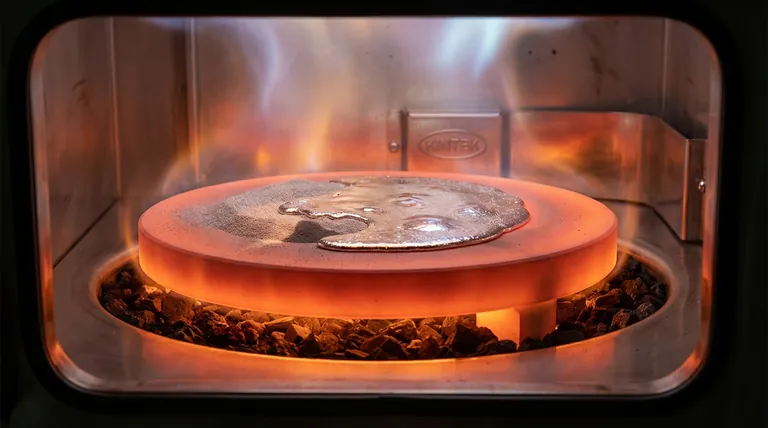
In the microwave cladding process, the graphite plate serves as a critical interface between the heating medium and the alloy powder. It functions simultaneously as a physical shield to maintain material purity and as a thermal regulator to ensure precise heat application.
The graphite plate acts as a dual-purpose separator that preserves the chemical integrity of the High-Entropy Alloy (HEA) while utilizing its high thermal conductivity to smooth out temperature gradients, resulting in a uniform, defect-free coating.
Preserving Material Purity
The Physical Barrier
The primary role of the graphite plate is to establish a distinct boundary. It is positioned directly between the charcoal susceptor (the heat source) and the HEA powder layer.
Preventing Contamination
Without this separation, charcoal particles would inevitably mix with the molten alloy. This intrusion would introduce impurities into the coating.
Maintaining Chemical Integrity
The plate specifically prevents carbon contamination from the charcoal. By isolating the powder, it ensures the final coating retains its intended chemical composition and microstructural purity.
Optimizing Thermal Distribution
Leveraging Thermal Conductivity
Graphite is utilized specifically for its excellent thermal properties. It efficiently absorbs the intense heat generated by the charcoal susceptor.
Regulating Heat Transfer
Rather than allowing the uneven heat of the charcoal to impact the powder directly, the plate acts as a thermal buffer. It facilitates the transfer of energy uniformly to the cladding zone.
Ensuring Uniformity
This mechanism prevents hot spots and cold zones. The result is an even temperature distribution across the entire cladding interface, which is vital for consistent melting.
Understanding the Process Trade-offs
Indirect vs. Direct Heating
The use of a graphite plate introduces an intermediate layer between the source and the target. While this prevents contamination, it moves the process from direct contact heating to indirect conduction.
The Cost of Isolation
Separating the materials is a necessary compromise. You sacrifice direct exposure to the heat source to gain control over the chemical environment.
Dependence on Graphite Quality
The success of the process becomes heavily reliant on the integrity of the graphite sheet. Any breach in the plate would immediately result in the contamination the system is designed to avoid.
Making the Right Choice for Your Goal
To ensure the success of your microwave cladding project, consider how the graphite plate aligns with your specific objectives:
- If your primary focus is Chemical Purity: Rely on the graphite plate as a strict isolation layer to prevent carbon diffusion from the charcoal susceptor into the alloy.
- If your primary focus is Microstructural Consistency: Utilize the high thermal conductivity of the plate to mitigate thermal gradients and ensure the powder layer melts evenly.
The graphite plate is not just a separator; it is the control mechanism that transforms raw heat into a precision tool for alloy synthesis.
Summary Table:
| Feature | Role of Graphite Plate | Benefit to High-Entropy Alloys |
|---|---|---|
| Physical Shielding | Acts as a barrier between charcoal and powder | Prevents carbon contamination and maintains purity |
| Thermal Regulation | Absorbs and redistributes heat via high conductivity | Eliminates hot spots and ensures uniform melting |
| Chemical Stability | Isolates the reaction environment | Preserves intended chemical composition and microstructure |
| Process Control | Facilitates indirect heat conduction | Produces defect-free, consistent coatings |
Optimize Your Material Synthesis with KINTEK Expertise
Precision in high-entropy alloy cladding requires the highest quality thermal components and furnace technology. At KINTEK, we understand the critical balance of temperature control and material purity in microwave and high-temp processing.
Backed by expert R&D and world-class manufacturing, KINTEK offers Muffle, Tube, Rotary, Vacuum, and CVD systems, along with specialized lab high-temp furnaces—all fully customizable to meet your unique research or production needs.
Ready to elevate your lab's performance? Contact us today to discuss your project requirements and discover how our advanced heating solutions can bring precision to your workflow.
References
- Shubham Sharma, Emad A. A. Ismail. Investigation of surface hardness, thermostability, tribo-corrosion, and microstructural morphological properties of microwave-synthesized high entropy alloy FeCoNiMnCu coating claddings on steel. DOI: 10.1038/s41598-024-55331-y
This article is also based on technical information from Kintek Furnace Knowledge Base .
Related Products
- 915MHz MPCVD Diamond Machine Microwave Plasma Chemical Vapor Deposition System Reactor
- Multi Zone Laboratory Quartz Tube Furnace Tubular Furnace
- Multi Heating Zones CVD Tube Furnace Machine for Chemical Vapor Deposition Equipment
- Vacuum Induction Melting Furnace
- 1400℃ Muffle Oven Furnace for Laboratory
People Also Ask
- What is the MPCVD method and why is it considered effective for diamond deposition? Superior Purity & High Growth Rates
- What factors influence the quality of diamond deposition in the MPCVD method? Master the Critical Parameters for High-Quality Diamond Growth
- What are some key features and benefits of the microwave plasma chemical vapor deposition system? Achieve Unmatched Material Synthesis
- What is the purpose of a microwave plasma chemical vapor deposition system? Grow High-Purity Diamonds and Advanced Materials
- What is the basic principle of operation for the microwave plasma chemical vapor deposition system? Unlock High-Purity Material Growth