
Using external thermometers provides a critical layer of independent verification for your thermal processes, ensuring the reality of the molten bath matches the settings of the furnace controller. While integrated systems maintain the general heating environment, external sensors are necessary to detect localized temperature fluctuations caused by operational activities like stirring or adding materials.
Reliable refining requires distinguishing between the temperature of the furnace and the temperature of the solution. External monitoring bridges this gap, preventing process failures caused by undetected thermal drops during critical chemical reactions.
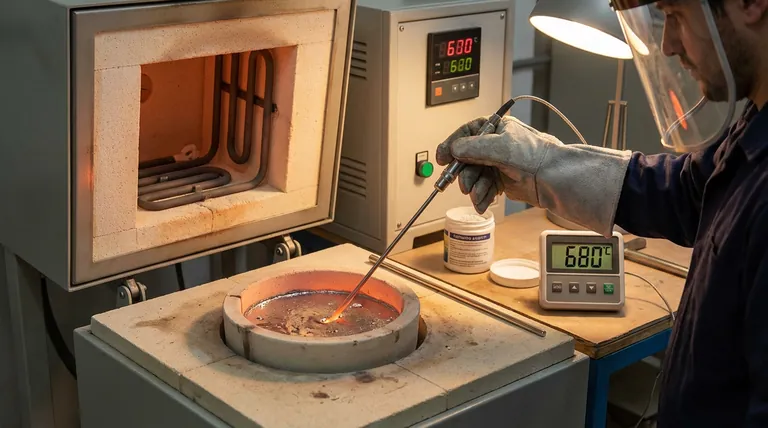
The Gap Between Furnace Control and Bath Reality
Integrated furnace controls are designed to maintain the environment, but they often lack the granularity to monitor the specific material inside the crucible.
Independent Verification
Relying solely on the laboratory resistance furnace's built-in system creates a single point of failure regarding data accuracy.
External thermometers serve as independent auditing tools. They verify that the furnace’s integrated control system is calibrating and reporting the temperature correctly.
Overcoming Sensor Placement Bias
Furnace sensors are typically located near the heating elements or the chamber walls.
This placement measures the heat applied, not necessarily the heat absorbed by the lead bath. An external thermometer placed directly in the medium ensures you are measuring the process, not just the equipment.
Managing Process-Induced Fluctuations
The act of refining lead involves physical interventions that disrupt thermal equilibrium. External sensors are the only way to track these rapid changes.
The Impact of Material Addition
Adding refining agents or other materials introduces a thermal load to the bath.
This action causes immediate, localized thermal fluctuations that a wall-mounted furnace sensor may not register quickly. External sensors capture this drop in real-time, allowing for immediate adjustment.
Thermal Effects of Stirring
Mechanical agitation is necessary for refining, but it also alters temperature distribution.
Stirring promotes homogeneity but can cause temporary cooling or redistribution of heat zones. High-precision external sensors detect these shifts, ensuring the average bath temperature remains within the target range.
Preventing Chemical Failure Modes
Temperature is not just a physical state; it is a catalyst for chemical success. Inaccurate monitoring leads directly to process failure.
Ensuring Complete Dissolution
Specific refining agents require precise thermal thresholds to function correctly.
For example, maintaining the lead bath at an optimal start temperature, such as 680°C, is non-negotiable for certain reactions. External monitoring ensures this specific threshold is met before reagents are introduced.
Avoiding Incomplete Reactions
If the temperature drops unnoticed due to stirring or additions, the chemical process is compromised.
A common failure mode is the incomplete dissolution of refining agents like aluminum. If the bath is cooler than the furnace controller indicates, the aluminum will not dissolve properly, rendering the refining step ineffective.
Understanding the Trade-offs
While external monitoring is superior for accuracy, it introduces operational complexity that must be managed.
Equipment Complexity and Ergonomics
Introducing external probes adds physical clutter to the workspace.
Operators must carefully position sensors to avoid interference with stirring mechanisms or material addition. Poor placement can lead to damaged sensors or inaccurate readings due to proximity to the crucible walls.
Data Interpretation
External sensors are highly sensitive and may show rapid fluctuations that look like instability.
Operators must be trained to distinguish between transient noise caused by agitation and actual thermal drift. Reacting to every micro-fluctuation can lead to over-correction of the furnace controls.
Making the Right Choice for Your Goal
To maximize the efficacy of your lead refining process, match your monitoring strategy to your precision requirements.
- If your primary focus is general melting: Relying on the integrated furnace control system is typically sufficient for maintaining a liquid state.
- If your primary focus is chemical refining: You must use high-precision external thermometers to ensure agents like aluminum dissolve completely at optimal temperatures (e.g., 680°C).
True process control is achieved when you stop assuming the temperature is correct and start verifying it directly at the source.
Summary Table:
| Feature | Integrated Furnace Control | External Thermometer Monitoring |
|---|---|---|
| Primary Function | Maintains heating environment & elements | Verifies actual medium/solution temperature |
| Sensor Placement | Near chamber walls/heating elements | Directly inside the molten lead bath |
| Responsiveness | Slower to detect bath-specific changes | Real-time detection of stirring & material cooling |
| Accuracy Goal | Equipment operational stability | Chemical reaction & dissolution success |
| Best Use Case | General melting & heat maintenance | High-precision refining (e.g., Al dissolution) |
Optimize Your Thermal Precision with KINTEK
Don't let inaccurate temperature readings compromise your refining results. KINTEK provides industry-leading thermal solutions backed by expert R&D and manufacturing. Whether you require Muffle, Tube, Rotary, Vacuum, or CVD systems, our lab high-temp furnaces are fully customizable to meet your unique chemical and metallurgical needs.
Take control of your process today:
- Expert Consultation: Match your furnace with the right external monitoring tools.
- Custom Solutions: Tailored equipment for specific chemical thresholds.
- Reliable Performance: Built for durability in demanding lab environments.
Contact KINTEK to discuss your custom furnace needs
References
- Daniel Malecha, Stanisław Małecki. Analysis of the Lead Refining Method Using Aluminum. DOI: 10.1007/s11661-025-07813-5
This article is also based on technical information from Kintek Furnace Knowledge Base .
Related Products
- Small Vacuum Heat Treat and Tungsten Wire Sintering Furnace
- Vertical Laboratory Quartz Tube Furnace Tubular Furnace
- Laboratory Quartz Tube Furnace RTP Heating Tubular Furnace
- Vacuum Heat Treat Furnace with Ceramic Fiber Liner
- 1700℃ High Temperature Laboratory Tube Furnace with Alumina Tube
People Also Ask
- How does vacuum sintering improve dimensional tolerances? Achieve Uniform Shrinkage and Precision
- What is the purpose of setting a mid-temperature dwell stage? Eliminate Defects in Vacuum Sintering
- What are the key components of a vacuum sintering furnace? Essential Parts for Precision Material Processing
- What are the main structural components of a vacuum sintering furnace? Unlock Precision in High-Temperature Processing
- What are the main types of sintering furnaces? Find the Perfect Match for Your Materials



















