
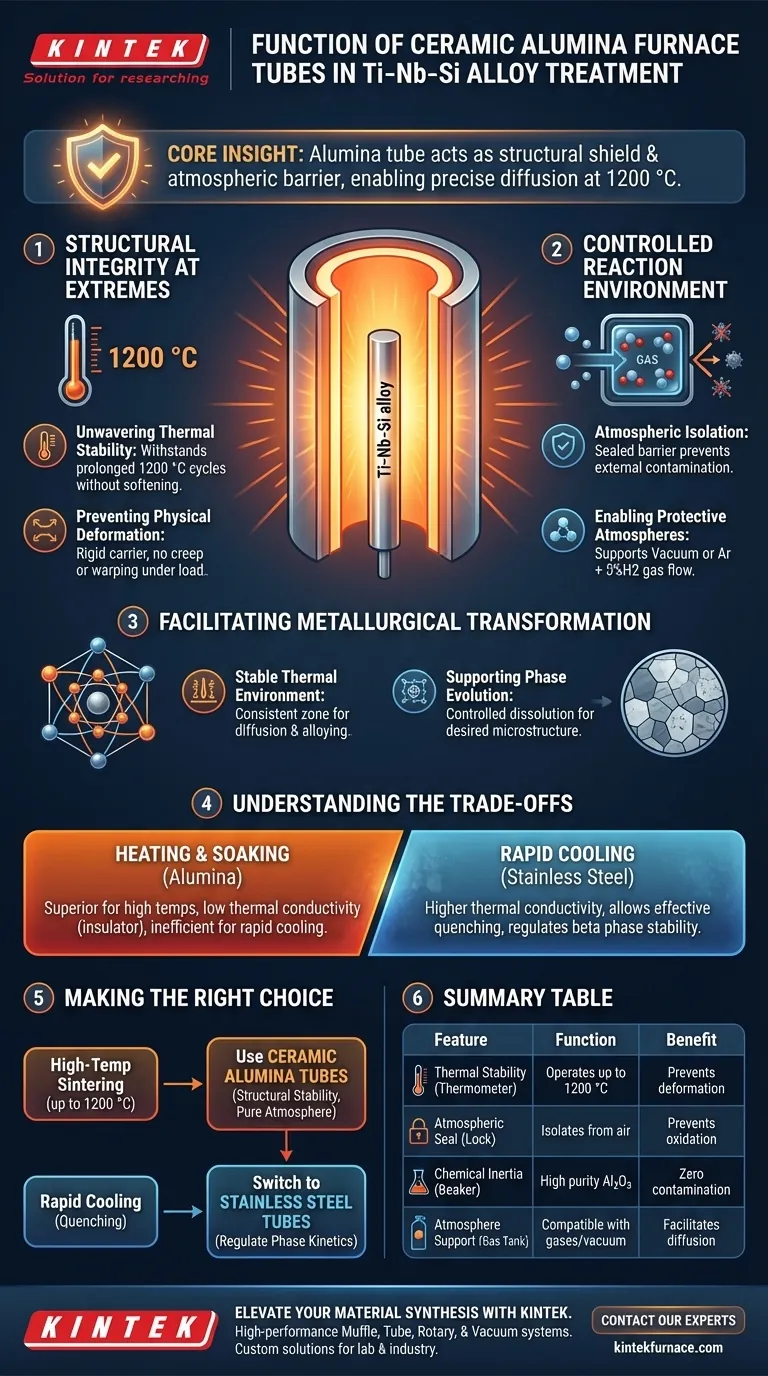
Ceramic alumina furnace tubes serve as the critical reaction vessel that enables the safe and effective sintering of Ti–Nb–Si alloys. Their primary function is to provide a thermally stable, hermetically sealed environment capable of withstanding temperatures up to 1200 °C, ensuring the alloying process occurs without physical deformation or atmospheric contamination.
Core Insight: The alumina tube acts as both a structural shield and an atmospheric barrier. By maintaining rigidity at extreme temperatures while isolating the sample, it allows for the precise chemical diffusion required to synthesize high-quality alloys without introducing impurities.

Ensuring Structural Integrity at Extremes
Unwavering Thermal Stability
The synthesis of Ti–Nb–Si alloys requires sustained exposure to temperatures reaching 1200 °C.
Ceramic alumina tubes possess the necessary thermal resistance to operate at these levels. They withstand prolonged heating cycles without softening or losing structural integrity.
Preventing Physical Deformation
Unlike many metal reaction vessels, alumina does not creep or warp under the specific thermal load of this sintering process.
This rigidity ensures the tube remains a reliable carrier for the sintering reaction, maintaining the physical geometry required for the process.
Creating a Controlled Reaction Environment
Atmospheric Isolation
Titanium alloys are highly reactive and susceptible to contamination from the external environment.
The alumina tube provides a sealed environment, effectively isolating the sintering process from external air and contaminants. This isolation is non-negotiable for maintaining the purity of the alloy.
Enabling Protective Atmospheres
Because the tube creates a sealed chamber, it facilitates the use of controlled protective atmospheres, such as vacuum or Ar + 5%H2 reducing gas.
This controlled atmosphere inhibits high-temperature oxidation and assists in removing residual oxygen from the powder surfaces, ensuring the metallurgical quality of the sintered alloy.
Facilitating Metallurgical Transformation
Stable Thermal Environment
The tube furnace creates a consistent thermal zone that facilitates the diffusion and alloying of titanium, niobium, and silicon atoms.
This stability is crucial, as minor temperature deviations can lead to drastic changes in phase content or excessive grain coarsening.
Supporting Phase Evolution
By maintaining the sample accurately within specific two-phase or single-phase regions, the tube allows for the controlled dissolution of phases.
This promotes the desired microstructural evolution, which is essential for achieving specific plasticity and toughness targets in the final material.
Understanding the Trade-offs
The Cooling Limitation
While alumina is superior for the heating and holding phases, its thermal conductivity is relatively low.
It acts as an insulator, which makes it inefficient for processes requiring rapid cooling or quenching.
The Need for Material Switching
For phases of treatment requiring a fast cooling rate to regulate beta phase stability, alumina tubes are often replaced with stainless steel tubes.
Steel offers higher thermal conductivity, allowing for effective external ventilation and rapid temperature drops that alumina cannot support.
Making the Right Choice for Your Goal
To optimize the heat treatment of Ti–Nb–Si alloys, select your furnace tube material based on the specific phase of the thermal cycle:
- If your primary focus is high-temperature sintering (up to 1200 °C): Rely on ceramic alumina tubes to ensure structural stability and maintain a pure, oxidation-free protective atmosphere.
- If your primary focus is rapid cooling (quenching): Switch to stainless steel tubes to leverage higher thermal conductivity for regulating phase precipitation kinetics.
Success in treating these alloys relies on using alumina to protect the chemistry during the heat soak, while recognizing its limitations during the cool down.
Summary Table:
| Feature | Function in Ti–Nb–Si Treatment | Benefit |
|---|---|---|
| Thermal Stability | Operates up to 1200 °C without softening | Prevents vessel deformation during sintering |
| Atmospheric Seal | Isolates sample from external air | Prevents oxidation of reactive titanium |
| Chemical Inertia | High purity Al2O3 composition | Ensures zero contamination of the alloy melt |
| Atmosphere Support | Compatible with Ar + 5%H2 or vacuum | Facilitates precise chemical diffusion and reduction |
Elevate Your Advanced Material Synthesis with KINTEK
Precision in Ti–Nb–Si alloying requires the perfect balance of thermal resistance and atmospheric control. KINTEK provides high-performance Muffle, Tube, Rotary, and Vacuum systems designed specifically for the rigorous demands of laboratory research and industrial sintering.
Backed by our expert R&D and manufacturing capabilities, we offer fully customizable high-temperature furnace solutions tailored to your unique metallurgical needs. Ensure the purity and structural integrity of your alloys today.
Ready to optimize your high-temperature processes?
Contact Our Technical Experts Now"
Form) to find the ideal furnace configuration for your lab."
Visual Guide
References
- Douglas Daniel de Carvalho, Cristiano Binder. Effect of Nb and Si Content on Phase Stability, Microstructure and Mechanical Properties of Sintered Ti–Nb–Si Alloys. DOI: 10.3390/met15010034
This article is also based on technical information from Kintek Furnace Knowledge Base .
Related Products
- 1400℃ High Temperature Laboratory Tube Furnace with Alumina Tube
- 1700℃ High Temperature Laboratory Tube Furnace with Alumina Tube
- Custom Made Versatile CVD Tube Furnace Chemical Vapor Deposition CVD Equipment Machine
- Vacuum Heat Treat Furnace with Ceramic Fiber Liner
- Slide PECVD Tube Furnace with Liquid Gasifier PECVD Machine
People Also Ask
- How does zone-melting in tube furnaces synthesize bismuth micro-wires? Master Single-Crystal Thermoelectric Growth
- How are high-temp tube furnaces used to measure diffusion coefficients per Fick's law? Master Precision Annealing
- How are high-temperature laboratory tube furnaces applied in long-term vacuum homogenization heat treatments for intermetallic samples?
- How do high-temperature laboratory tube furnaces ensure environmental stability? Precision Thermal Reduction Tips
- How are high-temperature tube furnaces applied in testing ceramic-supported alloy membranes? Insights


















