
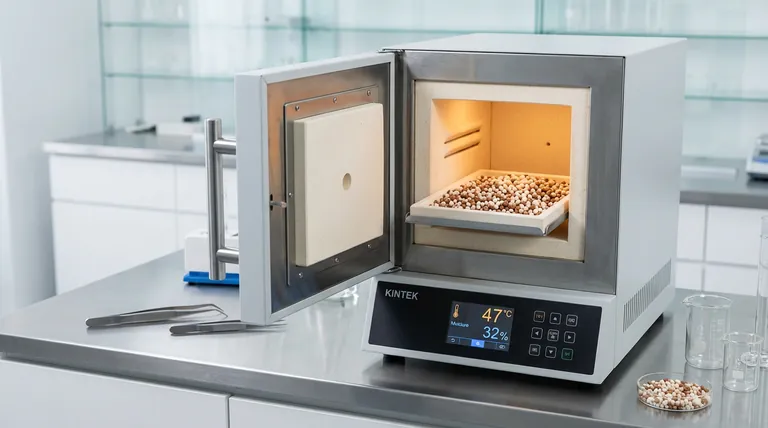
Precise thermal regulation is the mechanism by which a laboratory drying oven ensures the structural stability of microcapsule granules. By maintaining a constant temperature range of 45 to 50 °C, the oven facilitates gentle moisture removal to prevent the physical fractures that compromise the granule's protective shell during post-processing.
The core function of the drying oven is to prevent "stress cracking" caused by rapid dehydration. By stabilizing the thermal environment, the oven preserves the mechanical strength of fertilizer granules and ensures the encapsulated nutrients remain securely contained.
The Mechanics of Structural Preservation
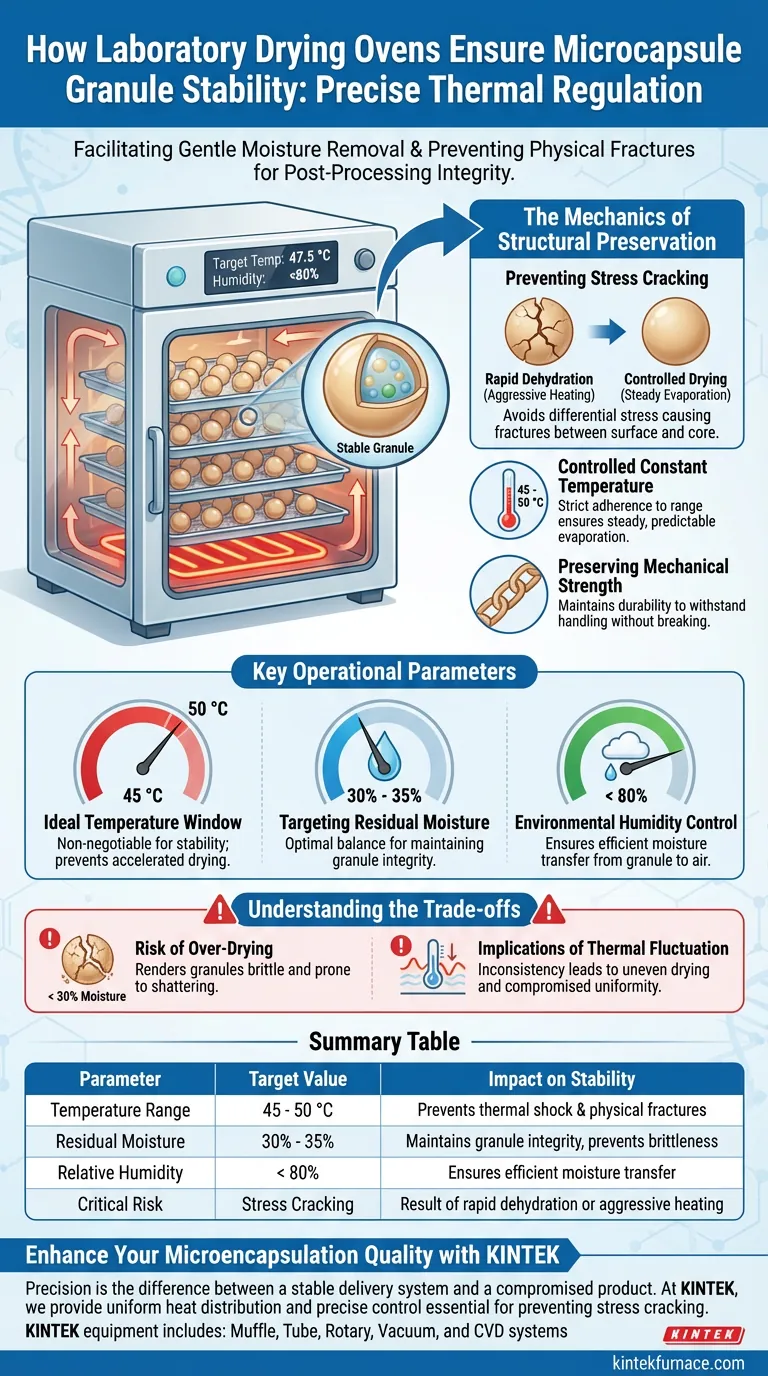
Preventing Stress Cracking
The most critical risk to microcapsules during post-processing is rapid dehydration. If moisture is removed too quickly, the differential stress between the surface and the core of the granule causes the structure to crack.
Controlled Constant Temperature
To mitigate this risk, the laboratory oven provides a constant-temperature environment. Keeping the temperature strictly between 45 and 50 °C ensures that the rate of evaporation is steady and predictable, rather than aggressive.
Preserving Mechanical Strength
This controlled process is directly linked to the durability of the final product. By avoiding thermal shock, the oven maintains the mechanical strength of the fertilizer granules, ensuring they can withstand handling without breaking apart.
Key Operational Parameters
The Ideal Temperature Window
Adherence to the specific range of 45 to 50 °C is non-negotiable for stability. Temperatures exceeding this range risk accelerating the drying process beyond the structural limits of the microcapsule materials.
Targeting Residual Moisture
The goal of the drying phase is not total dehydration, but rather achieving a specific balance. The process targets a residual moisture content of 30 to 35%, which is optimal for maintaining granule integrity.
Environmental Humidity Control
Effective drying requires managing the surrounding atmosphere as well as the heat. The oven environment must maintain a relative humidity below 80% to ensure efficient moisture transfer from the granule to the air.
Understanding the Trade-offs
The Risk of Over-Drying
While removing moisture is necessary, excessive drying can be as damaging as insufficient drying. Deviating below the 30% residual moisture target can render the granules brittle and prone to shattering.
Implications of Thermal Fluctuation
Inconsistency in the heating element can lead to uneven drying rates across a batch. If the oven fails to maintain the constant temperature band, some granules may suffer from stress cracking while others remain too moist, compromising the uniformity of nutrient release.
Making the Right Choice for Your Goal
To ensure the success of your microencapsulation process, you must align your drying parameters with your specific quality metrics.
- If your primary focus is Physical Durability: strictly maintain the temperature between 45 and 50 °C to prevent the stress fractures that lower mechanical strength.
- If your primary focus is Nutrient Retention: monitor the residual moisture content closely to ensure it settles between 30 and 35%, ensuring the core remains encapsulated.
Controlled, gentle drying is the only way to transform a fragile wet granule into a stable, effective delivery system.
Summary Table:
| Parameter | Target Value | Impact on Stability |
|---|---|---|
| Temperature Range | 45 - 50 °C | Prevents thermal shock & physical fractures |
| Residual Moisture | 30% - 35% | Maintains granule integrity and prevents brittleness |
| Relative Humidity | < 80% | Ensures efficient moisture transfer and steady drying |
| Critical Risk | Stress Cracking | Result of rapid dehydration or aggressive heating |
Enhance Your Microencapsulation Quality with KINTEK
Precision is the difference between a stable delivery system and a compromised product. At KINTEK, we understand that delicate materials require specialized thermal solutions. Our advanced laboratory ovens provide the uniform heat distribution and precise temperature control essential for preventing stress cracking in microcapsule granules.
Backed by expert R&D and world-class manufacturing, KINTEK offers a comprehensive range of lab high-temp equipment including Muffle, Tube, Rotary, Vacuum, and CVD systems. Whether you need standard laboratory drying or customizable systems for unique research requirements, our technology ensures your materials achieve peak mechanical strength and nutrient retention.
Ready to optimize your drying process? Contact us today to discuss your project and see how our customizable furnace solutions can support your scientific innovation.
Visual Guide
References
- Alibek Mutushev, Dauren Mukhanov. Development and application of microcapsules based on rice husk and metallurgical sludge to improve soil fertility. DOI: 10.1038/s41598-024-73329-4
This article is also based on technical information from Kintek Furnace Knowledge Base .
Related Products
- 1200℃ Muffle Oven Furnace for Laboratory
- Laboratory Muffle Oven Furnace with Bottom Lifting
- High Temperature Muffle Oven Furnace for Laboratory Debinding and Pre Sintering
- 1400℃ Muffle Oven Furnace for Laboratory
- 1800℃ High Temperature Muffle Oven Furnace for Laboratory
People Also Ask
- What is the primary function of a high-temperature laboratory muffle furnace in chemical synthesis? Achieve Precision.
- How does a high-temperature laboratory muffle furnace affect material properties? Transform Anodic Oxide Films Fast
- How is a laboratory muffle furnace used in 3D-printed PP-CF cross-linking? Achieve Thermal Stability at 150 °C
- Why is a laboratory high-temperature muffle furnace required for LaNixFe1-xO3 catalysts? Optimize Two-Stage Synthesis
- What role does a muffle furnace play in plant bark mineral analysis? Essential for Precise Dry Ashing & Trace Extraction






