
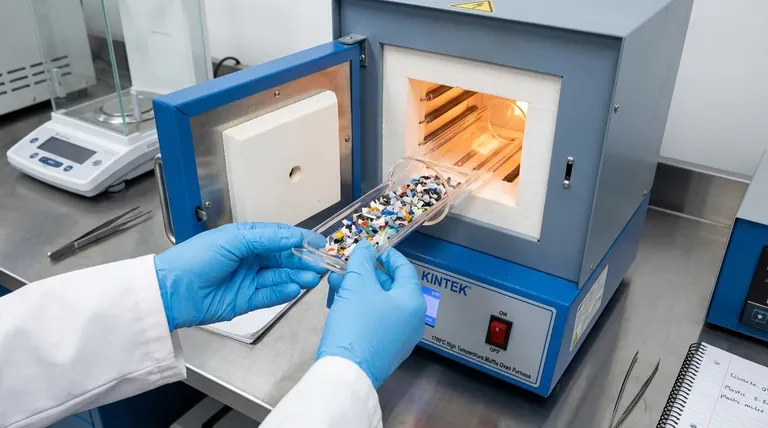
The technical necessity of a glass boat lies in its ability to standardize the environment within the pyrolysis reactor. It serves as a removable carrier that positions shredded plastic (typically 3-5mm) directly into the quartz tube's heated center, ensuring uniform thermal decomposition and enabling precise quantitative analysis of the residues.
The glass boat is not merely a loading tool; it is a critical component for experimental control. It ensures the feedstock is subjected to uniform temperatures—preventing erratic data caused by localized burning—and allows for the complete recovery of solid residues for mass balance calculations.
Optimizing Thermal Dynamics
Achieving Uniform Heat Distribution
For pyrolysis to yield reliable data, the feedstock must degrade at a consistent rate. A glass boat allows you to spread the shredded plastic evenly across a specific surface area.
This prevents the material from piling up, which would cause the outer layers to react faster than the inner layers. By ensuring the 3-5mm particles are uniformly distributed, the boat facilitates a predictable reaction kinetic.
Preventing Localized Carbonization
Direct contact between plastic and the reactor tube can lead to uneven heating. Without a boat, material may clump or stick to the tube walls, creating "hot spots."
These hot spots cause localized carbonization, where parts of the sample burn to char rather than decomposing into the desired vapors. The glass boat acts as a consistent thermal interface, ensuring the heat is applied evenly to the entire sample.
Accurate Positioning in the Heated Center
Pyrolysis furnaces often have temperature gradients; the temperature is most stable in the geometric center of the quartz tube.
The glass boat allows you to mechanically slide the sample exactly into this heated center. This precise positioning eliminates variables caused by placing the sample in cooler zones near the tube's edges.
Ensuring Experimental Precision
Facilitating Loading and Unloading
Handling loose, shredded plastic inside a narrow quartz tube is operationally difficult. The boat serves as a container that simplifies the insertion process.
It effectively isolates the feedstock from the tube itself. This prevents cross-contamination between runs, as melted plastic or residue does not adhere directly to the expensive quartz tube walls.
Enabling Accurate Mass Balance
One of the primary goals of pyrolysis experiments is analyzing the leftover solid carbon residue or catalyst.
The glass boat captures 100% of this remaining solid material. By weighing the boat before and after the experiment, you can determine the exact mass of the residue, allowing for highly accurate mass balance calculations.
Operational Considerations
Handling Fragility
While chemically inert, glass boats are mechanically fragile. They must be handled with precision specifically during the loading phase to avoid breakage inside the tube.
Thermal Compatibility
Ensure the glass composition of the boat is compatible with your target pyrolysis temperatures. While the boat ensures even heating, rapid temperature changes (thermal shock) during insertion or removal can crack the vessel if the material grade is insufficient.
Making the Right Choice for Your Goal
To maximize the reliability of your pyrolysis data, consider the following applications of the glass boat:
- If your primary focus is Reaction Kinetics: Spread the 3-5mm plastic pieces in a thin, single layer within the boat to maximize surface area exposure and ensure instant, uniform heat transfer.
- If your primary focus is Mass Balance Analysis: Pre-weigh the empty boat with high-precision scales and handle it with forceps to prevent oil transfer from skin, ensuring the final residue weight is exact.
The glass boat is the bridge between a chaotic reaction and a controlled, reproducible scientific experiment.
Summary Table:
| Feature | Technical Necessity in Pyrolysis | Benefit to Experiment |
|---|---|---|
| Uniform Distribution | Spreads 3-5mm plastic evenly | Ensures predictable reaction kinetics and consistent degradation. |
| Thermal Interface | Prevents direct tube-to-sample contact | Eliminates localized hot spots and erratic carbonization. |
| Precise Positioning | Locates sample in the heated center | Minimizes temperature gradient variables for reliable data. |
| Residue Recovery | Acts as a removable containment vessel | Enables 100% recovery of solids for accurate mass balance analysis. |
| Tube Protection | Isolates melted feedstock from quartz walls | Prevents cross-contamination and extends the life of the reactor tube. |
Elevate Your Pyrolysis Research with KINTEK
Precision is the foundation of scientific discovery. Whether you are analyzing reaction kinetics or calculating mass balance, KINTEK provides the high-performance laboratory equipment necessary for repeatable results.
Backed by expert R&D and manufacturing, KINTEK offers customizable Muffle, Tube, Rotary, Vacuum, and CVD systems tailored to your unique high-temperature research needs. Don't let inconsistent heating or poor sample positioning compromise your data.
Ready to optimize your lab's thermal processes? Contact our technical specialists today to find the perfect furnace solution for your application.
Visual Guide

References
- Hitesh Panchal. Fuel Extraction from Plastic Waste. DOI: 10.22214/ijraset.2025.66489
This article is also based on technical information from Kintek Furnace Knowledge Base .
Related Products
- Electric Rotary Kiln Small Rotary Furnace Biomass Pyrolysis Plant Rotating Furnace
- Electric Rotary Kiln Pyrolysis Furnace Plant Machine Small Rotary Kiln Calciner
- Electric Rotary Kiln Continuous Working Small Rotary Furnace Kiln for Pyrolysis Plant Heating
- Vacuum Heat Treat Sintering Furnace with Pressure for Vacuum Sintering
- High Temperature Muffle Oven Furnace for Laboratory Debinding and Pre Sintering
People Also Ask
- What are the main applications of a rotary kiln electric furnace? Achieve Uniform Heat Treatment for Powders
- What are the key components of a rotary kiln electric furnace? Unlock Efficient Thermal Processing
- What is the significance of the refractory lining in a rotary kiln electric furnace? Unlock Efficiency and Longevity
- What is the benefit of adjustable speed control in rotary kilns? Optimize Efficiency and Quality
- What are the main advantages of using rotary kilns for bulk solids processing? Achieve High-Volume, Uniform Thermal Processing



















