
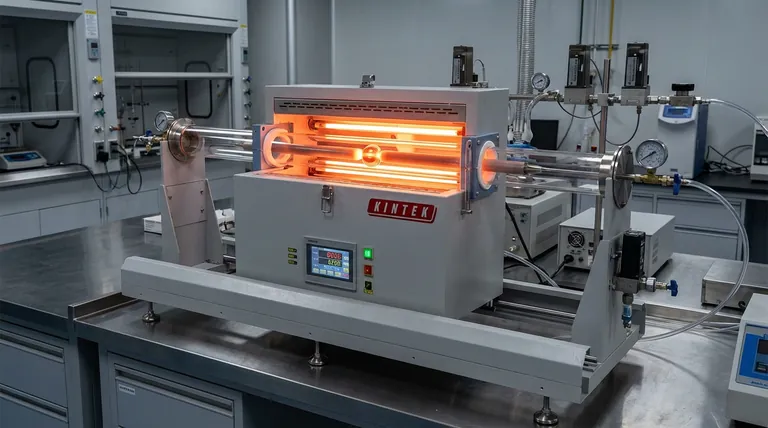
The transparent quartz tube primarily functions as a dual-purpose isolation chamber. It physically separates the molten zone from the external environment to allow for precise atmospheric control, while simultaneously acting as a highly efficient optical window for external heat sources. By utilizing the transparency of quartz, the system can focus radiant energy onto the material rod with minimal loss.
The quartz tube is the critical interface that allows you to manipulate the chemical environment of the crystal growth without obstructing the energy required to melt it.
Establishing Environmental Control
Physical Isolation
In the Floating-Zone (FZ) technique, the purity of the crystal is paramount. The quartz tube serves as a physical barrier that completely isolates the molten zone from the outside laboratory environment.
Precise Atmosphere Regulation
By sealing the growth area, the tube allows researchers to dictate the specific conditions surrounding the melt.
Depending on the chemical properties of the material being grown, you can introduce high pressure, maintain a high vacuum, or establish specific oxygen partial pressures. This containment prevents contamination and stabilizes volatile elements during the growth process.
Maximizing Energy Efficiency
High Optical Transparency
The "transparent" nature of the quartz is not merely for observation; it is a functional requirement for the heating mechanism.
Because the FZ technique often relies on external optical heating, the barrier must be invisible to the energy source.
Focusing Radiant Energy
External sources, such as halogen lamps or lasers, direct intense heat toward the sample.
The high transparency of the quartz tube ensures that this radiant energy passes through the barrier and is focused onto the material rod with minimal absorption or scattering. This ensures that the energy goes into melting the crystal, not heating the container.
Understanding the Trade-offs
Isolation vs. Mechanical Support
It is vital to distinguish the role of the quartz tube in the Floating-Zone technique compared to other methods like Modified Bridgman.
In Modified Bridgman growth, the quartz tube often acts as the primary vessel, providing physical support and a mold for the melt.
The FZ Distinction
In contrast, the FZ quartz tube acts strictly as an atmospheric envelope, not a physical support structure.
The molten zone in FZ is typically supported by surface tension, not by touching the walls of the tube. Relying on the tube for support in FZ would negate the "floating" aspect and introduce the very contact-based contamination the technique aims to avoid.
Making the Right Choice for Your Goal
When designing your crystal growth experiment, understanding the function of the enclosure is critical.
- If your primary focus is preventing contamination: Ensure your quartz tube is sealed to handle high vacuum or specific gas pressures to chemically stabilize the material.
- If your primary focus is thermal efficiency: Select high-grade, optical-quality quartz to minimize energy loss from your halogen or laser sources.
The quartz tube is not just a container; it is an active component in defining the thermodynamics and chemistry of your crystal growth.
Summary Table:
| Feature | Function in FZ Technique |
|---|---|
| Physical Isolation | Barrier against external contaminants and lab environment. |
| Atmospheric Control | Allows for high vacuum, high pressure, or specific gas partial pressures. |
| Optical Transparency | Permits radiant energy from lamps/lasers to pass through with minimal loss. |
| Role vs. Support | Acts as an atmospheric envelope rather than a physical mold/crucible. |
| Material Purity | Ensures zero contact between the melt and the tube wall. |
Elevate Your Material Research with KINTEK Precision
Are you looking to achieve superior single crystal growth? KINTEK provides high-performance high-temperature solutions tailored to your laboratory's most demanding requirements.
Backed by expert R&D and world-class manufacturing, we offer a comprehensive range of Muffle, Tube, Rotary, Vacuum, and CVD systems. Whether you need standard quartz components or fully customizable high-temperature furnaces, our team ensures your setup maximizes thermal efficiency and atmospheric purity.
Ready to optimize your growth process? Contact KINTEK today to discuss your unique project needs with our technical experts.
References
- Naoki Kikugawa. Recent Progress of Floating-Zone Techniques for Bulk Single-Crystal Growth. DOI: 10.3390/cryst14060552
This article is also based on technical information from Kintek Furnace Knowledge Base .
Related Products
- Vertical Laboratory Quartz Tube Furnace Tubular Furnace
- Multi Zone Laboratory Quartz Tube Furnace Tubular Furnace
- High Pressure Laboratory Vacuum Tube Furnace
- Laboratory Quartz Tube Furnace RTP Heating Tubular Furnace
- 1200℃ Split Tube Furnace Laboratory Quartz Tube Furnace with Quartz Tube
People Also Ask
- What are the key differences between single-zone and multi-zone vertical tube furnaces? Choose the Right Furnace for Your Lab
- What makes a vertical tube furnace easy to operate? Discover Intuitive Automation for Precision Heating
- Why is a vertical tube furnace preferred for quenching tests? Achieve Rapid, Repeatable Cooling for Accurate Results
- How do heat treatment processes influence the configuration of a vertical tube furnace? Optimize for Quenching, Annealing, and More
- How does a vertical single-temperature zone tube furnace facilitate the growth of high-quality PdSe2 single crystals?



















