
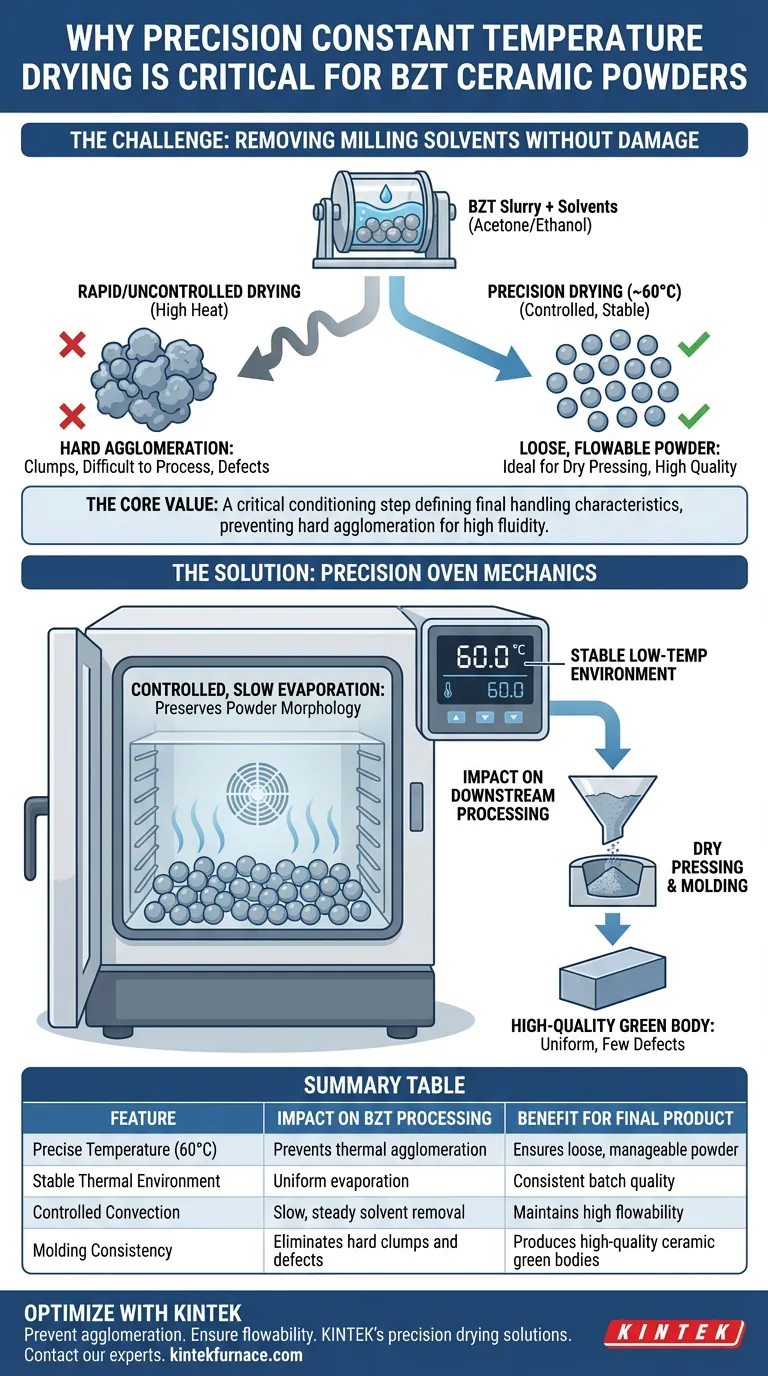
A precision constant temperature drying oven is essential for removing processing solvents without compromising the physical structure of the ceramic powder. Specifically for Barium Zirconium Titanate (BZT), this equipment maintains a stable, low-temperature environment (typically around 60 °C) to safely evaporate solvents like acetone introduced during milling. This controlled approach is the only way to ensure the material remains loose and suitable for subsequent manufacturing steps.
The Core Value The drying phase is not merely about evaporation; it is a critical conditioning step that defines the powder's final handling characteristics. By preventing rapid evaporation, the oven avoids "hard agglomeration," ensuring the BZT powder retains the high fluidity and loose consistency required for successful dry pressing.
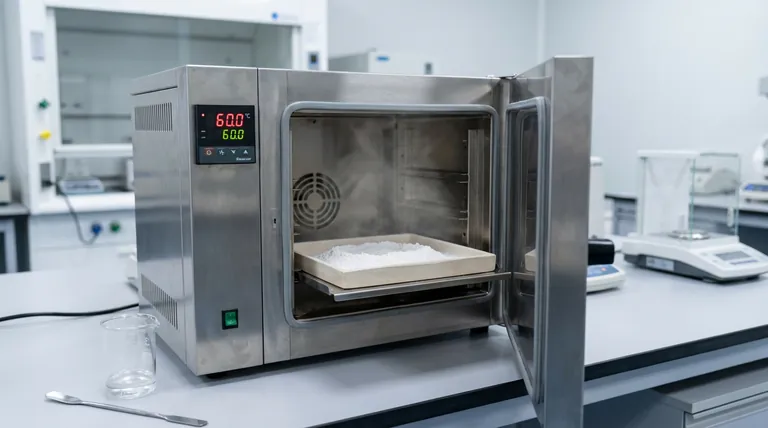
The Mechanics of Controlled Solvent Removal
Managing the Milling Medium
Processing BZT powders involves a wet milling stage to achieve the correct particle size, often using solvents such as acetone or anhydrous ethanol.
Thermal Stability
Once milling is complete, this liquid must be removed. A precision oven provides a constant thermal environment. Unlike standard heating, which may fluctuate, a constant temperature ensures that the solvent evaporates at a steady, predictable rate throughout the entire batch.
Preventing Structural Degradation
Avoiding Thermal Agglomeration
The primary danger during drying is thermal agglomeration. If BZT slurry is dried too quickly or at uncontrolled high temperatures, the particles bind together tightly, forming hard clumps.
Preserving Powder Morphology
According to standard processing protocols, maintaining a temperature near 60 °C prevents these hard clumps from forming. This "soft" drying approach ensures the pre-treated powder remains loose and manageable, rather than fusing into a solid cake that is difficult to process further.
Impact on Downstream Processing
Ensuring Flowability
For the next stage of production—typically dry pressing and molding—the powder must flow like a fluid. Precision drying preserves this flowability.
Molding Consistency
If the powder suffers from agglomeration due to poor drying, it will not pack evenly into molds. By using a precision oven, you ensure the powder is uniform, which leads to a higher quality ceramic green body (the unfired object) with fewer internal defects.
Understanding the Trade-offs
Time vs. Throughput
The main trade-off in using a precision constant temperature oven at low temperatures (e.g., 60 °C) is time. This process is significantly slower than high-heat flash drying. However, prioritizing speed over precision invariably leads to hard agglomerates that require aggressive grinding later, potentially introducing impurities or altering particle size distribution.
Atmosphere Control
While a standard constant temperature oven is effective for basic solvent removal, it relies on air convection. For materials extremely sensitive to oxidation or requiring lower drying temperatures to protect active materials, a vacuum drying oven might be referenced as an alternative. However, for standard BZT processing focused on acetone removal, the precision constant temperature oven strikes the right balance between complexity and performance.
Making the Right Choice for Your Project
The specific requirements of your drying process depend on your production goals.
- If your primary focus is Powder Consistency: Prioritize a lower temperature setting (approx. 60 °C) and longer duration to maximize flowability and minimize clumping.
- If your primary focus is Oxidation Prevention: Consider upgrading to a vacuum environment if your specific BZT formulation is sensitive to air exposure during drying.
Ultimately, the precision oven serves as the quality gatekeeper between raw slurry and the finished ceramic form.
Summary Table:
| Feature | Impact on BZT Processing | Benefit for Final Product |
|---|---|---|
| Precise Temperature (60°C) | Prevents thermal agglomeration | Ensures loose, manageable powder morphology |
| Stable Thermal Environment | Uniform evaporation of acetone/ethanol | Consistent batch quality and particle size |
| Controlled Convection | Slow, steady solvent removal | Maintains high flowability for dry pressing |
| Molding Consistency | Eliminates hard clumps and defects | Produces high-quality ceramic green bodies |
Optimize Your Ceramic Powder Processing with KINTEK
Don't let poor drying compromise your material integrity. KINTEK’s precision drying solutions prevent hard agglomeration and ensure the high flowability required for superior BZT ceramic production.
Backed by expert R&D and manufacturing, KINTEK offers a comprehensive range of lab high-temp equipment, including Muffle, Tube, Rotary, Vacuum, and CVD systems—all fully customizable to meet your unique research or production needs.
Take control of your material quality today. Contact our experts for a custom solution.
Visual Guide
References
- T. Avanish Babu, W. Madhuri. Energy storage and catalytic behaviour of cmWave assisted BZT and flexible electrospun BZT fibers for energy harvesting applications. DOI: 10.1038/s41598-024-52705-0
This article is also based on technical information from Kintek Furnace Knowledge Base .
Related Products
- Dental Porcelain Zirconia Sintering Ceramic Vacuum Press Furnace
- High Temperature Muffle Oven Furnace for Laboratory Debinding and Pre Sintering
People Also Ask
- What factors determine the quality of sintered zirconia restorations? Master Material, Equipment, and Technique
- How do conventional vs rapid sintering in dental furnaces affect zirconia? Optimize Efficiency Without Sacrificing Strength
- What is the purpose of dental sintering furnaces? Transform Zirconia into Durable, High-Quality Dental Restorations
- What precautions should be taken when sintering zirconia in the Fast Slow Dental Sintering Furnace? Master Key Steps for Perfect Results
- What temperature range is used for sintering zirconia ceramics? Achieve Optimal Strength and Translucency

