
The primary function of a high-purity ceramic crucible with a sealed lid is to create a controlled, quasi-anaerobic environment essential for pyrolysis. By establishing a state of micro-positive pressure, the vessel allows volatile gases to escape while strictly blocking the ingress of external oxygen. This prevents the biomass from undergoing oxidative combustion (burning), ensuring high carbon retention and the formation of a complete microporous structure.
While the furnace supplies the heat, the crucible dictates the chemistry. The lid’s precision alignment acts as a passive valve that facilitates thermal decomposition rather than combustion, directly determining the biochar's final stability and surface area.
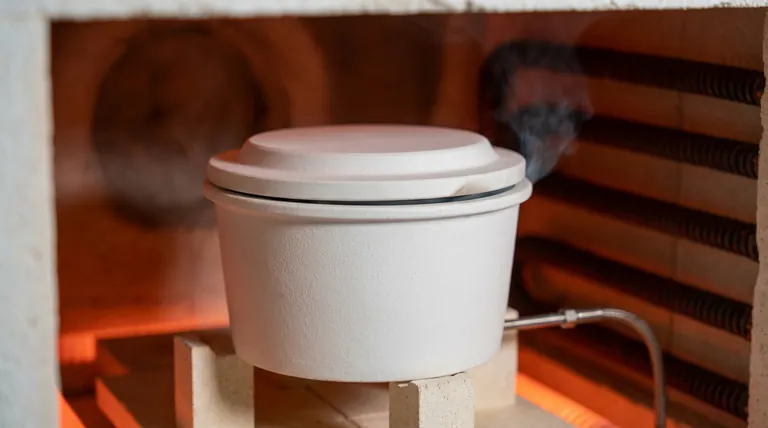
Creating the Ideal Pyrolysis Environment
The Mechanism of Micro-Positive Pressure
As the furnace heats the biomass, volatile components vaporize and expand. A precision-aligned lid allows these gases to escape just enough to prevent dangerous pressure buildup.
This outward flow of gas creates a micro-positive pressure zone inside the crucible. This pressure barrier effectively pushes against the atmosphere, preventing oxygen from entering the reaction chamber.
Preventing Oxidative Combustion
If external oxygen interacts with the biomass at high temperatures, the material will burn to ash rather than carbonize.
The sealed crucible ensures a quasi-anaerobic (low oxygen) state. This forces the material to decompose thermally without burning, which is the fundamental requirement for producing biochar rather than ash.
Developing the Microporous Structure
The physical structure of biochar relies on the preservation of the carbon skeleton.
By protecting the sample from oxidation, the crucible ensures maximum carbon retention. This stability allows the material to develop a complex, complete microporous structure, which is critical for the biochar's adsorption capabilities.
Material Properties and Thermal Dynamics
Thermal Stability and Chemical Inertness
Biochar production often requires temperatures reaching up to 1000 °C.
High-purity ceramic is selected for its superior thermal stability, ensuring the container does not warp or degrade under this stress. Furthermore, its chemical inertness guarantees that the crucible will not react with either the raw biomass or the resulting biochar, preserving the sample's purity.
Controlled Heat Conduction
Beyond containment, the crucible plays an active role in heat transfer.
The ceramic material possesses specific heat conduction properties that moderate the temperature changes. This assists in achieving a smooth and controllable decomposition of the biomass, avoiding rapid thermal shocks that could alter the char's properties.
Understanding the Trade-offs
The Risk of Imperfect Sealing
The efficacy of this method relies entirely on the precision alignment of the lid.
If the lid is too loose, the micro-positive pressure fails, oxygen enters, and the yield drops significantly due to combustion. Conversely, if the lid were hermetically sealed (airtight) rather than just "precision-aligned," pressure could build to dangerous levels, leading to mechanical failure of the vessel.
Thermal Lag
Ceramic is an excellent material for stability, but it is not an instant conductor of heat.
There is a slight delay (thermal lag) between the furnace temperature and the sample temperature inside the crucible. Operators must account for this by adjusting ramp rates to ensure the biomass is thoroughly treated at the target temperature.
Optimizing Your Experimental Setup
To ensure you achieve the highest quality biochar, align your equipment choice with your specific research or production goals:
- If your primary focus is Surface Area and Pore Structure: Prioritize the lid alignment to ensure a strict quasi-anaerobic environment, as any oxygen leakage will destroy micropores.
- If your primary focus is Chemical Purity: Ensure you are using high-purity ceramic to prevent trace element contamination from the crucible itself during high-temperature phases.
Success in biochar production is not just about heating biomass; it is about precisely controlling the atmosphere in which that heating occurs.
Summary Table:
| Feature | Function in Biochar Pyrolysis | Impact on Final Product |
|---|---|---|
| Sealed Lid | Creates micro-positive pressure & blocks oxygen | Prevents combustion to ash; ensures carbonization |
| High-Purity Ceramic | Provides thermal stability & chemical inertness | Eliminates contamination; maintains sample purity |
| Quasi-Anaerobic Environment | Facilitates thermal decomposition | Develops complex microporous structures |
| Controlled Heat Transfer | Moderates temperature changes | Ensures uniform decomposition and stability |
Maximize Your Biochar Yield with Precision Engineering
Success in thermal decomposition depends on the perfect balance of atmosphere and temperature control. At KINTEK, we understand that while the furnace provides the heat, the vessel dictates the chemistry.
Backed by expert R&D and manufacturing, KINTEK offers a comprehensive range of lab high-temp solutions, including:
- Muffle, Tube, and Vacuum Furnaces optimized for pyrolysis.
- High-Purity Ceramic Crucibles designed for precise lid alignment and chemical inertness.
- Customizable Systems tailored to your specific biomass research or production needs.
Don't let oxygen leakage or material contamination compromise your carbon retention. Partner with KINTEK for equipment that ensures superior surface area and pore structure in every batch.
Upgrade Your Lab Setup — Contact KINTEK Today
References
- Nathan Howell, Bridget Guerrero. Utilization of cotton gin waste biochars for agronomic benefits in soils. DOI: 10.1007/s13399-024-05545-x
This article is also based on technical information from Kintek Furnace Knowledge Base .
Related Products
- High Temperature Muffle Oven Furnace for Laboratory Debinding and Pre Sintering
- Dental Porcelain Zirconia Sintering Ceramic Vacuum Press Furnace
- 1400℃ Muffle Oven Furnace for Laboratory
- Chairside Dental Porcelain Zirconia Sintering Furnace with Transformer for Ceramic Restorations
- Vacuum Dental Porcelain Sintering Furnace for Dental Laboratories
People Also Ask
- What thermal phenomena occur during polymer binder burnout in ceramic green bodies? Lab Furnace Guide
- What role does a high-temperature muffle furnace play in STFO synthesis? Achieve Pure Perovskite Results
- Why is controlled heat treatment in a muffle furnace necessary for calcined clay? Achieve Optimal Pozzolanic Activity
- How does a high-temperature muffle furnace facilitate the formation of LaNbxAl1−xO3+δ perovskite structures? Key Roles
- What role does a high-temperature muffle furnace play in the formation of biochar catalysts? Master Catalyst Synthesis



















