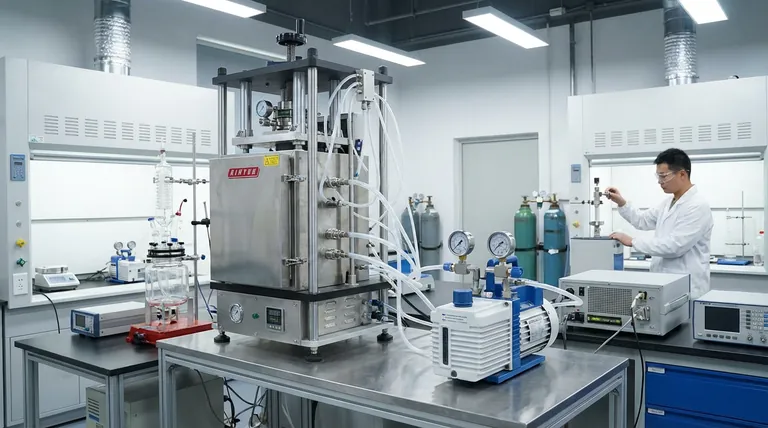
The primary function of a laboratory vacuum system in photocatalytic hydrogen evolution is to create a chemically isolated environment within the reactor. Before the experiment begins, the system evacuates ambient air—specifically removing oxygen and nitrogen—to prevent these atmospheric gases from interfering with the chemical reaction. This step ensures that the hydrogen production measured is solely the result of the catalyst decomposing water.
By eliminating dissolved oxygen and other atmospheric contaminants, the vacuum system establishes a clean baseline. This guarantees that the hydrogen detected by analysis instruments is derived exclusively from the experimental reaction, ensuring the validity of performance data.
The Critical Role of Gas Removal
Eliminating Ambient Air
The atmosphere contains gases, primarily nitrogen and oxygen, that naturally inhabit the headspace and liquid phase of a reactor.
Before initiating a photocatalytic reaction, these gases must be physically removed. A vacuum system extracts them from the reactor vessel to prepare the "blank" canvas required for accurate chemistry.
The Problem with Dissolved Oxygen
Oxygen is particularly problematic in hydrogen evolution experiments. It can act as an electron scavenger, competing with protons for the electrons generated by the photocatalyst.
If oxygen remains in the system, it suppresses the hydrogen evolution reaction. Removing it via vacuum prevents this interference and allows the reduction of protons to hydrogen to proceed efficiently.
Ensuring Experimental Accuracy
Verifying the Hydrogen Source
Scientific validity relies on knowing the exact origin of the products being measured.
By establishing a vacuum, researchers ensure that the system is closed and free of external inputs. Consequently, any pressure increase or gas detection can be confidently attributed to the catalyst's decomposition of water.
Precision in Chromatography
Most modern setups use online gas chromatography to quantify the hydrogen produced.
A vacuum-purged system ensures that the chromatograph detects only the gases evolved during the experiment. This eliminates the "noise" of atmospheric background gases, drastically increasing the accuracy of the performance measurement.
Common Pitfalls in Vacuum Application
Incomplete Evacuation
A common error is failing to hold the vacuum long enough to degas the liquid completely.
Simply removing air from the headspace is insufficient; dissolved oxygen trapped in the water must also be pulled out. Failure to do so will result in artificially low hydrogen yield data.
System Integrity and Leaks
A vacuum system is only as good as its seal.
If the reactor or tubing has even minor leaks, atmospheric oxygen will continuously re-enter the system. This not only invalidates the vacuum but introduces variable interference that makes data non-reproducible.
Maximizing Experimental Reliability
To ensure your hydrogen evolution data is publication-grade, consider the following approach:
- If your primary focus is precise kinetic data: Ensure you perform a thorough degassing cycle to remove all dissolved oxygen from the liquid phase, not just the headspace.
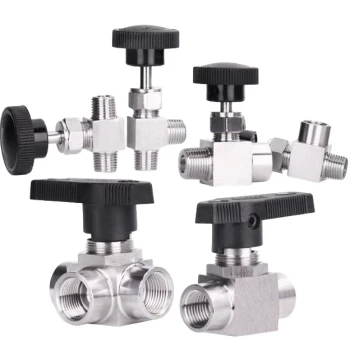
- If your primary focus is equipment longevity: Regularly test the vacuum seals and valves to prevent the ingress of air that could skew long-duration experiments.
A rigorous vacuum protocol is the invisible foundation of reproducible and accurate hydrogen evolution research.
Summary Table:
| Feature | Function in Hydrogen Evolution | Importance for Research |
|---|---|---|
| Ambient Air Removal | Eliminates N2 and O2 from reactor headspace | Creates a clean baseline for gas measurement |
| Liquid Degassing | Extracts dissolved oxygen from the water/liquid phase | Prevents O2 from acting as an electron scavenger |
| System Isolation | Establishes a closed, leak-free environment | Ensures detected hydrogen comes solely from the catalyst |
| Chromatography Prep | Reduces background atmospheric "noise" | Improves accuracy of online gas chromatography peaks |
Maximize Your Research Precision with KINTEK
High-purity hydrogen evolution requires more than just a catalyst; it demands a flawlessly controlled environment. KINTEK provides the advanced laboratory vacuum solutions and high-temperature systems necessary to eliminate interference and ensure your data is publication-grade.
Backed by expert R&D and manufacturing, KINTEK offers a comprehensive range of customizable equipment, including:
- High-Vacuum Systems for absolute atmospheric isolation.
- Muffle, Tube, Rotary, and CVD Systems for advanced material synthesis.
- Custom Lab Furnaces tailored to your unique photocatalytic research needs.
Ready to elevate your experimental accuracy? Contact our technical experts today to find the perfect system for your lab.
References
- Hubing Li, Xin Xiao. The Preparation of g-C3N4/ZnIn2S4 Nano-Heterojunctions and Their Enhanced Efficient Photocatalytic Hydrogen Production. DOI: 10.3390/molecules29112571
This article is also based on technical information from Kintek Furnace Knowledge Base .
Related Products
- Laboratory Vacuum Tilt Rotary Tube Furnace Rotating Tube Furnace
- Vacuum Dental Porcelain Sintering Furnace for Dental Laboratories
- Small Vacuum Heat Treat and Tungsten Wire Sintering Furnace
- Cylindrical Resonator MPCVD Machine System for Lab Diamond Growth
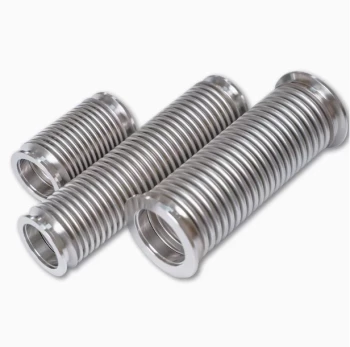
- High Performance Vacuum Bellows for Efficient Connection and Stable Vacuum in Systems
People Also Ask
- What are the key advantages of using a rotary tube furnace? Achieve Dynamic, Uniform Heating for Powders
- What other fields utilize rotary tube furnaces? Discover Versatile Heating Solutions for Multiple Industries
- What are the technical advantages of using a rotary tube furnace for hydrochar activation? Achieve Superior Porosity
- What optional features enhance the processing capabilities of rotary tube furnaces? Boost Efficiency with Advanced Customizations
- When are rotary tube furnaces not suitable for a process? Avoid Costly Mistakes in Thermal Processing