
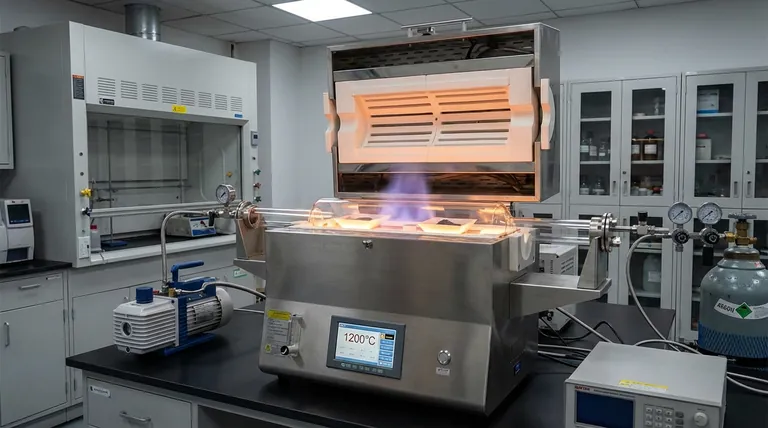
The synergistic use of vacuum systems and quartz tubes establishes a controlled, inert environment essential for the successful synthesis of Zinc Sulfide (ZnS) nanobelts. The vacuum system functions primarily to evacuate oxygen to prevent oxidation at high temperatures, while the high-purity quartz tube serves as a stable, thermally conductive vessel that facilitates the transport of vaporized precursors via carrier gases like Argon.
Achieving high-quality ZnS nanobelts requires rigorous control over atmospheric composition and thermal dynamics. The vacuum system eliminates chemical contaminants, while the quartz tube provides the physical architecture necessary for precise vapor transport and deposition.
The Critical Role of the Vacuum System
Preventing Unwanted Oxidation
The primary threat to ZnS synthesis is the presence of oxygen. At the high temperatures required for thermal evaporation, precursors become highly reactive.
The vacuum system actively removes air from the reaction space. This prevents the Zinc Sulfide from reacting with ambient oxygen, which would otherwise degrade the material into unwanted oxides rather than forming pure nanobelts.
Establishing a Clean Baseline
By evacuating the chamber, the system creates a "blank slate" environment. This ensures that the only active chemical species in the chamber are the intended precursors and the inert carrier gas.
The Function of High-Purity Quartz Tubes
Chemical Stability Under Heat
High-purity quartz is selected as the reaction vessel because of its exceptional resistance to thermal shock and chemical interaction.
Even at the elevated temperatures required to vaporize ZnS precursors, the quartz remains inert. This prevents impurities from the tube walls from leaching into the reaction and contaminating the growing nanobelts.
Facilitating Vapor Transport
The quartz tube acts as a directed channel for physical transport. It confines the reaction flow, allowing carrier gases like Argon to move efficiently through the system.
This guided flow transports the vaporized precursors from the high-temperature source zone to the lower-temperature deposition zone. This controlled movement is vital for ensuring the nanobelts grow with morphological consistency.
Understanding Synthesis Sensitivities
The Risk of Vacuum Breaches
The integrity of the vacuum seal is non-negotiable. Even a microscopic leak can introduce enough oxygen to compromise the entire batch.
If the vacuum fails to maintain a low-pressure, oxygen-free environment, the resulting material will likely exhibit surface defects or mixed phases of oxides and sulfides, rendering the nanobelts unusable for high-precision applications.
Thermal Conductivity and Deposition
While quartz is thermally conductive, the process relies on a specific thermal gradient.
The tube must effectively transfer heat to vaporize the source, but the downstream zone must be cool enough for deposition. If the carrier gas flow or tube positioning is incorrect, the vapor may not condense at the target location, leading to poor yields.
Optimizing Your Synthesis Setup
To maximize the quality of your Zinc Sulfide nanobelts, focus on maintaining the integrity of these two environmental controls.
- If your primary focus is Chemical Purity: Prioritize a high-performance vacuum system to ensure the absolute removal of oxygen and prevent oxidation reactions.
- If your primary focus is Morphological Uniformity: Optimize the flow rate of Argon within the quartz tube to ensure stable transport of precursors to the deposition zone.
Mastering the interplay between vacuum pressure and containment geometry is the defining factor in producing high-grade nanostructures.
Summary Table:
| Component | Primary Function | Impact on ZnS Synthesis |
|---|---|---|
| Vacuum System | Oxygen evacuation & contamination removal | Prevents oxidation; ensures material purity and clean chemical baseline. |
| Quartz Tube | High-temp containment & vapor channeling | Provides chemical stability; facilitates controlled precursor transport. |
| Argon (Carrier Gas) | Mass transport of vaporized precursors | Determines morphological consistency and deposition efficiency. |
| Thermal Gradient | Regulates vaporization and condensation | Controls where nanobelts grow and ensures high yield. |
Elevate Your Nanomaterial Synthesis with KINTEK
Precision in Zinc Sulfide nanobelt production demands uncompromising environmental control. Backed by expert R&D and manufacturing, KINTEK offers high-performance Vacuum Systems, CVD systems, and Customizable High-Temperature Furnaces designed to meet the rigorous demands of material science research.
Whether you need ultra-pure quartz tubes or advanced thermal systems to prevent oxidation and ensure morphological uniformity, our solutions are tailored to your unique lab requirements.
Ready to optimize your synthesis yields? Contact our technical experts today to find the perfect equipment for your high-precision applications.
References
- Amartya Chakrabarti, Emily Alessandri. Syntheses, Properties, and Applications of ZnS-Based Nanomaterials. DOI: 10.3390/applnano5030010
This article is also based on technical information from Kintek Furnace Knowledge Base .
Related Products
- High Pressure Laboratory Vacuum Tube Furnace
- Laboratory Quartz Tube Furnace RTP Heating Tubular Furnace
- Multi Zone Laboratory Quartz Tube Furnace Tubular Furnace
- Vertical Laboratory Quartz Tube Furnace Tubular Furnace
- 1200℃ Split Tube Furnace Laboratory Quartz Tube Furnace with Quartz Tube
People Also Ask
- What role does a high vacuum tube furnace play in Co-Al sintering? Master High-Purity Porous Material Synthesis
- What are the different types of tube furnaces available? Find the Perfect Fit for Your Lab's Needs
- What are the main advantages of vacuum tube furnaces in the market? Achieve Purity and Precision in Material Processing
- What is the role of a vacuum tube furnace during the final thermal treatment stage of Fe3O4@CSAC catalysts?
- What conditions do tube furnaces provide for Au-Seeded TiO2 nanowires? Master Precision Thermal Synthesis



















