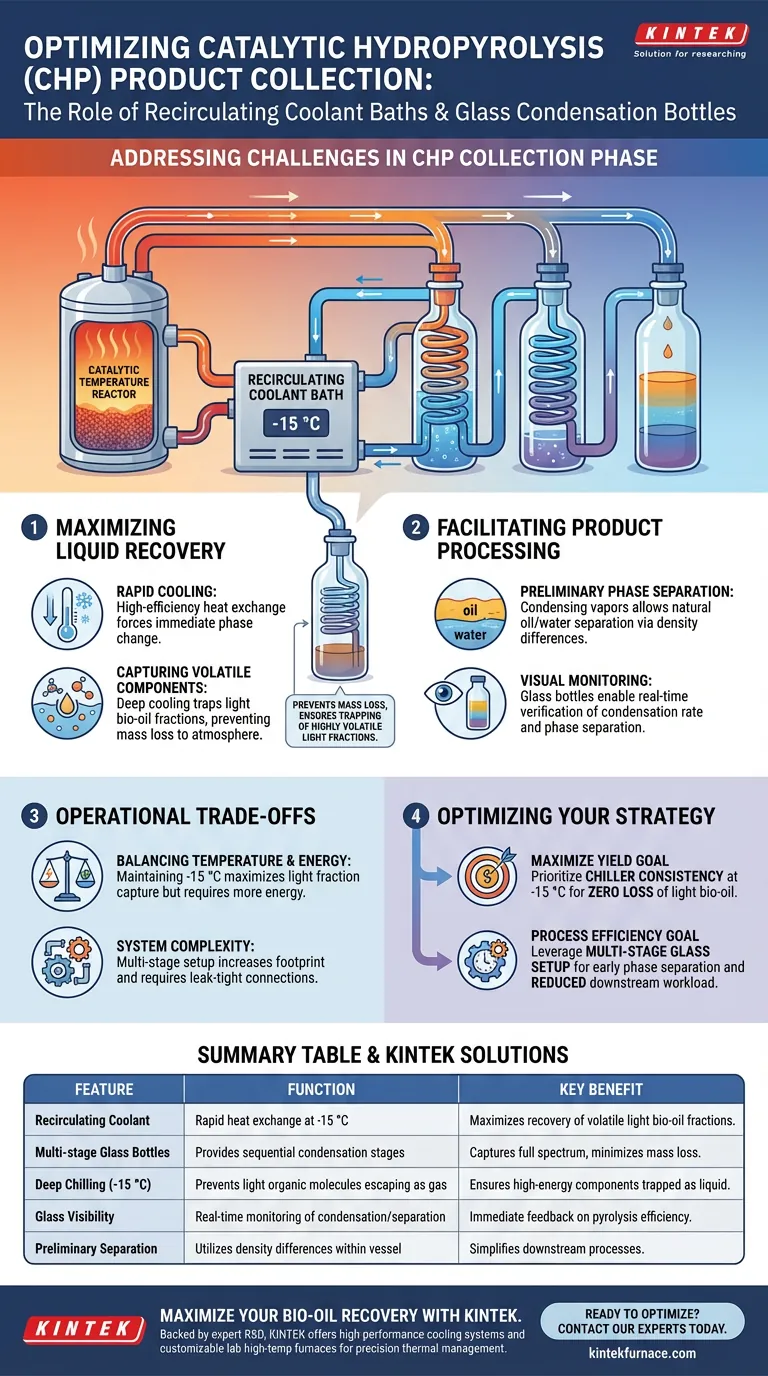
Recirculating coolant baths and glass condensation bottles serve as the critical interface between high-temperature reactions and tangible product recovery in Catalytic Hydropyrolysis (CHP). By employing a multi-stage system that chills vapors to as low as -15 °C, this setup addresses the twin challenges of maximizing bio-oil yield and managing phase separation.
The primary function of this cooling assembly is not merely temperature reduction, but the prevention of mass loss; it ensures that highly volatile light fractions are trapped as liquid rather than escaping as gas.
Maximizing Liquid Recovery
The Role of Rapid Cooling
The core challenge in CHP collection is the transition from high-temperature pyrolysis vapors to stable liquids. Recirculating coolant baths provide a high-efficiency heat exchange environment.
By circulating coolant at temperatures as low as -15 °C, the system forces a rapid phase change. This immediate drop in thermal energy is essential for condensing both organic components and water vapor simultaneously.
Capturing Volatile Components
Without aggressive cooling, lighter organic molecules often remain in the vapor phase and are lost to the atmosphere.
The use of multi-stage glass collection bottles combined with deep cooling traps these volatile components. This specifically prevents the loss of light bio-oil fractions, which are often the most valuable high-energy components of the product slate.
Facilitating Product Processing
Preliminary Phase Separation
Collecting the product is only half the battle; separating the useful oil from the byproduct water is the next step.
This collection method facilitates the preliminary separation of aqueous and organic phases. By condensing both vapors into the glass bottles, the natural density differences allow the oil and water to begin separating immediately within the collection vessel.
Visual Monitoring
The use of glass condensation bottles offers a distinct operational advantage.
It allows operators to visually verify the condensation rate and observe the phase separation in real-time. This provides immediate feedback on the efficiency of the upstream pyrolysis reaction.
Operational Trade-offs
Balancing Temperature and Energy
While achieving temperatures of -15 °C maximizes the capture of light fractions, it requires a robust recirculating chiller system.
There is a direct trade-off between the energy required to maintain sub-zero temperatures and the incremental yield gained from capturing the lightest volatiles.
System Complexity
Implementing a multi-stage collection system increases the physical footprint and complexity of the apparatus compared to a single-stage condenser.
Operators must ensure leak-tight connections across multiple glass stages to prevent the escape of vapors or the ingress of air, which could compromise the sample quality.
Optimizing Your Collection Strategy
To ensure your CHP process meets its recovery targets, evaluate your cooling requirements based on your specific yield goals.
- If your primary focus is Maximizing Yield: Prioritize the chiller's ability to maintain -15 °C consistently to ensure zero loss of light bio-oil fractions.
- If your primary focus is Process Efficiency: Leverage the multi-stage glass setup to initiate phase separation early, reducing the workload on downstream separation equipment.
Effective CHP product collection relies on the precise thermal management of vapors to secure the full spectrum of bio-oil components.
Summary Table:
| Feature | Function in CHP Collection | Key Benefit |
|---|---|---|
| Recirculating Coolant | Rapid heat exchange at temperatures as low as -15 °C | Maximizes recovery of volatile light bio-oil fractions |
| Multi-stage Glass Bottles | Provides sequential condensation stages | Captures the full spectrum of products and minimizes mass loss |
| Deep Chilling (-15 °C) | Prevents light organic molecules from escaping as gas | Ensures high-energy components are trapped as liquid |
| Glass Visibility | Real-time monitoring of condensation and phase separation | Provides immediate feedback on pyrolysis reaction efficiency |
| Preliminary Separation | Utilizes density differences within the collection vessel | Simplifies downstream oil-water separation processes |
Maximize Your Bio-oil Recovery with KINTEK
Don't let valuable high-energy fractions escape your collection system. Backed by expert R&D and manufacturing, KINTEK offers high-performance cooling systems and customizable lab high-temp furnaces, including Muffle, Tube, Rotary, Vacuum, and CVD systems. Our precision thermal management solutions are designed to help researchers achieve zero mass loss and superior phase separation in complex processes like Catalytic Hydropyrolysis (CHP).
Ready to optimize your lab's collection efficiency? Contact our experts today to build a tailored high-temperature and cooling setup for your unique research needs!
Visual Guide
References
- Hoda Shafaghat, Olov Öhrman. Customized Atmospheric Catalytic Hydropyrolysis of Biomass to High-Quality Bio-Oil Suitable for Coprocessing in Refining Units. DOI: 10.1021/acs.energyfuels.3c05078
This article is also based on technical information from Kintek Furnace Knowledge Base .
Related Products
- Multi Heating Zones CVD Tube Furnace Machine for Chemical Vapor Deposition Equipment
- High Temperature Muffle Oven Furnace for Laboratory Debinding and Pre Sintering
- Stainless Steel Quick Release Vacuum Chain Three Section Clamp
- Electric Rotary Kiln Small Rotary Furnace for Activated Carbon Regeneration
- Electric Rotary Kiln Continuous Working Small Rotary Furnace Kiln for Pyrolysis Plant Heating
People Also Ask
- What is the function of a multi-zone tube furnace in CVD synthesis? Master 2D In2Se3 Nanosheet Precision
- Why are multi zone tube furnaces particularly useful for nanomaterial research? Unlock Precise Thermal Control for Advanced Synthesis
- What temperature-related capabilities make multi zone tube furnaces valuable for research? Unlock Precision Thermal Control
- What role do multi zone tube furnaces play in new energy research? Unlock Precise Thermal Control for Innovation
- What environmental protection applications utilize multi zone tube furnaces? Unlock Precision in Waste Treatment and Green Tech