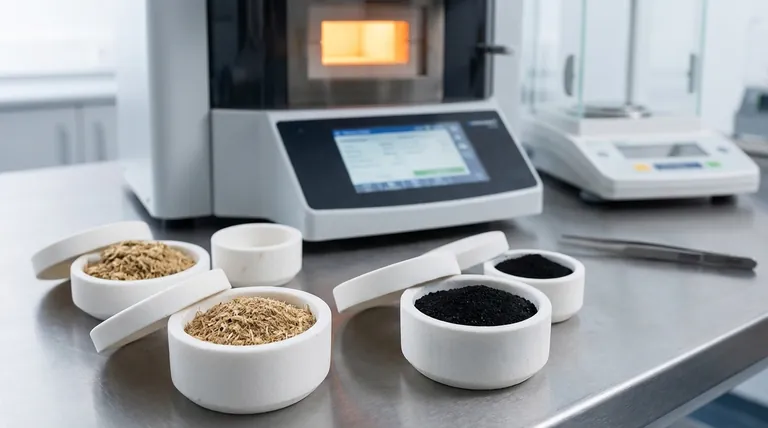
Open corundum crucibles are the definitive choice for the thermal analysis of biomass and coal due to their exceptional material properties and open architecture. By combining high-temperature stability with chemical inertness, they provide the necessary environment for capturing accurate heat flow signals and mass loss data across a wide thermal range.
Core Takeaway To obtain reliable thermal data for complex organic materials like coal and biomass, the sample container must be invisible to the experiment. Open corundum crucibles achieve this by remaining thermally and chemically neutral up to 1000°C, ensuring that the measured reactions are strictly from the sample and not the hardware.
Ensuring Data Integrity Through Material Properties
The reliability of thermal analysis depends heavily on the interaction between the sample and its container. Open corundum crucibles address this through three specific material advantages.
Superior Chemical Inertness
Biomass and coal are chemically complex and can release reactive volatiles during decomposition. Corundum is chemically inert, meaning it resists reacting with these powders even as they undergo phase changes or combustion.
This non-reactivity is critical for experimental validity. It ensures that the mass loss data recorded is solely due to the sample's decomposition, rather than a secondary reaction between the sample and the crucible walls.
High-Temperature Stability
Thermal analysis of fuel sources often requires sweeping temperature ramps. These crucibles maintain their structural integrity across a rigorous range of 30°C to 1000°C.
Because the material does not soften, warp, or degrade within this window, the baseline measurement remains stable. This stability guarantees that the resulting data reflects the true behavior of the biomass or coal.
Optimized Thermal Conductivity
Accurate heat flow measurement requires the sample temperature to track the furnace temperature precisely. Corundum possesses superior thermal conductivity, allowing heat to transfer efficiently and uniformly to the sample.
This rapid heat transfer minimizes thermal lag. Consequently, the heat flow signals detected are sharper and more accurate, providing a clear picture of the sample's thermal events.
Understanding Operational Limits
While open corundum crucibles are highly effective for this specific application, it is important to recognize the constraints outlined by the performance data.
The Temperature Ceiling
The guaranteed accuracy for these specific measurements is bounded at 1000°C. While corundum can technically withstand higher temperatures in other contexts, the specific assurance for signal integrity and non-reactivity with these samples is defined within the 30°C to 1000°C window.
The "Open" Configuration
The use of an open crucible is a deliberate design choice intended to allow volatiles to escape, which is essential for mass loss analysis. However, this configuration is not suitable for experiments where the containment of vapors or the maintenance of a specific self-generated atmosphere is required.
Making the Right Choice for Your Goal
To maximize the quality of your thermal analysis, match your equipment selection to your specific analytical objectives.
- If your primary focus is Mass Loss (TGA): Use these crucibles to ensure volatiles escape freely without chemically interacting with the container walls.
- If your primary focus is Heat Flow (DSC): Rely on the superior thermal conductivity of corundum to minimize thermal lag and produce crisp, interpretable signal peaks.
By leveraging the inert and conductive nature of corundum, you transform the crucible from a variable into a constant, ensuring your data is a true representation of the sample.
Summary Table:
| Feature | Benefit for Thermal Analysis |
|---|---|
| Material | High-purity Corundum (Alumina) |
| Temperature Range | Stable from 30°C up to 1000°C |
| Chemical Inertness | Prevents reactions between sample and container |
| Thermal Conductivity | Rapid heat transfer for sharp heat flow signals |
| Open Configuration | Facilitates unhindered mass loss and volatile release |
| Primary Applications | Biomass, coal, and complex organic sample analysis |
Precision thermal analysis starts with the right equipment. Backed by expert R&D and manufacturing, KINTEK offers high-performance Muffle, Tube, Rotary, Vacuum, and CVD systems, along with premium consumables tailored for your laboratory's success. Whether you are analyzing coal, biomass, or advanced materials, our customizable high-temperature solutions ensure your data remains a true representation of your sample. Optimize your laboratory results—Contact KINTEK today!
Visual Guide

Related Products
- High Temperature Muffle Oven Furnace for Laboratory Debinding and Pre Sintering
- Multi Zone Laboratory Quartz Tube Furnace Tubular Furnace
- Vertical Laboratory Quartz Tube Furnace Tubular Furnace
- 1400℃ Muffle Oven Furnace for Laboratory
- Multi Heating Zones CVD Tube Furnace Machine for Chemical Vapor Deposition Equipment
People Also Ask
- What thermal phenomena occur during polymer binder burnout in ceramic green bodies? Lab Furnace Guide
- Why is controlled heat treatment in a muffle furnace necessary for calcined clay? Achieve Optimal Pozzolanic Activity
- What role does a high-temperature muffle furnace play in STFO synthesis? Achieve Pure Perovskite Results
- How does a high-temperature muffle furnace facilitate the formation of LaNbxAl1−xO3+δ perovskite structures? Key Roles
- What role does a high-temperature muffle furnace play in the multi-stage synthesis of Li0.5MnFe1.5O4? Key to Pure Spinel