
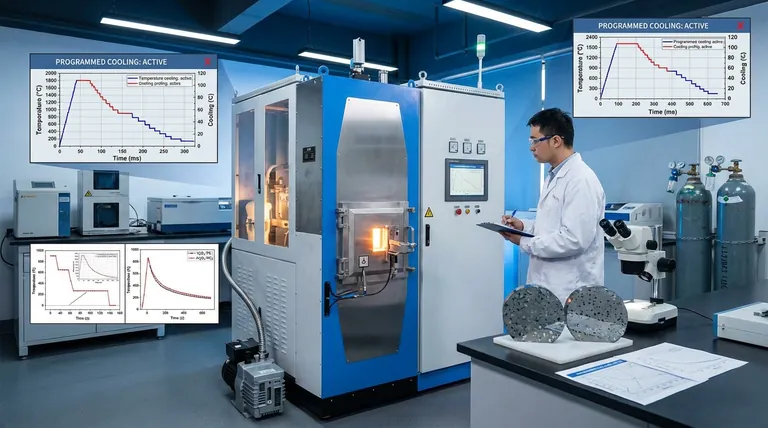
A precision programmed cooling system safeguards structural integrity by strictly regulating the rate of temperature reduction following the sintering process. By preventing rapid temperature drops, this system minimizes the accumulation of severe thermal stress that naturally occurs due to the differing physical properties of the composite materials.
The core challenge in sintering Al2O3-TiC composites is the mismatch in thermal expansion between the two phases. Programmed cooling mitigates this by allowing the material to stabilize gradually, reducing stress at the phase interfaces and effectively preventing micro-crack formation.
The Mechanism of Thermal Stress
The Challenge of Thermal Expansion Mismatch
The structural vulnerability of an Al2O3-TiC composite stems from its dual-phase nature. Alumina (Al2O3) and Titanium Carbide (TiC) possess different thermal expansion coefficients.
This means that as the material cools from the high sintering temperatures, the two distinct materials attempt to contract at different rates.
The Danger of Rapid Cooling
If the composite is subjected to a rapid, uncontrolled temperature drop, the material does not have time to equilibrate.
This rapid contraction forces the different phases to pull against one another violently. This creates an accumulation of severe thermal stress within the bulk material.
How Programmed Cooling Preserves Integrity
Strictly Controlled Cooling Rates
A precision programmed cooling system replaces natural, passive cooling with a regulated active process.
The system dictates the exact speed at which the temperature falls. This control prevents the "thermal shock" associated with sudden temperature changes.
Mitigating Interfacial Micro-Stress
The critical zone for failure in composites is the phase interface—the boundary where the Al2O3 and TiC grains meet.
By slowing down the cooling process, the programmed system allows these interfaces to accommodate the mismatch in contraction rates. This significantly mitigates micro-stress at the boundaries between the ceramic and the carbide.
Preventing Micro-Crack Formation
When stress at the interfaces exceeds the material's bond strength, micro-cracks initiate.
By keeping the interfacial stress below this critical threshold, the programmed cooling process directly reduces the risk of micro-crack formation. This ensures the final product remains a cohesive, structurally sound unit rather than a flawed, brittle component.
Operational Considerations and Trade-offs
Process Time vs. Structural Quality
Implementing a precision cooling program invariably extends the total cycle time of the sintering process.
While rapid cooling allows for higher manufacturing throughput, it drastically increases the scrap rate due to cracking. You are trading production speed for guaranteed material reliability.
Complexity of Control
Using a programmed system requires sophisticated equipment capable of managing complex thermal profiles.
Operators must understand the specific thermal properties of both Al2O3 and TiC to define the optimal cooling curve, adding a layer of technical complexity to the operation.
Optimizing Your Sintering Strategy
To achieve the best results with Al2O3-TiC composites, align your cooling strategy with your performance requirements:
- If your primary focus is maximum structural integrity: Implement a slow, stepped cooling profile to minimize internal stress and eliminate micro-cracking risks.
- If your primary focus is process efficiency: Analyze the specific thermal expansion difference to find the fastest cooling rate that remains just below the threshold of crack initiation.
Mastering the cooling phase is just as critical to the final quality of a composite as the sintering temperature itself.
Summary Table:
| Feature | Rapid Cooling | Precision Programmed Cooling |
|---|---|---|
| Thermal Stress | High accumulation at phase interfaces | Minimal, allows for equilibration |
| Structural Risk | High risk of micro-crack formation | Maintains structural integrity |
| Cooling Rate | Uncontrolled / Passive | Strictly regulated / Active |
| Throughput | High speed, higher scrap rate | Slower cycle, guaranteed reliability |
| Material Quality | Brittle and prone to failure | Cohesive and structurally sound |
Elevate Your Composite Material Performance with KINTEK
Don't let thermal stress compromise the quality of your Al2O3-TiC composites. Backed by expert R&D and world-class manufacturing, KINTEK provides precision-engineered Spark Plasma Sintering (SPS) solutions, including advanced Muffle, Tube, and Vacuum furnace systems. Our equipment features sophisticated programmable cooling profiles designed to mitigate micro-cracking and ensure superior structural integrity for your laboratory and industrial needs.
Ready to optimize your sintering cycle for maximum reliability?
Contact our technical experts today to discover our customizable high-temperature solutions tailored to your unique material requirements.
References
- Zara Cherkezova‐Zheleva, Radu Robert Piticescu. Green and Sustainable Rare Earth Element Recycling and Reuse from End-of-Life Permanent Magnets. DOI: 10.3390/met14060658
This article is also based on technical information from Kintek Furnace Knowledge Base .
Related Products
- Spark Plasma Sintering SPS Furnace
- Chairside Dental Porcelain Zirconia Sintering Furnace with Transformer for Ceramic Restorations
- Controlled Inert Nitrogen Hydrogen Atmosphere Furnace
- Dental Porcelain Zirconia Sintering Ceramic Vacuum Press Furnace
- 9MPa Air Pressure Vacuum Heat Treat and Sintering Furnace
People Also Ask
- How does the heating mechanism of Spark Plasma Sintering (SPS) function? Enhance TiC/SiC Composite Fabrication
- Why is it necessary to maintain a high vacuum environment during the SPS of SiC? Key to High-Density Ceramics
- What are the technical advantages of using an SPS sintering furnace? Elevate Al2O3-TiC Material Performance
- What are the steps in the discharge plasma sintering process? Master Fast, High-Density Material Consolidation
- What are the advantages of spark plasma sintering (SPS) over traditional forging? Precision Microstructural Control



















