Knowledge Why is a glassy carbon boat preferred over an alumina crucible for Na3Cu4Se4? Ensuring Phase Purity in Flux Synthesis
Author avatar

Tech Team · Kintek Furnace

Updated 7 hours ago

Why is a glassy carbon boat preferred over an alumina crucible for Na3Cu4Se4? Ensuring Phase Purity in Flux Synthesis


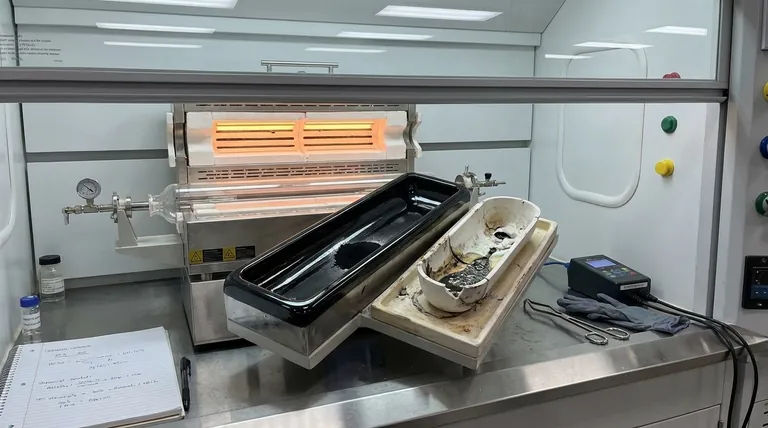
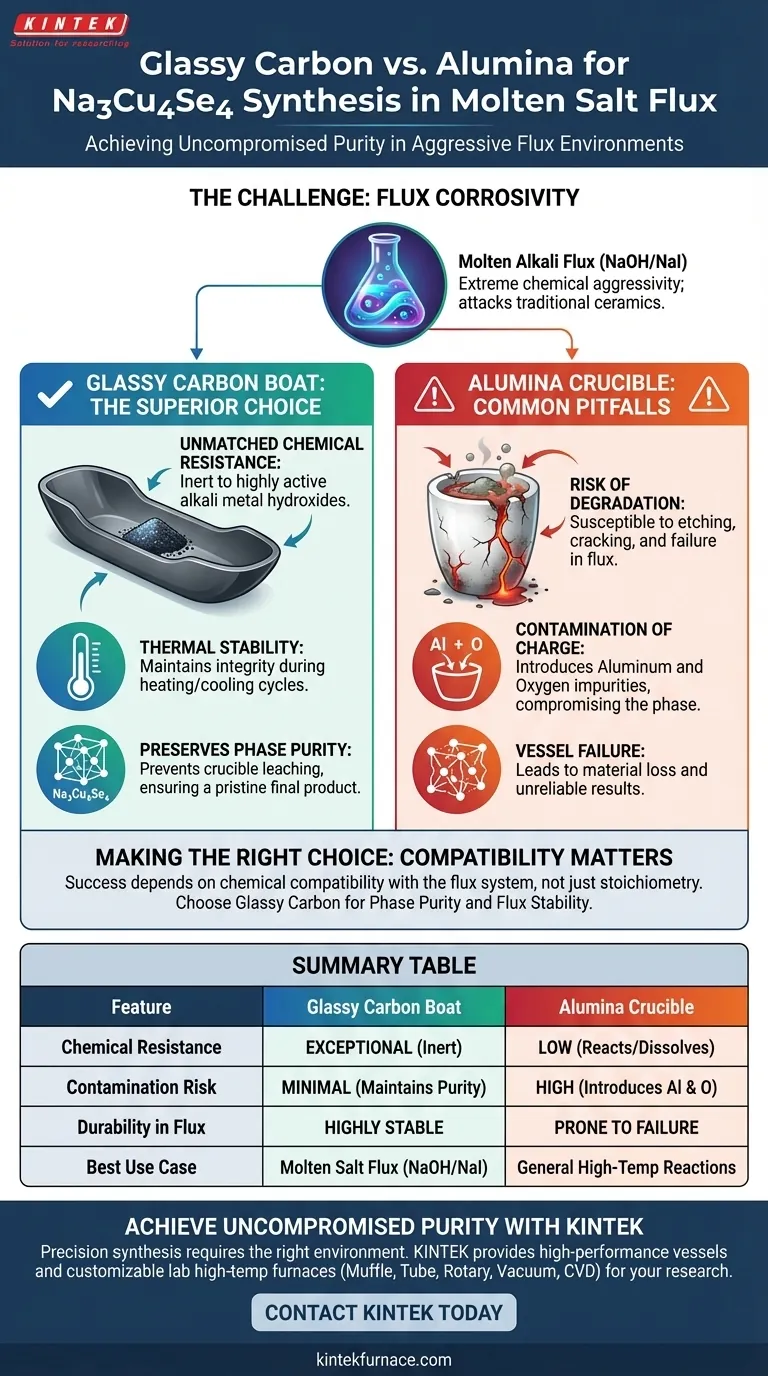
The preference for a glassy carbon boat over standard alumina crucibles is dictated by the extreme chemical corrosivity of the alkali metal hydroxide-sodium iodide flux used in this synthesis. While alumina is sufficient for many reactions, it degrades rapidly when exposed to this specific highly active molten salt mixture. Glassy carbon provides the necessary chemical inertness to prevent the vessel from reacting with the flux and contaminating the final product.

The synthesis of Na3Cu4Se4 relies on maintaining a chemically pristine environment amidst a highly aggressive flux. Glassy carbon is the critical enabler, offering superior chemical resistance that prevents crucible degradation and ensures the phase purity of the final material.
Why is a glassy carbon boat preferred over an alumina crucible for Na3Cu4Se4? Ensuring Phase Purity in Flux Synthesis

The Challenge of Flux Corrosivity

Understanding the Reaction Environment

The synthesis of the Na3Cu4Se4 phase utilizes a specific alkali metal hydroxide-sodium iodide mixed molten salt flux.

This mixture creates a highly active chemical environment that is far more aggressive than standard solid-state reactions.

The Vulnerability of Ceramics

Traditional ceramic materials, such as alumina (aluminum oxide) or porcelain, are generally susceptible to attack by strong alkali fluxes.

When these crucibles are exposed to the molten hydroxide mixture, the container walls begin to dissolve or react chemically with the flux.

Why Glassy Carbon is Superior

Unmatched Chemical Resistance

Glassy carbon is distinct from standard ceramics because it possesses superior chemical resistance to corrosive salts.

It remains inert even when in direct contact with the highly active alkali metal hydroxide flux.

Thermal Stability

In addition to chemical inertness, glassy carbon offers excellent thermal stability at the temperatures required for this synthesis.

This ensures the boat maintains its structural integrity throughout the heating and cooling cycles of the flux method.

Preserving Phase Purity

The ultimate goal of using glassy carbon is to protect the integrity of the Na3Cu4Se4 phase.

By using a material that does not leach into the melt, you ensure the final product remains free from impurities derived from the container.

Common Pitfalls to Avoid

The Risk of Crucible Degradation

Attempting this synthesis in an alumina or porcelain crucible is a common error that leads to vessel failure.

The corrosive flux will etch the crucible, potentially causing it to crack or leak during the procedure.

Contamination of the Charge

The most significant downside of using the wrong vessel is chemical contamination.

As an alumina crucible degrades, aluminum and oxygen atoms are introduced into the molten flux, compromising the purity of the charge-unbalanced Na3Cu4Se4 phase.

Making the Right Choice for Your Goal

Selecting the correct reaction vessel is not a matter of cost, but of chemical compatibility with your specific flux system.

  • If your primary focus is Phase Purity: Use glassy carbon to ensure no foreign elements leach from the crucible into your crystal lattice.
  • If your primary focus is Flux Stability: Avoid oxide-based ceramics (like alumina) whenever working with aggressive alkali metal hydroxide fluxes to prevent reaction leaks.

The success of a molten salt synthesis often depends as much on the inertness of the container as it does on the stoichiometry of the reagents.

Summary Table:

Feature Glassy Carbon Boat Alumina Crucible
Chemical Resistance Exceptional; inert to alkali hydroxides Low; reacts with and dissolves in flux
Contamination Risk Minimal; maintains phase purity High; introduces Al and O impurities
Durability in Flux Highly stable and long-lasting Prone to etching, cracking, and leaking
Best Use Case Molten salt flux (NaOH/NaI) systems General high-temp solid-state reactions

Achieve Uncompromised Material Purity with KINTEK

Precision in material synthesis starts with the right environment. Whether you are performing complex molten salt flux reactions or high-temperature sintering, KINTEK provides the high-performance vessels and equipment your research demands. Backed by expert R&D and manufacturing, KINTEK offers Muffle, Tube, Rotary, Vacuum, and CVD systems, along with specialized lab high-temp furnaces—all fully customizable to meet your unique chemical compatibility and thermal requirements.

Don't let crucible degradation compromise your results. Contact KINTEK today to discuss your specific needs with our technical team and discover how our advanced lab solutions can enhance your lab's efficiency and ensure the success of your most challenging synthesis projects.

Visual Guide
Why is a glassy carbon boat preferred over an alumina crucible for Na3Cu4Se4? Ensuring Phase Purity in Flux Synthesis Visual Guide

References

  1. С.А. Новиков, Vladislav V. Klepov. Structural evolution and bonding features of electron deficient copper chalcogenides. DOI: 10.1039/d5ce00479a

This article is also based on technical information from Kintek Furnace Knowledge Base .

Related Products

People Also Ask

Related Products

1400℃ High Temperature Laboratory Tube Furnace with Quartz and Alumina Tube

1400℃ High Temperature Laboratory Tube Furnace with Quartz and Alumina Tube

KINTEK's Tube Furnace with Alumina Tube: Precision high-temperature processing up to 2000°C for labs. Ideal for material synthesis, CVD, and sintering. Customizable options available.

1400℃ Muffle Oven Furnace for Laboratory

1400℃ Muffle Oven Furnace for Laboratory

KT-14M Muffle Furnace: Precision 1400°C heating with SiC elements, PID control, and energy-efficient design. Ideal for labs.

1700℃ High Temperature Muffle Oven Furnace for Laboratory

1700℃ High Temperature Muffle Oven Furnace for Laboratory

KT-17M Muffle Furnace: High-precision 1700°C lab furnace with PID control, energy efficiency, and customizable sizes for industrial & research applications.

Molybdenum Disilicide MoSi2 Thermal Heating Elements for Electric Furnace

Molybdenum Disilicide MoSi2 Thermal Heating Elements for Electric Furnace

High-performance MoSi2 heating elements for labs, reaching 1800°C with superior oxidation resistance. Customizable, durable, and reliable for high-temperature applications.

1400℃ Controlled Inert Nitrogen Atmosphere Furnace

1400℃ Controlled Inert Nitrogen Atmosphere Furnace

KT-14A Controlled Atmosphere Furnace for labs & industry. 1400°C max temp, vacuum sealing, inert gas control. Customizable solutions available.

High Temperature Muffle Oven Furnace for Laboratory Debinding and Pre Sintering

High Temperature Muffle Oven Furnace for Laboratory Debinding and Pre Sintering

KT-MD Debinding & Pre-Sintering Furnace for ceramics - precise temperature control, energy-efficient design, customizable sizes. Boost your lab efficiency today!

1700℃ High Temperature Laboratory Tube Furnace with Quartz or Alumina Tube

1700℃ High Temperature Laboratory Tube Furnace with Quartz or Alumina Tube

KINTEK's Tube Furnace with Alumina Tube: Precision heating up to 1700°C for material synthesis, CVD, and sintering. Compact, customizable, and vacuum-ready. Explore now!

Laboratory Muffle Oven Furnace with Bottom Lifting

Laboratory Muffle Oven Furnace with Bottom Lifting

Boost lab efficiency with KT-BL Bottom Lifting Furnace: precise 1600℃ control, superior uniformity, and enhanced productivity for material science and R&D.

1200℃ Split Tube Furnace Laboratory Quartz Tube Furnace with Quartz Tube

1200℃ Split Tube Furnace Laboratory Quartz Tube Furnace with Quartz Tube

Discover KINTEK's 1200℃ Split Tube Furnace with quartz tube for precise high-temperature lab applications. Customizable, durable, and efficient. Get yours now!

High Pressure Laboratory Vacuum Tube Furnace Quartz Tubular Furnace

High Pressure Laboratory Vacuum Tube Furnace Quartz Tubular Furnace

KINTEK High Pressure Tube Furnace: Precision heating up to 1100°C with 15Mpa pressure control. Ideal for sintering, crystal growth, and lab research. Customizable solutions available.

CF KF Flange Vacuum Electrode Feedthrough Lead Sealing Assembly for Vacuum Systems

CF KF Flange Vacuum Electrode Feedthrough Lead Sealing Assembly for Vacuum Systems

Reliable CF/KF flange vacuum electrode feedthrough for high-performance vacuum systems. Ensures superior sealing, conductivity & durability. Customizable options available.

Molybdenum Vacuum Heat Treat Furnace

Molybdenum Vacuum Heat Treat Furnace

High-performance molybdenum vacuum furnace for precise 1400°C heat treatment. Ideal for sintering, brazing, and crystal growth. Durable, efficient, and customizable.

Vacuum Hot Press Furnace Machine Heated Vacuum Press Tube Furnace

Vacuum Hot Press Furnace Machine Heated Vacuum Press Tube Furnace

Discover KINTEK's advanced Vacuum Tube Hot Press Furnace for precise high-temperature sintering, hot pressing, and material bonding. Customizable solutions for labs.

Vacuum Heat Treat Furnace with Ceramic Fiber Liner

Vacuum Heat Treat Furnace with Ceramic Fiber Liner

KINTEK's Vacuum Furnace with Ceramic Fiber Lining offers precise high-temperature processing up to 1700°C, ensuring uniform heat distribution and energy efficiency. Ideal for labs and production.

2200 ℃ Graphite Vacuum Heat Treat Furnace

2200 ℃ Graphite Vacuum Heat Treat Furnace

2200℃ Graphite Vacuum Furnace for high-temperature sintering. Precise PID control, 6*10⁻³Pa vacuum, durable graphite heating. Ideal for research & production.

Silicon Carbide SiC Thermal Heating Elements for Electric Furnace

Silicon Carbide SiC Thermal Heating Elements for Electric Furnace

High-performance SiC heating elements for labs, offering 600-1600°C precision, energy efficiency, and long lifespan. Customizable solutions available.

1700℃ Controlled Inert Nitrogen Atmosphere Furnace

1700℃ Controlled Inert Nitrogen Atmosphere Furnace

KT-17A Controlled Atmosphere Furnace: Precise 1700°C heating with vacuum & gas control. Ideal for sintering, research & material processing. Explore now!

Vacuum Heat Treat Sintering Furnace Molybdenum Wire Vacuum Sintering Furnace

Vacuum Heat Treat Sintering Furnace Molybdenum Wire Vacuum Sintering Furnace

KINTEK's Vacuum Molybdenum Wire Sintering Furnace excels in high-temperature, high-vacuum processes for sintering, annealing, and material research. Achieve precise 1700°C heating with uniform results. Custom solutions available.

1200℃ Controlled Inert Nitrogen Atmosphere Furnace

1200℃ Controlled Inert Nitrogen Atmosphere Furnace

KINTEK 1200℃ Controlled Atmosphere Furnace: Precision heating with gas control for labs. Ideal for sintering, annealing, and material research. Customizable sizes available.

Ultra High Vacuum CF Flange Stainless Steel Sapphire Glass Observation Sight Window

Ultra High Vacuum CF Flange Stainless Steel Sapphire Glass Observation Sight Window

CF sapphire viewing window for ultra-high vacuum systems. Durable, clear, and precise for semiconductor and aerospace applications. Explore specs now!


Leave Your Message