
Nickel crucibles provide superior chemical stability when working with molten alkalis at high temperatures. Their primary advantage lies in their outstanding corrosion resistance against potassium hydroxide (KOH) at temperatures up to 700°C, a condition that typically degrades other crucible materials.
Core Takeaway The critical value of a nickel crucible is its ability to maintain structural integrity in molten alkali, thereby preventing metal ions from leaching into your sample. This isolation is essential for synthesizing high-purity nitrogen-doped porous carbon with reliable electrochemical properties.
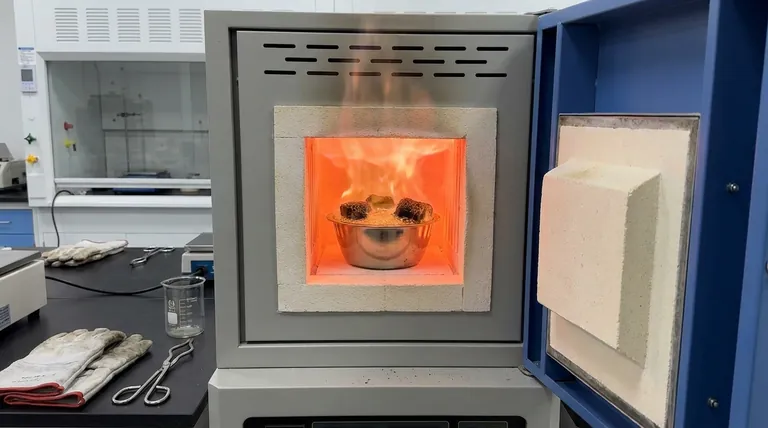
The Mechanics of Alkaline Resistance
Withstanding Extreme Chemical Aggression
Potassium hydroxide (KOH) becomes an aggressively corrosive agent when it transitions to a molten state. Nickel exhibits outstanding resistance to this specific form of chemical attack.
Stability at Elevated Temperatures
The activation process often requires temperatures reaching 700°C to be effective. Nickel retains its resilience at this thermal threshold, resisting the erosion that typically compromises standard laboratory vessels during alkali fusion.
Ensuring Sample Purity
Preventing Material Contamination
The most significant risk during high-temperature activation is the introduction of impurities. When a crucible degrades, it sheds metal ions into the reaction mixture. Nickel’s resistance effectively eliminates this erosion, ensuring the reaction occurs in a pure environment.
Protecting Sensitive Precursors
The reference highlights the synthesis of nitrogen-doped porous carbon. Contaminants in this process can alter the pore structure or surface chemistry. Using nickel ensures the final carbon material remains chemically distinct and free of foreign metal artifacts.
Preserving Electrochemical Performance
The Impact on Final Application
For materials intended for electrochemical applications—such as supercapacitors or batteries—purity is paramount. Impurities act as defect sites that can degrade conductivity or capacitance.
Consistency of Results
By preventing the leaching of impurities, nickel crucibles ensure that the electrochemical performance of the synthesized material reflects its true properties, rather than the interference of contaminants.
Common Pitfalls to Avoid
The Risk of Alternative Materials
A common mistake in alkaline activation is assuming standard ceramic or glass vessels can withstand molten KOH. These materials often react with the alkali, leading to vessel failure and catastrophic sample contamination.
Specificity of Application
While nickel is excellent for resisting molten alkali, it is a specialized tool. Its "outstanding" rating is specific to strong alkaline environments; this implies that the choice of crucible must always be matched strictly to the chemical pH of your activation agent.
Making the Right Choice for Your Goal
To ensure the success of your activation process, apply the following guidelines:
- If your primary focus is High-Temperature Activation (700°C): Rely on nickel to withstand the aggressive combination of thermal stress and molten chemical attack.
- If your primary focus is Electrochemical Integrity: Use nickel to prevent metal leaching that will negatively skew the performance data of your porous carbon material.
Choosing the correct vessel is not just about safety; it is the baseline requirement for accurate, reproducible scientific data.
Summary Table:
| Feature | Nickel Crucible Performance | Benefit for KOH Activation |
|---|---|---|
| Chemical Stability | Outstanding resistance to molten alkalis | Prevents vessel degradation and failure |
| Temperature Limit | Resilient up to 700°C | Ideal for carbon activation processes |
| Sample Purity | Zero leaching of metal ions | Maintains electrochemical integrity |
| Corrosion Type | High resistance to molten KOH | Eliminates contamination in porous carbon |
Elevate Your Lab Research with KINTEK Quality
Precision in high-temperature activation starts with the right equipment. KINTEK provides high-performance laboratory solutions backed by expert R&D and manufacturing. Whether you need specialized nickel crucibles or advanced Muffle, Tube, Rotary, Vacuum, and CVD systems, our products are fully customizable to meet your unique scientific needs.
Don't let material contamination compromise your electrochemical data. Trust KINTEK for durable, high-purity laboratory hardware designed for extreme environments.
Contact Our Experts Today to Discuss Your Custom Solution
References
- Y. Bai, Shicheng Zhang. In Situ, Nitrogen-Doped Porous Carbon Derived from Mixed Biomass as Ultra-High-Performance Supercapacitor. DOI: 10.3390/nano14161368
This article is also based on technical information from Kintek Furnace Knowledge Base .
Related Products
- High Temperature Muffle Oven Furnace for Laboratory Debinding and Pre Sintering
- Small Vacuum Heat Treat and Tungsten Wire Sintering Furnace
- 1200℃ Controlled Inert Nitrogen Atmosphere Furnace
- Vertical Laboratory Quartz Tube Furnace Tubular Furnace
- Controlled Inert Nitrogen Hydrogen Atmosphere Furnace
People Also Ask
- What thermal phenomena occur during polymer binder burnout in ceramic green bodies? Lab Furnace Guide
- What role does a high-temperature muffle furnace play in STFO synthesis? Achieve Pure Perovskite Results
- Why is controlled heat treatment in a muffle furnace necessary for calcined clay? Achieve Optimal Pozzolanic Activity
- How does a high-temperature muffle furnace facilitate the formation of LaNbxAl1−xO3+δ perovskite structures? Key Roles
- What role does a high-temperature muffle furnace play in the multi-stage synthesis of Li0.5MnFe1.5O4? Key to Pure Spinel



















