
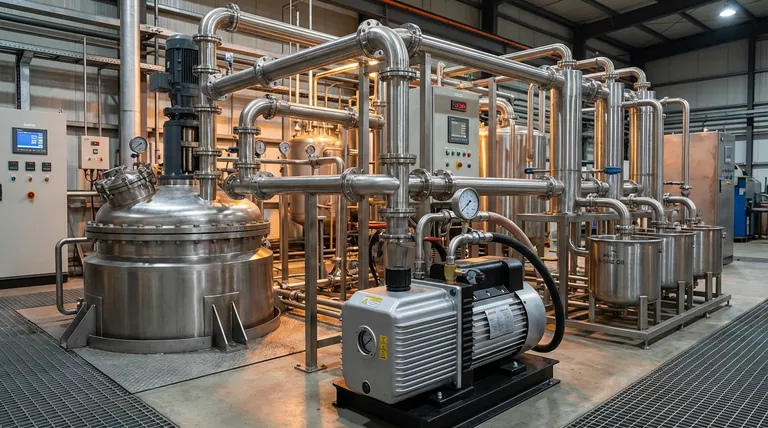
A vacuum pump system acts as the central pressure regulator within a plastic pyrolysis setup. Its primary purpose is to lower the atmospheric pressure inside the reactor, which significantly reduces the temperature required to crack plastic molecules and accelerates the transfer of oil gas into the cooling system.
By maintaining a controlled negative pressure environment, the vacuum system allows for pyrolysis to occur at lower temperatures while ensuring that gaseous products are extracted and condensed more efficiently.
Thermal Dynamics and Energy Efficiency
Lowering the Cracking Temperature
The fundamental benefit of the vacuum pump is the manipulation of atmospheric pressure. By lowering the pressure inside the reactor, the system alters the physical properties of the plastic feedstock.
This pressure reduction lowers the boiling and cracking points of the plastic molecules. Consequently, the pyrolysis process can occur at a significantly reduced temperature compared to a system operating at standard atmospheric pressure.
Reducing Energy Consumption
Because the plastic breaks down at lower temperatures, the heating requirements for the reactor are decreased.
This direct correlation between pressure and temperature results in better energy efficiency for the overall operation.
Optimizing Process Flow and Recovery
Accelerating Gas Extraction
Beyond temperature control, the vacuum pump plays a vital role in the movement of materials. It creates a suction force that facilitates the rapid movement of gaseous products out of the reactor.
Without this active extraction, gases might linger in the reactor, potentially leading to inefficiencies. The vacuum ensures a continuous, smooth flow from the heating zone to the downstream components.
Improving Collection Efficiency
The system directs these gases immediately into the cooling section.
By ensuring the gas moves quickly to the condenser, the system significantly improves condensation and collection efficiency. This results in a more effective recovery of the final liquid oil product.
Operational Considerations
The Necessity of Control
While the benefits are clear, the reference highlights that this is a "controlled vacuum environment." This implies that the vacuum level must be precisely regulated, not just maximized blindly.
System Interdependence
The vacuum pump does not operate in isolation; it is deeply integrated with the cooling and collection systems. A failure in the vacuum pump directly impacts the thermal requirements and the yield collection, making it a critical point of failure that requires consistent maintenance.
Maximizing Pyrolysis Efficiency
To determine how to best utilize a vacuum system in your setup, consider your primary operational metrics:
- If your primary focus is energy conservation: Utilize the vacuum system to lower internal pressure, allowing you to run the reactor at lower temperatures and reduce fuel consumption.
- If your primary focus is production speed and yield: Optimize the vacuum flow to ensure the rapid evacuation of gases into the cooling system for maximum condensation efficiency.
Integrating a vacuum pump transforms the pyrolysis process from a passive thermal treatment into a highly controlled, efficient production cycle.
Summary Table:
| Feature | Impact on Pyrolysis | Key Benefit |
|---|---|---|
| Pressure Regulation | Lowers internal atmospheric pressure | Reduces cracking temperature required |
| Thermal Dynamics | Decreases heating requirements | Significant energy savings |
| Gas Extraction | Creates active suction force | Prevents gas stagnation in the reactor |
| Condensation | Accelerates gas flow to cooling system | Improves liquid oil collection efficiency |
Elevate Your Pyrolysis Performance with KINTEK
Maximize your production efficiency and ensure precise process control with high-performance vacuum integration. Backed by expert R&D and manufacturing, KINTEK offers specialized vacuum systems, Muffle, Tube, Rotary, and CVD furnaces, all customizable to meet your unique laboratory or industrial needs. Our technical experts are ready to help you optimize your setup for superior yield and energy conservation.
Contact KINTEK today to discuss your custom solution
References
- José Alfredo Torres Tovar, Francisco Javier Sánchez-Ruíz. Degradation of Plastic Materials through Small-Scale Pyrolysis: Characterization of the Obtained Hydrocarbons and Life Cycle Analysis. DOI: 10.3390/recycling9010005
This article is also based on technical information from Kintek Furnace Knowledge Base .
Related Products
- Electric Rotary Kiln Continuous Working Small Rotary Furnace Kiln for Pyrolysis Plant Heating
- Electric Rotary Kiln Pyrolysis Furnace Plant Machine Small Rotary Kiln Calciner
- Vacuum Induction Melting Furnace
People Also Ask
- What are the advantages of electric rotary kilns compared to fuel-fired ones? Boost Precision and Efficiency in Your Process
- What materials can be processed in an electric rotary kiln? Versatile Solutions for Advanced Materials
- What advantages do electric rotary kilns offer over fuel-based kilns? Boost Efficiency and Purity in Your Process
- What are the primary applications of electric rotary kilns? Precision Thermal Processing for High-Value Materials
- How do electric rotary kilns achieve high thermal efficiency? Unlock Over 95% Thermal Efficiency


