
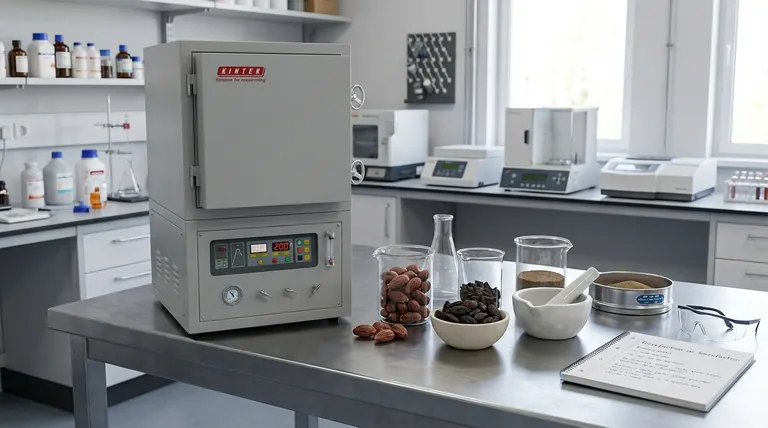
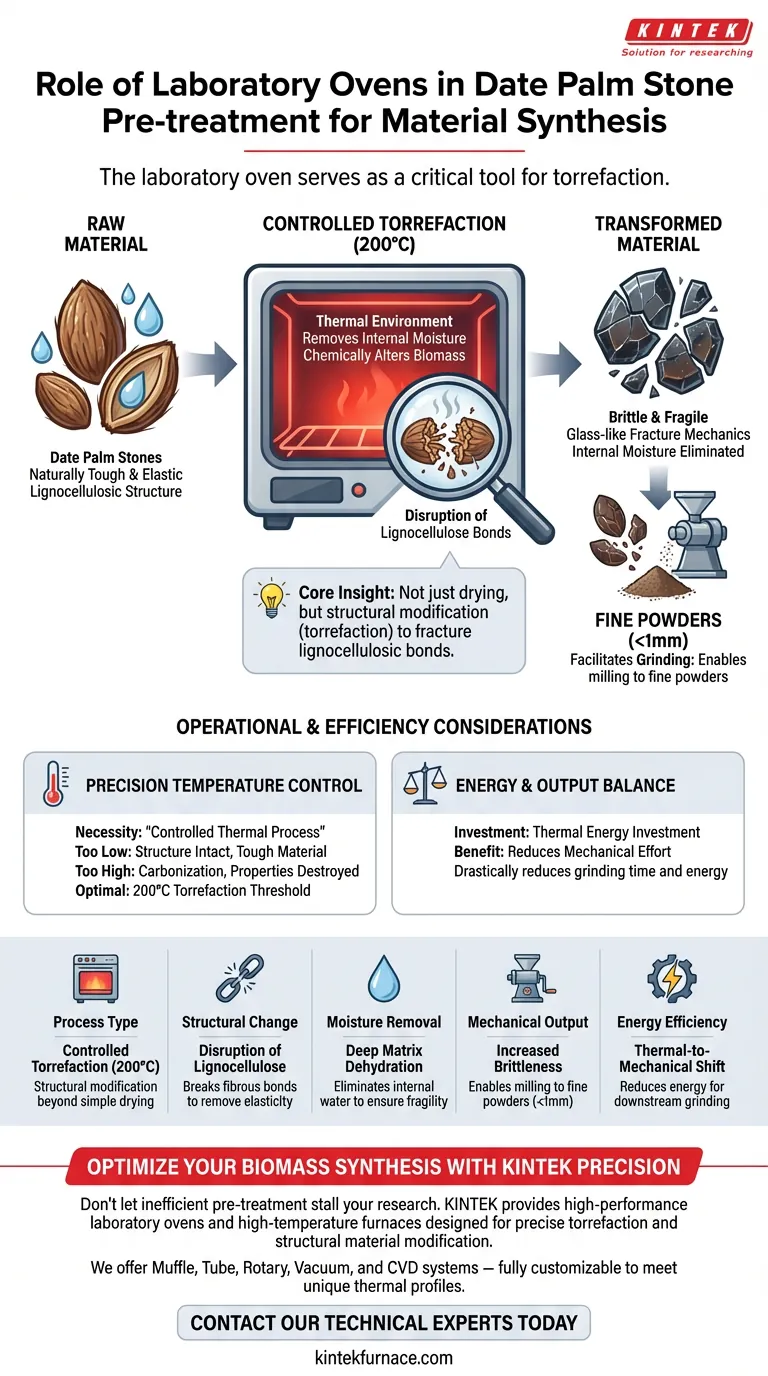
The laboratory oven serves as a critical tool for torrefaction in the pre-treatment of Date Palm Stones.
By subjecting the raw stones to a controlled thermal environment of approximately 200°C, the oven removes internal moisture and chemically alters the biomass. This process converts the naturally tough date stone into a brittle material, which is a prerequisite for effective mechanical grinding.
Core Insight While simple drying removes water, the laboratory oven in this context performs a structural modification known as torrefaction. This step is essential not just for dehydration, but for fracturing the material's lignocellulosic bonds to ensure it can be pulverized into fine powders later in the process.
The Mechanism of Thermal Pre-treatment
Controlled Torrefaction
The laboratory oven is not merely used for drying; it is utilized to induce torrefaction.
This is a mild form of pyrolysis carried out at specific temperatures, such as 200°C.
It creates a thermal environment that goes beyond surface evaporation to fundamentally alter the state of the raw material.
Disruption of Lignocellulose
Date Palm Stones are naturally composed of a rigid lignocellulosic structure.
The thermal treatment provided by the oven partially disrupts this structure.
By breaking down these internal fibrous bonds, the material loses its inherent elasticity and toughness.
Elimination of Internal Moisture
The process ensures the complete removal of internal moisture trapped deep within the stone's matrix.
This is distinct from surface drying, as it prevents the material from remaining pliable due to retained water content.
Impact on Downstream Processing
Increasing Brittleness
The primary outcome of this oven treatment is a significant increase in brittleness.
Raw date stones are hard and fibrous, making them difficult to crush.
Post-treatment, the stones become fragile and glass-like in their fracture mechanics.
Facilitating Grinding
This induced brittleness is the key enabler for the grinding stage.
Without thermal pre-treatment, grinding equipment would struggle to reduce the tough biomass efficiently.
The oven treatment allows the material to be easily milled into fine powders with particle sizes below 1mm.
Operational Considerations
The Necessity of Temperature Control
The process relies on a "controlled thermal process."
If the temperature is too low, the lignocellulosic structure will remain intact, resulting in a tough material that resists grinding.
If the temperature is too high (uncontrolled), you risk full carbonization or ashing, which destroys the desired organic synthesis properties.
Balancing Energy and Output
The use of the oven represents an energy investment to save mechanical effort later.
Investing thermal energy during pre-treatment drastically reduces the mechanical energy and time required to grind the stones to the necessary fineness.
Making the Right Choice for Your Goal
To maximize the efficiency of your material synthesis from Date Palm Stones, consider your specific processing requirements.
- If your primary focus is Ease of Comminution (Grinding): Ensure the oven reaches the full 200°C torrefaction threshold to maximize brittleness and minimize wear on grinding equipment.
- If your primary focus is Particle Size Uniformity: rigorous thermal pre-treatment is required to prevent fibrous strands from contaminating your <1mm powder fraction.
Thermal pre-treatment is not an optional drying step; it is a structural preparation that defines the quality of your final powder.
Summary Table:
| Feature | Role in Pre-treatment | Impact on Material Synthesis |
|---|---|---|
| Process Type | Controlled Torrefaction (200°C) | Structural modification beyond simple drying |
| Structural Change | Disruption of Lignocellulose | Breaks fibrous bonds to remove elasticity |
| Moisture Removal | Deep Matrix Dehydration | Eliminates internal water to ensure fragility |
| Mechanical Output | Increased Brittleness | Enables milling to fine powders (<1mm) |
| Energy Efficiency | Thermal-to-Mechanical Shift | Reduces energy required for downstream grinding |
Optimize Your Biomass Synthesis with KINTEK Precision
Don't let inefficient pre-treatment stall your research. KINTEK provides high-performance laboratory ovens and high-temperature furnaces designed for precise torrefaction and structural material modification.
Backed by expert R&D and world-class manufacturing, we offer Muffle, Tube, Rotary, Vacuum, and CVD systems—all fully customizable to meet the unique thermal profiles required for date palm stone processing and material synthesis.
Ready to achieve superior particle uniformity and grinding efficiency? Contact our technical experts today to find the perfect thermal solution for your lab's unique needs!
Visual Guide
References
- Shaimaa K. Mohamed, Rasha M. Kamel. Efficient and low-cost mesoporous magnetic carbon composites derived from date palm stones for environmental remediation of hexavalent chromium. DOI: 10.1007/s10934-024-01611-x
This article is also based on technical information from Kintek Furnace Knowledge Base .
Related Products
- Laboratory Muffle Oven Furnace with Bottom Lifting
- 1200℃ Muffle Oven Furnace for Laboratory
- 1400℃ Muffle Oven Furnace for Laboratory
- 1800℃ High Temperature Muffle Oven Furnace for Laboratory
- 1700℃ High Temperature Muffle Oven Furnace for Laboratory
People Also Ask
- Why is a high-temperature muffle furnace required for FeOx-MOx/TiO2? Engineering High-Performance Nanocomposites
- What is the importance of the calcination process? Master High-Purity Calcium Phosphate Nanopowder Production
- Why is a high-temperature laboratory muffle furnace essential for the alkali fusion process in zeolite synthesis?
- What function does a muffle furnace perform in Ba0.75Ca0.25TiO3 calcination? Ensure Phase Purity & Synthesis
- What are the primary functions of a high-temperature laboratory muffle furnace in the preparation of biosorbent materials?

















