
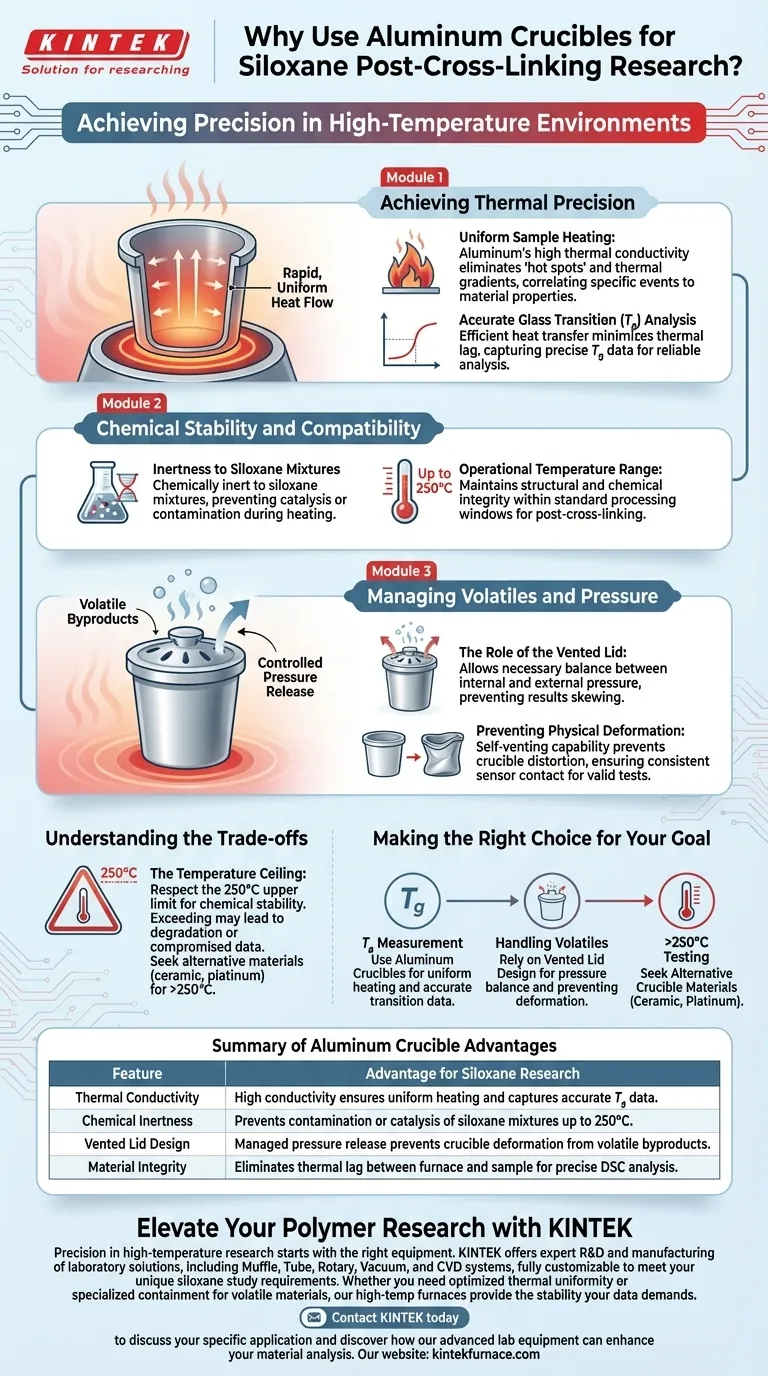
Aluminum crucibles differ significantly from other containment options by offering a precise balance of thermal efficiency and chemical inertness essential for accurate polymer analysis. For post-cross-linking research of siloxane materials, they provide superior thermal conductivity for uniform heating and maintain chemical stability up to 250 °C without reacting with the sample mixture.
Core Takeaway: By combining high thermal conductivity with a vented lid design, aluminum crucibles ensure uniform heating and effective pressure management, resulting in highly accurate glass transition temperature ($T_g$) data for siloxane materials.
Achieving Thermal Precision
Uniform Sample Heating
In Differential Scanning Calorimetry (DSC) and static heat treatments, temperature gradients within a sample can skew data.
Aluminum provides excellent thermal conductivity, ensuring that heat flows quickly and evenly throughout the crucible.
This uniformity eliminates "hot spots" in the siloxane mixture, allowing the researcher to correlate specific thermal events directly to the material's properties rather than experimental artifacts.
Accurate Glass Transition Analysis
The precision of thermal data relies heavily on how the crucible interacts with the heat source.
Because aluminum transfers heat so efficiently, it minimizes thermal lag between the furnace and the sample.
This efficiency is critical for capturing accurate glass transition temperature ($T_g$) data, which is often the primary metric in post-cross-linking research.
Chemical Stability and Compatibility
Inertness to Siloxane Mixtures
Material research requires a container that will not chemically alter the substance being tested.
Aluminum crucibles are chemically inert regarding siloxane mixtures, meaning they will not catalyze unwanted reactions or contaminate the sample during heating.
This neutrality ensures that the observed cross-linking behaviors are intrinsic to the polymer and not influenced by the container material.
Operational Temperature Range
While metals can degrade under stress, aluminum maintains its structural and chemical integrity in specific thermal windows.
These crucibles remain chemically stable at temperatures up to 250 °C.
This range covers the standard processing and testing temperatures for most siloxane post-cross-linking studies.
Managing Volatiles and Pressure
The Role of the Vented Lid
Siloxane curing and cross-linking can release volatile byproducts that build pressure inside a sealed container.
Aluminum crucibles featuring a vented lid design allow for the necessary balance between internal and external pressure.
This venting mechanism allows volatiles to escape in a controlled manner, preventing pressure buildup that could otherwise skew results.
Preventing Physical Deformation
If pressure is not managed, the crucible itself can distort, breaking contact with the sensor or altering the sample geometry.
The self-venting capability prevents crucible deformation caused by these volatile components.
By maintaining its shape, the crucible ensures consistent contact with the thermal sensors, preserving the validity of the test.
Understanding the Trade-offs
The Temperature Ceiling
While aluminum is highly effective for standard polymer research, it has a distinct thermal limit.
You must respect the 250 °C upper limit for chemical stability mentioned in standard protocols.
Exceeding this temperature may lead to crucible degradation or reactions that could compromise the siloxane data.
Making the Right Choice for Your Goal
To ensure your research yields valid, reproducible results, select your equipment based on your specific experimental parameters.
- If your primary focus is accurate $T_g$ measurement: Use aluminum crucibles to ensure uniform heating and eliminate thermal gradients that skew transition data.
- If your primary focus is handling volatiles: Rely on the vented lid design to balance pressure and prevent mechanical deformation of the sample pan.
- If your primary focus is high-temperature testing (>250 °C): You must seek alternative crucible materials (such as ceramic or platinum), as aluminum is no longer chemically stable beyond this point.
Selecting the correct crucible ensures that your data reflects the true properties of the siloxane, not the limitations of your hardware.
Summary Table:
| Feature | Advantage for Siloxane Research |
|---|---|
| Thermal Conductivity | High conductivity ensures uniform heating and captures accurate $T_g$ data. |
| Chemical Inertness | Prevents contamination or catalysis of siloxane mixtures up to 250 °C. |
| Vented Lid Design | Managed pressure release prevents crucible deformation from volatile byproducts. |
| Material Integrity | Eliminates thermal lag between furnace and sample for precise DSC analysis. |
Elevate Your Polymer Research with KINTEK
Precision in high-temperature research starts with the right equipment. Backed by expert R&D and manufacturing, KINTEK offers a wide range of laboratory solutions, including Muffle, Tube, Rotary, Vacuum, and CVD systems, all fully customizable to meet your unique siloxane study requirements.
Whether you need optimized thermal uniformity or specialized containment for volatile materials, our high-temp furnaces provide the stability your data demands. Contact KINTEK today to discuss your specific application and discover how our advanced lab equipment can enhance your material analysis.
Visual Guide
References
- Max Briesenick, Guido Kickelbick. Thermal Post-Cross-Linking of Siloxane/Silsesquioxane Hybrids with Polycyclic Aromatic Units for Tailored Softening Behavior in High-Temperature Applications. DOI: 10.3390/molecules30173532
This article is also based on technical information from Kintek Furnace Knowledge Base .
Related Products
- High Temperature Muffle Oven Furnace for Laboratory Debinding and Pre Sintering
- 1400℃ High Temperature Laboratory Tube Furnace with Alumina Tube
- Vertical Laboratory Quartz Tube Furnace Tubular Furnace
- 1700℃ High Temperature Laboratory Tube Furnace with Alumina Tube
- 1700℃ High Temperature Muffle Oven Furnace for Laboratory
People Also Ask
- What thermal phenomena occur during polymer binder burnout in ceramic green bodies? Lab Furnace Guide
- What role does a high-temperature muffle furnace play in STFO synthesis? Achieve Pure Perovskite Results
- Why is controlled heat treatment in a muffle furnace necessary for calcined clay? Achieve Optimal Pozzolanic Activity
- How does a high-temperature muffle furnace facilitate the formation of LaNbxAl1−xO3+δ perovskite structures? Key Roles
- What role does a high-temperature muffle furnace play in the formation of biochar catalysts? Master Catalyst Synthesis



















