
In the world of advanced materials, few components are as foundational yet critical as the quartz tube. Quartz tubes are indispensable because they uniquely combine three properties: exceptional resistance to extreme temperatures, high chemical inertness that prevents corrosion and contamination, and remarkable purity. This triad of characteristics makes them essential in demanding fields where process integrity is non-negotiable, including semiconductor manufacturing, industrial processing, and scientific research.
The value of quartz is not found in a single property, but in the powerful combination of thermal, chemical, and optical stability. This makes it one of the few materials that can maintain its integrity in environments where nearly any other material would fail, degrade, or contaminate a critical process.
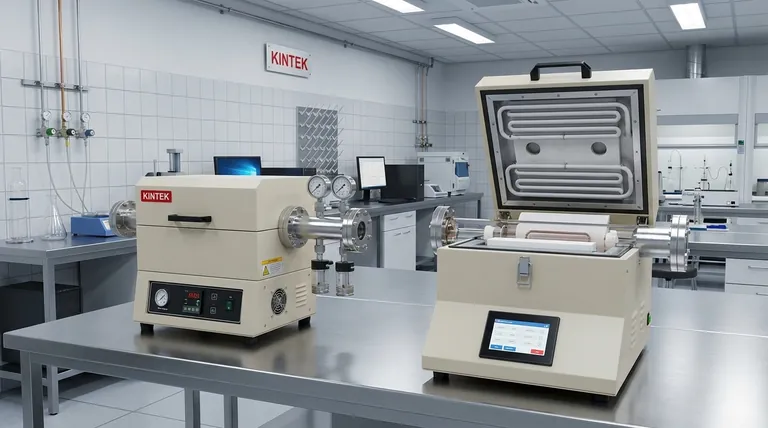
The Core Properties That Define Quartz
The utility of a quartz tube stems from a unique set of physical and chemical characteristics that allow it to perform under conditions that would destroy lesser materials.
Extreme Thermal Resistance
Quartz can withstand continuous operating temperatures well over 1000°C and endure severe thermal shock—rapid changes in temperature—without cracking. This makes it an ideal protective shield for sensitive instruments like thermocouples in high-temperature furnaces.
Unmatched Chemical Purity and Inertness
High-purity fused quartz is one of the purest materials manufactured today. It is highly resistant to acids, neutral solutions, and other corrosive chemicals, ensuring that the tube itself does not react with or contaminate the process it contains. This is why it is used for vessels like quartz boats, which hold delicate silicon wafers during manufacturing.
Superior Optical Clarity
Quartz tubes are transparent from the ultraviolet through the visible and into the infrared spectrums. This clarity allows for the visual monitoring of processes inside the tube, making them perfect for use as sight glasses or level gauges in industrial reactors where direct observation is necessary.
Where These Properties Become Mission-Critical
In many advanced technology sectors, the properties of quartz are not just beneficial; they are enabling. Without it, many modern processes would be unreliable or impossible.
In Semiconductor Manufacturing
The production of microchips demands an environment of absolute purity. Any microscopic contaminant can ruin an entire batch of wafers. Quartz tubes form the process chambers for high-temperature deposition and etching steps, guaranteeing that no impurities leach from the container into the silicon.
In High-Temperature Industrial Processes
Industries rely on quartz to handle extreme heat and harsh chemicals simultaneously. It serves as a protective sleeve for sensors, a durable liner for reactors, and a structurally sound component in vacuum systems, where its low thermal expansion and strength are critical.
In Scientific and Laboratory Settings
For researchers, quartz provides a clean and non-reactive environment for experiments. Whether containing a chemical reaction or holding a sample for high-temperature analysis, its inertness ensures that the results are a product of the experiment, not the container.
Understanding the Practical and Economic Advantages
Beyond its core scientific properties, quartz offers tangible operational benefits that make it a strategic choice.
Durability and Longevity
Quartz is a hard, durable material that is highly resistant to surface wear and abrasion. This toughness means a longer operational life and less frequent replacement compared to other materials.
Lower Operational Costs
The exceptionally smooth surface of a quartz tube minimizes the buildup of residue from chemical processes. This translates directly to reduced downtime for cleaning and maintenance, leading to lower overall operational costs and higher productivity.
Structural Integrity
Even under high vacuum conditions, quartz tubes maintain their structural integrity without deforming or outgassing—the release of trapped gases that can ruin a vacuum. This makes them a reliable choice for vacuum chambers and systems.
Making the Right Choice for Your Application
Deciding whether to use a quartz tube depends on balancing its superior performance against its cost and handling requirements. Consider the following guidelines to make an informed decision.
- If your primary focus is process purity: Quartz is the default choice for applications like semiconductor fabrication or pharmaceutical research, where any contamination is unacceptable.
- If your primary focus is extreme temperature stability: For protecting sensors or containing processes above 500°C, quartz provides reliability that standard borosilicate glass cannot match.
- If your primary focus is cost-sensitive general use: For less demanding applications without extreme heat or purity needs, other materials like borosilicate glass may offer a more economical solution.
Ultimately, choosing quartz is an investment in process integrity and reliability, ensuring that the container itself does not become a variable in your critical work.
Summary Table:
| Property | Key Benefit | Common Applications |
|---|---|---|
| Extreme Thermal Resistance | Withstands >1000°C, resists thermal shock | High-temperature furnaces, sensor protection |
| High Chemical Inertness | Prevents contamination and corrosion | Semiconductor manufacturing, chemical reactors |
| Superior Optical Clarity | Allows visual monitoring from UV to IR | Sight glasses, level gauges in industrial processes |
| Durability and Purity | Long lifespan, minimal maintenance | Laboratory experiments, vacuum systems |
Elevate your laboratory's capabilities with KINTEK's advanced high-temperature furnace solutions!
Leveraging exceptional R&D and in-house manufacturing, we provide diverse laboratories with tailored quartz tube applications in Muffle, Tube, Rotary Furnaces, Vacuum & Atmosphere Furnaces, and CVD/PECVD Systems. Our strong deep customization capability ensures precise alignment with your unique experimental needs, enhancing purity, efficiency, and reliability in processes like semiconductor fabrication and industrial research.
Contact us today to discuss how we can optimize your setup and drive innovation in your critical work!
Visual Guide

Related Products
- Laboratory Quartz Tube Furnace RTP Heating Tubular Furnace
- Multi Zone Laboratory Quartz Tube Furnace Tubular Furnace
- Vertical Laboratory Quartz Tube Furnace Tubular Furnace
- 1200℃ Split Tube Furnace Laboratory Quartz Tube Furnace with Quartz Tube
- High Pressure Laboratory Vacuum Tube Furnace
People Also Ask
- What physical conditions does a laboratory Tube Furnace provide for SOEC? Precision Heat for Solid Oxide Characterization
- What are the main features and functions of a laboratory tube furnace? Unlock Precise High-Temp Control for Your Lab
- What role does a laboratory tube furnace play in geological and mineralogical research? Unlock Earth's Secrets with Precision
- What parameters must be controlled when calcining freeze-dried oxide precursors in a laboratory tube furnace? A Guide
- What conditions does a tube furnace provide for post-ion-implantation? Achieve Precise Microstructural Repair
















