
High-alumina or ceramic crucibles serve as inert, high-temperature reaction vessels designed to facilitate the thermal decomposition of organic matter at 500 °C. Their primary function is to provide a physically stable and chemically neutral environment, ensuring that the layered oxide powder precursors can undergo necessary phase changes without reacting with the container itself.
By maintaining superior thermal stability and chemical inertness, these crucibles isolate the precursor material during heating, effectively preventing the introduction of external impurities that would compromise the purity of the final cathode material.
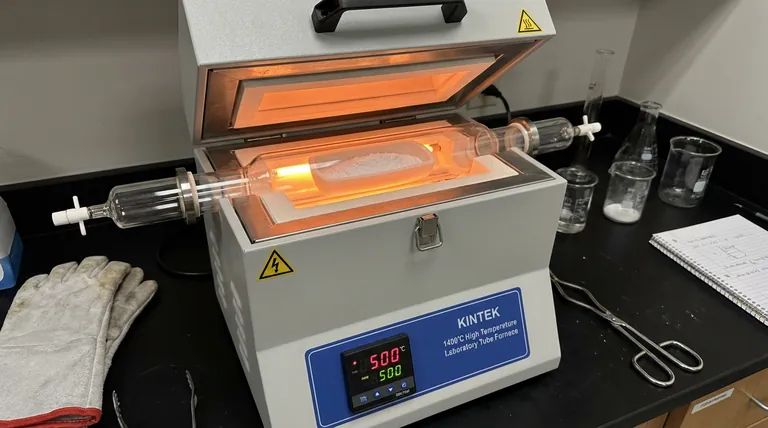
Facilitating the Reaction Process
Enabling Thermal Decomposition
At the 500 °C pre-calcination stage, the primary objective is the removal of organic components. The crucible acts as the containment vessel that allows this thermal decomposition to occur efficiently.
It holds the powder precursors securely while the temperature rises high enough to burn off organic matter. This step is critical for preparing the material for subsequent high-temperature sintering.
Structural Stability Under Heat
While 500 °C is a moderate temperature for advanced ceramics, the vessel must maintain rigid structural integrity. High-alumina and ceramic crucibles possess superior thermal stability.
They withstand these processing temperatures without undergoing deformation. This mechanical stability ensures the powder bed remains undisturbed during the heating cycle.
Protecting Material Integrity
Chemical Inertness
The defining characteristic of these crucibles is their non-reactive nature. At elevated temperatures, many materials become reactive and can leach elements into the powder they contain.
High-alumina ceramics are chemically inert, meaning they do not participate in the reaction. This ensures that no chemical reactions occur between the crucible and the precursor, preserving the stoichiometry of the layered oxide.
Shielding from Impurities
Purity is paramount when synthesizing cathode materials. Any foreign elements introduced during calcination can degrade the electrochemical performance of the final product.
By resisting chemical breakdown, the crucible prevents the introduction of external impurities. It provides a "clean room" environment on a micro-scale, ensuring the final phase formation is driven solely by the precursor ingredients.
Understanding the Constraints
The Importance of Material Selection
Not all crucibles are suitable for oxide synthesis. Using a vessel with lower chemical stability can lead to cross-contamination.
If the crucible material is not sufficiently inert, trace amounts of the vessel's components (such as Aluminum or Silicon) could diffuse into the precursor. This unintended doping can alter the crystal structure or impede the performance of the final layered oxide.
Thermal Limits and Durability
While 500 °C is the focus here, these crucibles are often selected because they can withstand significantly higher temperatures if subsequent processing requires it.
However, users must ensure the specific grade of ceramic chosen is resistant to thermal shock. Rapid heating or cooling cycles can cause inferior crucibles to crack, potentially ruining the sample.
Making the Right Choice for Your Project
Selecting the correct crucible is a balance between thermal requirements and chemical sensitivity.
- If your primary focus is Phase Purity: Prioritize high-alumina content (>99%) to maximize chemical inertness and eliminate the risk of reaction byproducts.
- If your primary focus is Process Durability: Ensure the ceramic grade selected has high thermal shock resistance to prevent cracking during heating and cooling cycles.
Ultimately, the role of the crucible is to be invisible—providing strong physical support while leaving zero chemical trace on your final product.
Summary Table:
| Feature | Role in 500 °C Pre-Calcination | Key Benefit |
|---|---|---|
| Chemical Inertness | Prevents reactions between vessel and precursor | Preserves stoichiometry and material purity |
| Thermal Stability | Maintains rigid structural integrity at heat | Ensures a stable, undisturbed powder bed |
| Thermal Decomposition | Safely contains precursors during organic burn-off | Prepares material for high-temp sintering |
| Purity Control | Blocks diffusion of external impurities | Prevents unintended doping of cathode materials |
Elevate Your Material Purity with KINTEK
Don't let crucible contamination compromise your research results. KINTEK provides premium high-alumina and ceramic crucibles designed specifically for the rigorous demands of battery precursor synthesis and oxide calcination. Backed by expert R&D and world-class manufacturing, we offer a full range of Muffle, Tube, Rotary, Vacuum, and CVD systems—all customizable to your unique thermal processing needs.
Ready to optimize your high-temperature workflows? Contact us today to find the perfect lab solution and ensure your phase purity remains pristine.
References
- Yongchun Li, Philipp Adelhelm. Competing Mechanisms Determine Oxygen Redox in Doped Ni–Mn Based Layered Oxides for Na‐Ion Batteries. DOI: 10.1002/adma.202309842
This article is also based on technical information from Kintek Furnace Knowledge Base .
Related Products
- 1400℃ High Temperature Laboratory Tube Furnace with Alumina Tube
- 1700℃ High Temperature Laboratory Tube Furnace with Alumina Tube
People Also Ask
- How are high-temperature laboratory tube furnaces applied in long-term vacuum homogenization heat treatments for intermetallic samples?
- How are high-temp tube furnaces used to measure diffusion coefficients per Fick's law? Master Precision Annealing
- How do high-temperature laboratory tube furnaces ensure environmental stability? Precision Thermal Reduction Tips
- How are high-temperature tube furnaces applied in testing ceramic-supported alloy membranes? Insights
- How does a laboratory high-temperature tube furnace contribute to the conversion of electrospun fibers? Expert Insights

