
High-alumina crucibles function as high-performance containment systems that facilitate the phase transformation of Li7La3Zr2O12 (LLZO) by providing a stable, 850 °C thermal environment. They serve as a protective barrier, ensuring the powder undergoes long-duration calcination without absorbing environmental impurities or reacting destructively with the vessel itself.
High-alumina crucibles are essential for the calcination of LLZO because they combine extreme thermal shock resistance with chemical inertness, enabling the consistent formation of the tetragonal phase while maintaining high material purity.

The Role of Containment in LLZO Synthesis
Maintaining Thermal Equilibrium at 850 °C
The calcination of LLZO requires a precise and sustained temperature of 850 °C to ensure uniform reaction kinetics. High-alumina crucibles act as a thermal buffer, providing a stable thermal environment that protects the powder from local temperature fluctuations within the furnace.
Facilitating Tetragonal Phase Transformation
The transition into the tetragonal Li7La3Zr2O12 phase is a time-sensitive process that requires long-duration heat treatments. These crucibles possess the thermal shock stability necessary to withstand these extended heating and cooling cycles without structural failure.
Physical Support for Powder Precursors
During the solid-state reaction, the precursor materials must be held in a compact, controlled volume to ensure efficient heat transfer. High-alumina vessels provide the high-temperature resistance required to support the weight and volume of the powder throughout the entire calcination cycle.
Protecting Material Integrity and Purity
Prevention of Environmental Contamination
One of the primary functions of the crucible is to act as a physical shield against the furnace environment. It prevents airborne particulates or furnace heating element off-gassing from contaminating the LLZO samples, which is critical for maintaining electrochemical performance.
Corrosion Resistance and Chemical Stability
LLZO precursors can be chemically aggressive at high temperatures, particularly regarding lithium volatility and reactivity. High-alumina materials offer excellent corrosion resistance, ensuring the crucible does not leach impurities into the powder or degrade during the 850 °C soak.
Understanding the Trade-offs
Risk of Lithium-Alumina Interaction
While high-alumina is generally stable at 850 °C, users must be aware that at higher sintering temperatures, lithium can react with alumina to form secondary phases like LiAlO2. This can lead to lithium loss in the final product and potential crucible degradation over many reuse cycles.
Balancing Cost and Performance
High-alumina is often chosen because it provides a cost-effective balance between durability and chemical inertness compared to more expensive alternatives like platinum or specialized zirconia. However, its slightly lower purity compared to 99.9% alumina must be factored into the final purity analysis of the LLZO powder.
Optimizing Your Calcination Strategy
When selecting and using high-alumina crucibles for LLZO production, consider these specific goals:
- If your primary focus is phase purity: Ensure the crucible is pre-cleaned and dedicated solely to LLZO to prevent cross-contamination from other materials.
- If your primary focus is crucible longevity: Avoid rapid quenching of the crucible, as utilizing its thermal shock stability within recommended cooling rates prevents micro-cracking.
- If your primary focus is minimizing lithium loss: Consider using a lid or "sacrificial" mother powder to further enhance the protective environment provided by the crucible.
By leveraging the thermal stability and chemical protection of high-alumina crucibles, researchers can reliably achieve the phase-pure tetragonal LLZO required for next-generation battery applications.
Summary Table:
| Feature | Function in LLZO Calcination | Key Benefit |
|---|---|---|
| Thermal Stability | Maintains stable 850°C environment | Ensures uniform tetragonal phase formation |
| Chemical Inertness | Resists aggressive Li-precursor reactions | Prevents sample contamination and leaching |
| Thermal Shock Resistance | Withstands long heating/cooling cycles | Increases crucible longevity and reliability |
| Physical Shielding | Barrier against furnace particulates | Maintains high electrochemical performance |
Maximize Your Material Synthesis Precision with KINTEK
Achieving the perfect tetragonal phase in LLZO powders requires more than just high temperatures—it demands uncompromising containment and thermal control. KINTEK provides the high-performance laboratory solutions needed to drive your battery research forward.
Backed by expert R&D and manufacturing, KINTEK offers Muffle, Tube, Rotary, Vacuum, and CVD systems, along with specialized high-alumina labware. All our lab high-temp furnaces and equipment are fully customizable to meet the unique thermal profiles and purity standards of your specific applications.
Ready to elevate your lab's efficiency and material integrity?
Contact KINTEK today to discuss your custom furnace needs!
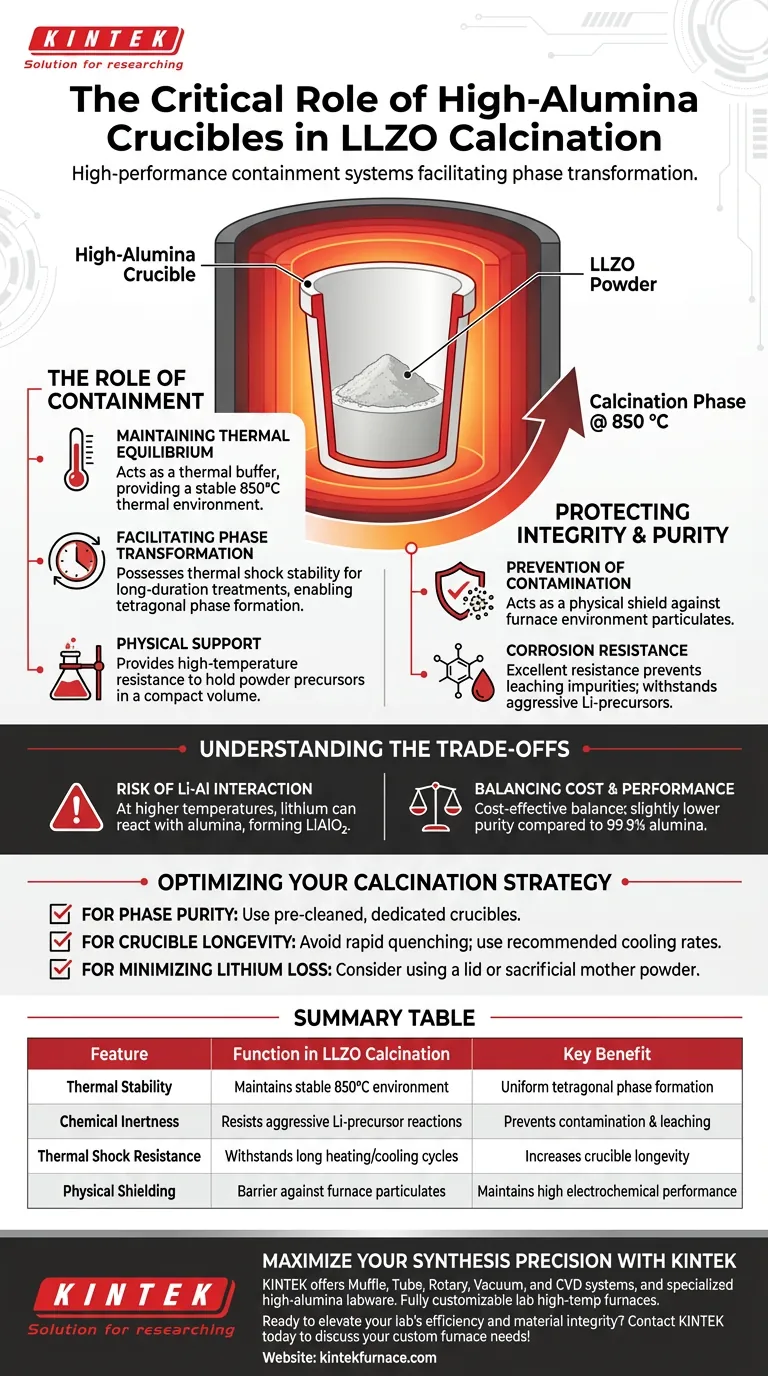
Visual Guide
References
- T. Y. Park, Dong‐Min Kim. Low-Temperature Manufacture of Cubic-Phase Li7La3Zr2O12 Electrolyte for All-Solid-State Batteries by Bed Powder. DOI: 10.3390/cryst14030271
This article is also based on technical information from Kintek Furnace Knowledge Base .
Related Products
- 1400℃ High Temperature Laboratory Tube Furnace with Alumina Tube
- 1700℃ High Temperature Laboratory Tube Furnace with Alumina Tube
People Also Ask
- How are high-temperature laboratory tube furnaces applied in long-term vacuum homogenization heat treatments for intermetallic samples?
- How are high-temp tube furnaces used to measure diffusion coefficients per Fick's law? Master Precision Annealing
- How do high-temperature laboratory tube furnaces ensure environmental stability? Precision Thermal Reduction Tips
- How are high-temperature tube furnaces applied in testing ceramic-supported alloy membranes? Insights
- How does a laboratory high-temperature tube furnace contribute to the conversion of electrospun fibers? Expert Insights

