
High-purity graphite molds and graphite paper are the functional backbone of Spark Plasma Sintering (SPS). The molds act simultaneously as the conductive heating element and the pressure vessel responsible for densifying the powder. Graphite paper serves as a critical protective interface, preventing the sample from chemically reacting with or bonding to the mold walls under extreme heat.
In the SPS process, the mold drives the sintering through Joule heating and mechanical compression, while the graphite paper preserves the sample’s chemical purity and structural integrity by acting as a non-reactive barrier.
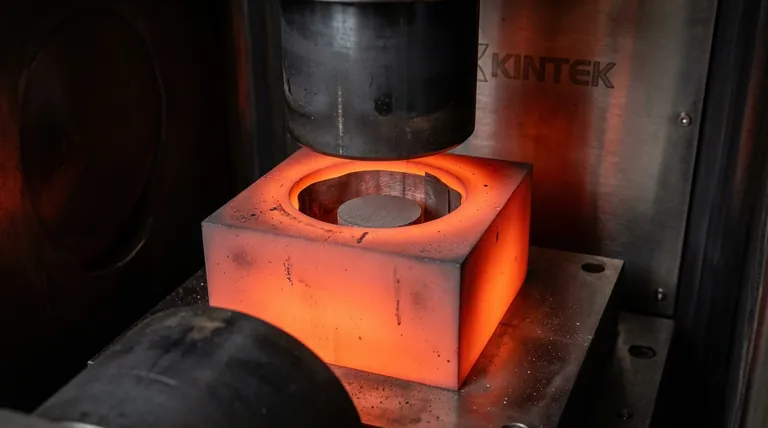
The Multifaceted Role of the Graphite Mold
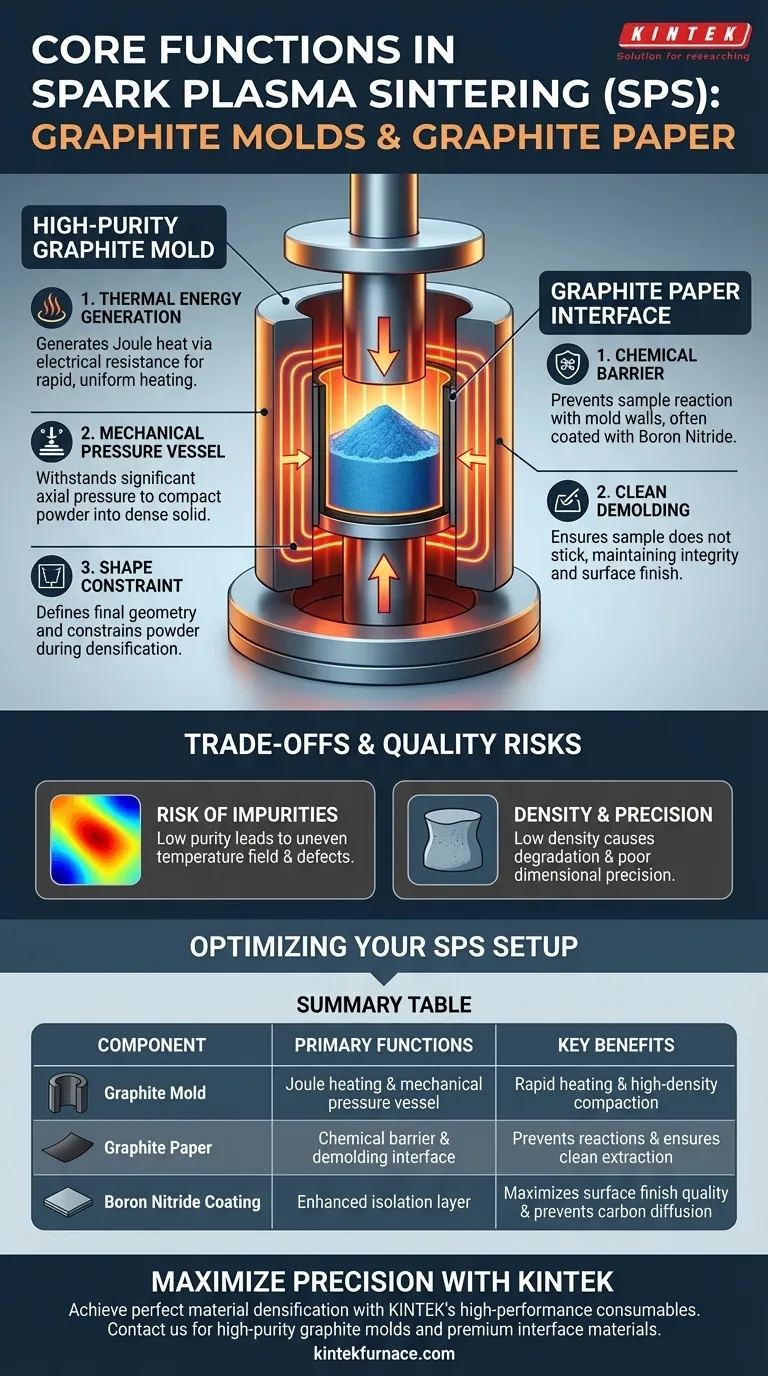
Generating Thermal Energy
Unlike traditional sintering methods that use external heating elements, the graphite mold itself generates the heat.
It acts as part of the current circuit, utilizing its own electrical resistance to generate Joule heat when high current is passed through it.
This allows for rapid heating rates, as the thermal energy is generated in the immediate vicinity of the sample.
Transmitting Mechanical Pressure
The mold serves as a high-strength pressure vessel.
It must withstand significant unidirectional mechanical force (axial pressure) transmitted by the hydraulic cylinder.
This pressure is essential for compacting the ceramic or composite powder into a dense, solid form.
Constraining the Material Shape
The mold defines the final geometry of the sintered part.
It acts as a rigid carrier that constrains the loose powder into a specific shape during the densification process.
The Critical Function of Graphite Paper
Acting as a Chemical Barrier
Graphite paper lines the inner cavity of the mold to isolate the sample.
This layer helps prevent the sample powder—particularly metals or reactive ceramics—from reacting with the carbon in the mold walls.
The paper is often coated with boron nitride to further enhance this isolation and prevent diffusion.
Ensuring Clean Demolding
Without this interface, samples would likely adhere to the mold at high sintering temperatures.
The paper ensures the sample does not stick, allowing for smooth extraction after the process is complete.
This protection maintains the structural integrity of the sample and ensures a high-quality surface finish.
Understanding the Trade-offs
The Risk of Impurities
The performance of the process relies heavily on the quality of the graphite used.
If the graphite mold lacks sufficient purity, it can lead to an uneven temperature field during sintering.
This lack of uniformity can result in inconsistent material properties or defects in the final composite.
Density and Dimensional Precision
The density of the graphite mold directly correlates to the quality of the final product.
Lower-density graphite may degrade faster or deform under high pressure, compromising the dimensional precision of the sintered part.
Investing in high-density, high-strength graphite is often necessary to achieve tight tolerances and superior surface quality.
Optimizing Your SPS Setup
To achieve the best results in your sintering process, consider the specific requirements of your material and the quality of your consumables.
- If your primary focus is Temperature Uniformity: Prioritize high-purity, high-density graphite molds to ensure consistent electrical conductivity and an even thermal field.
- If your primary focus is Surface Quality and Integrity: Ensure you are using graphite paper, ideally coated with boron nitride, to completely eliminate adhesion and reaction risks.
By selecting the correct mold grade and interface materials, you ensure precise control over both the thermal and mechanical forces shaping your final product.
Summary Table:
| Component | Primary Functions | Key Benefits |
|---|---|---|
| Graphite Mold | Joule heating & mechanical pressure vessel | Rapid heating rates & high-density material compaction |
| Graphite Paper | Chemical barrier & demolding interface | Prevents sample-mold reactions & ensures clean extraction |
| Boron Nitride Coating | Enhanced isolation layer | Maximizes surface finish quality & prevents carbon diffusion |
Maximize Your Sintering Precision with KINTEK
Achieving perfect material densification requires high-performance consumables. Backed by expert R&D and manufacturing, KINTEK offers high-purity, high-strength graphite molds and premium interface materials designed for the rigors of Spark Plasma Sintering (SPS). Whether you are working with advanced ceramics or complex composites, our customizable solutions—including Muffle, Tube, Rotary, Vacuum, and CVD systems—ensure uniform thermal fields and superior structural integrity.
Ready to elevate your lab's efficiency? Contact us today to find the perfect high-temperature solution for your needs!
Visual Guide
References
- Srinivasa Kartik Nemani, Babak Anasori. Ti <sub>3</sub> C <sub>2</sub> T <i> <sub>x</sub> </i> MXene‐Zirconium Diboride Based Ultra‐High Temperature Ceramics. DOI: 10.1002/advs.202500487
This article is also based on technical information from Kintek Furnace Knowledge Base .
Related Products
- Spark Plasma Sintering SPS Furnace
- 2200 ℃ Graphite Vacuum Heat Treat Furnace
- Vacuum Induction Melting Furnace
People Also Ask
- Why is it necessary to maintain a high vacuum environment during the SPS of SiC? Key to High-Density Ceramics
- How does the heating mechanism of Spark Plasma Sintering (SPS) function? Enhance TiC/SiC Composite Fabrication
- What are the technical advantages of using an SPS sintering furnace? Elevate Al2O3-TiC Material Performance
- What are the steps in the discharge plasma sintering process? Master Fast, High-Density Material Consolidation
- What are the advantages of spark plasma sintering (SPS) over traditional forging? Precision Microstructural Control


