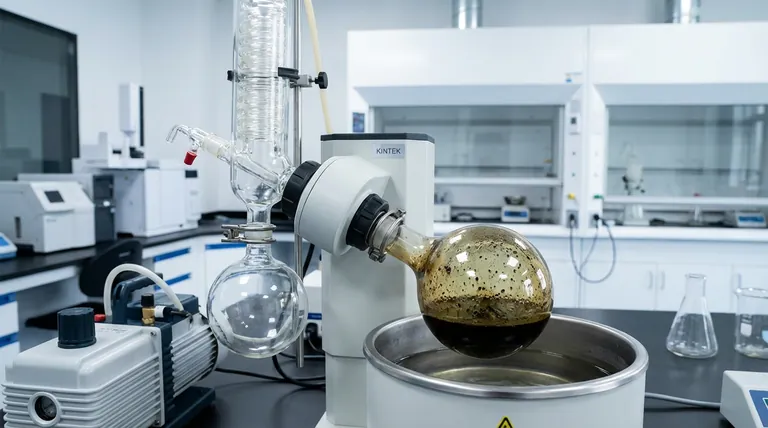
A vacuum rotary evaporator is critical for this process because it drives the physical deposition of nanosheets onto cathode particles through rapid, mechanically assisted solvent removal. Unlike passive methods, this active process forces the nanosheets to bond tightly with the cathode material while significantly reducing the time the active components are exposed to potentially damaging organic solvents.
Core Insight Natural sedimentation relies on gravity and time, often resulting in loose or uneven coatings. Vacuum rotary evaporation replaces this with kinetic energy and pressure control, ensuring a dense, high-loading interface between the nanosheets and the NCM (Nickel Cobalt Manganese) surface.
The Mechanics of Forced Deposition
Active vs. Passive Coating
The primary function of the vacuum rotary evaporator is to transition the coating process from a passive state to an active one.
In a static environment, nanosheets settle slowly. The rotary evaporator utilizes continuous stirring and vacuum pressure to force the nanosheets against the cathode particles.
Rapid Solvent Removal
The device uses vacuum pressure to lower the boiling point of the organic solvents.
This allows for rapid evaporation at lower temperatures. As the solvent volume decreases quickly, the concentration of nanosheets rises, effectively "pushing" them onto the surface of the cathode materials.
Performance Enhancements
Increasing Adhesion Tightness
The physical force generated by the evaporation process creates a superior bond.
The reference indicates that this controlled method significantly enhances adhesion tightness. The nanosheets do not just sit on the surface; they are mechanically compressed onto it, creating a more robust structure than natural sedimentation can achieve.
Maximizing Loading Amount
To improve battery performance, you often need a higher quantity of functional nanosheets on the cathode surface.
The rotary evaporation process prevents nanosheets from remaining suspended in the waste solvent. It drives a higher percentage of the available nanosheets onto the NCM surface, resulting in a higher effective loading amount.
Protecting the Active Material
Reducing Immersion Time
A critical, often overlooked advantage is the preservation of the core material.
Cathode materials (like NCM) can degrade or react adversely when soaked in organic solvents for extended periods.
Speed as a Safety Factor
Because the vacuum rotary evaporator removes the solvent rapidly, the total immersion time is drastically reduced.
This minimizes the chemical stress on the active materials, preserving their structural integrity while the coating is applied.
Understanding the Process Variables
The Necessity of Control
While this method is superior to sedimentation, it relies heavily on "controlled evaporation."
The reference highlights that this is not a random drying process. The combination of vacuum level, rotation speed, and temperature must be balanced to achieve the desired adhesion.
Comparison to Natural Sedimentation
It is important to recognize why the alternative fails.
Natural sedimentation is a slow, gravity-fed process. It lacks the mechanical energy to ensure tight adhesion, leading to looser coatings and longer exposure to solvents which may harm the cathode.
Making the Right Choice for Your Goal
When designing your deposition protocol, consider your priorities regarding coating quality and material health.
- If your primary focus is structural stability: Use the vacuum rotary evaporator to ensure maximum adhesion tightness and prevent the coating from delaminating.
- If your primary focus is material preservation: Rely on this method to minimize the time your active cathode materials spend immersed in reactive organic solvents.
- If your primary focus is maximizing active material: Choose this technique to force a higher loading amount of nanosheets onto the particle surface compared to gravity-based methods.
By using vacuum rotary evaporation, you are prioritizing a mechanically robust and chemically safe deposition process over a simple, passive one.
Summary Table:
| Feature | Natural Sedimentation | Vacuum Rotary Evaporation |
|---|---|---|
| Deposition Type | Passive (Gravity-fed) | Active (Mechanical/Kinetic) |
| Adhesion Quality | Loose and uneven | Dense and high-adherence |
| Solvent Exposure | High (Extended immersion) | Low (Rapid removal) |
| Loading Efficiency | Lower (Loss in suspension) | Higher (Forced onto surface) |
| Material Integrity | Potential chemical stress | Maximum preservation |
Precision engineering is the key to advanced battery research. Backed by expert R&D and manufacturing, KINTEK offers customizable Muffle, Tube, Rotary, and Vacuum systems tailored for your unique deposition needs. Whether you are optimizing nanosheet loading or protecting sensitive active materials, our high-performance laboratory solutions ensure consistent, superior results. Contact KINTEK today to discover how our high-temperature furnaces and rotary evaporation systems can elevate your research.
References
- Leonhard Karger, Torsten Brezesinski. Protective Nanosheet Coatings for Thiophosphate‐Based All‐Solid‐State Batteries. DOI: 10.1002/admi.202301067
This article is also based on technical information from Kintek Furnace Knowledge Base .
Related Products
- Laboratory Vacuum Tilt Rotary Tube Furnace Rotating Tube Furnace
- Vacuum Sealed Continuous Working Rotary Tube Furnace Rotating Tube Furnace
- Electric Rotary Kiln Continuous Working Small Rotary Furnace Kiln for Pyrolysis Plant Heating
- Inclined Rotary Plasma Enhanced Chemical Deposition PECVD Tube Furnace Machine
- Electric Rotary Kiln Pyrolysis Furnace Plant Machine Small Rotary Kiln Calciner
People Also Ask
- What are the key advantages of using a rotary tube furnace? Achieve Dynamic, Uniform Heating for Powders
- What other fields utilize rotary tube furnaces? Discover Versatile Heating Solutions for Multiple Industries
- What are the technical advantages of using a rotary tube furnace for hydrochar activation? Achieve Superior Porosity
- What optional features enhance the processing capabilities of rotary tube furnaces? Boost Efficiency with Advanced Customizations
- When are rotary tube furnaces not suitable for a process? Avoid Costly Mistakes in Thermal Processing