
The primary purpose of a PID controller in hydrogen release experiments is to enforce rigorous closed-loop control over the heating furnace. It ensures the system adheres to precise thermal protocols—such as ramping temperature at exactly 20°C per minute or holding a steady 700°C—which is necessary to capture accurate scientific data regarding metal hydrides.
In this context, the PID controller serves as the critical link between experimental design and physical reality. By actively correcting temperature errors, it allows researchers to isolate the exact thermal decomposition kinetics of a material without interference from environmental fluctuations.
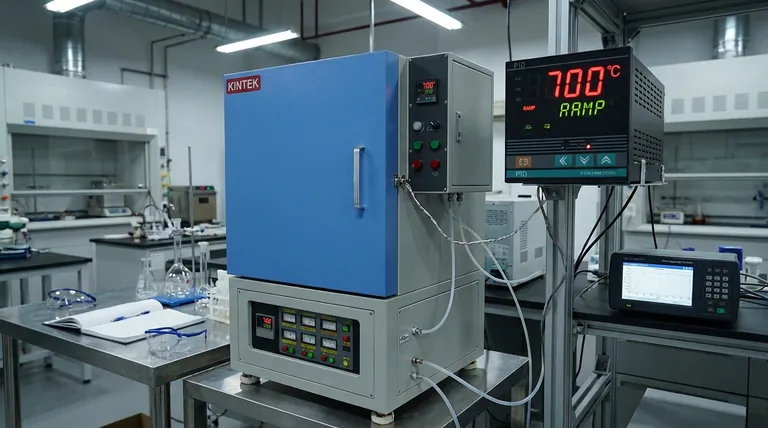
The Critical Role of Temperature Precision
The validity of a hydrogen release experiment depends entirely on the stability of the thermal environment. A PID controller manages this through several specific mechanisms.
Executing Precise Heating Rates
Many experiments require investigating how a material behaves as it warms up. The PID controller ensures the furnace follows a linear preset rate, such as 20°C per minute.
Without this control, heating would be inconsistent. The controller dynamically adjusts power to ensure the temperature rise is perfectly smooth, which is essential for characterizing material behavior over time.
Maintaining Steady-State Targets
Experiments often require holding a sample at a specific high temperature, such as 700°C, to observe total hydrogen release.
The controller monitors the furnace temperature continuously. It makes micro-adjustments to the power supply to lock the temperature at the setpoint, preventing the natural drift that would occur with a simple on-off thermostat.
Isolating Material Properties
To accurately study thermal decomposition kinetics, you must be certain that temperature readings reflect the sample's environment, not heater oscillation.
PID control minimizes noise in the temperature data. This clarity allows researchers to pinpoint the exact temperature at which hydrogen release begins, rather than guessing within a range of fluctuating values.
Common Pitfalls to Avoid
While PID controllers are essential tools, they rely on correct implementation to function effectively.
The Consequence of Poor Tuning
A PID controller is not "plug and play"; it must be tuned to the specific thermal mass of the furnace.
If the controller parameters are incorrect, the furnace may suffer from oscillation. This occurs when the temperature constantly overshoots and undershoots the target, rendering the resulting kinetic data unusable for high-precision analysis.
The Illusion of Stability
It is possible for a controller to appear stable while reacting too slowly to disturbances.
In hydrogen release experiments, a slow reaction time (over-damped response) can lead to a lag between the recorded temperature and the actual sample temperature during fast heating ramps. This introduces error into the calculated release temperatures.
Making the Right Choice for Your Experiment
To maximize the quality of your data, align your controller settings with your specific research objectives.
- If your primary focus is determining exact release temperatures: Prioritize a controller setup that eliminates overshoot, ensuring you do not accidentally exceed the release point before the measurement is taken.
- If your primary focus is studying decomposition kinetics: Ensure your controller is tuned for tight ramp adherence (linearity), as deviations from the preset heating rate (e.g., 20°C/min) will skew your kinetic calculations.
Precision in thermal control is the defining factor that transforms a rough observation into a reproducible scientific discovery.
Summary Table:
| Feature | Function in Hydrogen Experiments | Benefit to Researcher |
|---|---|---|
| Linear Ramping | Executes exact rates (e.g., 20°C/min) | Ensures accurate characterization of material behavior |
| Steady-State Holding | Locks temperature at specific setpoints | Prevents thermal drift during total hydrogen release |
| Error Correction | Actively adjusts for environmental noise | Isolates exact decomposition kinetics without interference |
| Closed-Loop Control | Continuous micro-adjustments to power | Eliminates oscillations that render kinetic data unusable |
Elevate Your Research Precision with KINTEK
Achieving reproducible results in hydrogen release experiments requires more than just a furnace; it requires rigorous thermal control.
Backed by expert R&D and manufacturing, KINTEK offers high-performance Muffle, Tube, Rotary, Vacuum, and CVD systems designed for the most demanding lab environments. Our high-temperature furnaces are fully customizable to your unique needs, ensuring that your PID control and heating profiles are perfectly tuned for material science breakthroughs.
Ready to eliminate thermal uncertainty?
Contact KINTEK today to discuss your custom furnace requirements.
References
- Measurement of Low-Concentration Hydrogen in Inert Gas Within a Small Closed Volume. DOI: 10.3390/s25123771
This article is also based on technical information from Kintek Furnace Knowledge Base .
Related Products
- Controlled Inert Nitrogen Hydrogen Atmosphere Furnace
- 2200 ℃ Graphite Vacuum Heat Treat Furnace
- Vacuum Heat Treat Sintering and Brazing Furnace
- Vacuum Hot Press Furnace Machine Heated Vacuum Press Tube Furnace
- 600T Vacuum Induction Hot Press Vacuum Heat Treat and Sintering Furnace
People Also Ask
- How does hydrogen furnace annealing assist in preparing mechanically alloyed powders for compaction?
- How does atmospheric annealing in a controlled hydrogen furnace affect the cold compaction behavior of metal powders?
- What are the characteristics and uses of hydrogen atmosphere in furnaces? Achieve Superior Surface Purity and Bonding
- What are the characteristics and uses of hydrogen atmospheres in furnaces? Unlock Clean Metal Processing
- What controlled-atmosphere furnace conditions are required for sintering powder metallurgy copper alloy compacts? Ideal Setup



















