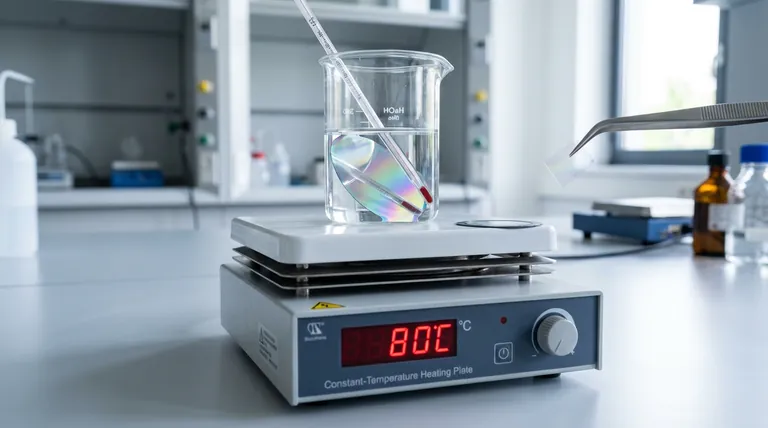
In the precision-driven wet transfer of 2D Transition Metal Dichalcogenide (TMD) films, the primary function of a constant-temperature heating plate is to maintain a stable 80 °C environment for the NaOH aqueous solution. This thermal activation is critical because it accelerates the chemical etching process at the interface between the SiO2 substrate and the TMD film. By providing consistent heat, the plate ensures the film delaminates and floats onto the liquid surface within 30 seconds, making it ready for transfer to TEM grids or other carriers.
The constant-temperature heating plate serves as a thermal catalyst that converts a slow chemical reaction into a rapid, controlled peeling process. By stabilizing the NaOH solution at 80 °C, it ensures the complete and efficient separation of the TMD film from its growth substrate while maintaining the material's integrity.
The Role of Thermal Activation in Chemical Etching
Accelerating Interfacial Reaction Rates
The chemical etching of the SiO2/TMD interface by NaOH is temperature-dependent. Without heat, the reaction is often too slow to be practical for high-quality film transfer.
Increasing the temperature to 80 °C provides the necessary kinetic energy to drive the etching process forward rapidly. This ensures that the chemical bonds holding the film to the substrate are broken efficiently.
Achieving Rapid Film Delamination
When the solution is properly heated, the TMD film can detach and float on the water surface in under 30 seconds. This speed is vital for minimizing the film's exposure to harsh chemicals.
Rapid delamination prevents the TMD film from becoming fragmented. A quick, clean "peel" results in a more continuous and high-quality 2D layer on the final carrier.
Precision Control for Substrate Separation
Maintaining Temperature Consistency
The "constant-temperature" aspect of the heating plate is as important as the heat itself. Fluctuations in temperature can lead to inconsistent etching rates across the substrate.
Stable heat ensures that the entire TMD film experiences the same chemical environment. This uniformity is essential for achieving a complete detachment without leaving residues or tearing the film.
Facilitating Transfer to Downstream Carriers
Once the film is floating, it is prepared for the next stage of the process, such as being picked up by TEM copper grids. The heating plate ensures the solution remains at the optimal state until the moment of transfer.
By streamlining the peeling phase, the heating plate allows researchers to move the film to its final destination quickly. This minimizes the risk of environmental contamination or mechanical damage during the transition.
Understanding the Trade-offs
Temperature Sensitivity and Etch Rates
While 80 °C is the standard for NaOH-based etching, exceeding this temperature can cause the solution to evaporate too quickly. This changes the concentration of the NaOH, which may lead to over-etching or damage to the TMD.
Conversely, if the temperature drops below the target, the etching process may stall. This results in incomplete peeling, often forcing the user to mechanically intervene, which risks tearing the 2D structure.
Chemical Safety and Surface Tension
Heating a NaOH solution requires careful monitoring to avoid splashes or caustic vapors. The thermal environment also affects the surface tension of the liquid.
If the surface tension is not balanced with the etching rate, the TMD film may curl or sink rather than floating flat. Maintaining the precise 80 °C setpoint is the most reliable way to balance these physical and chemical factors.
How to Apply This to Your Project
Recommendations for Successful Wet Transfer
The success of your TMD transfer depends on how you manage the thermal environment of your etching solution.
- If your primary focus is high throughput and speed: Ensure your heating plate is pre-heated to exactly 80 °C before introducing the substrate to achieve the 30-second delamination window.
- If your primary focus is maximizing film continuity: Monitor the solution level closely during heating to prevent NaOH concentration changes, ensuring a gentle and uniform etch across the entire interface.
By strictly controlling the thermal activation of the etching solution, you ensure a reliable, repeatable process for transitioning 2D films from growth substrates to experimental carriers.
Summary Table:
| Feature | Function in TMD Wet Transfer | Benefit |
|---|---|---|
| Target Temp (80 °C) | Provides thermal activation for NaOH etching | Accelerates chemical reaction at SiO2 interface |
| Delamination Speed | Completes separation within 30 seconds | Minimizes chemical exposure & prevents fragmentation |
| Thermal Stability | Ensures uniform etching across substrate | Promotes complete film detachment without residues |
| Interface Control | Breaks bonds between film and substrate | Maintains material integrity for TEM grid transfer |
Precision Lab Equipment for Your 2D Material Research
Achieving high-quality 2D film transfers requires rigorous thermal control and reliable performance. Backed by expert R&D and manufacturing, KINTEK offers a wide range of laboratory solutions including Muffle, Tube, Rotary, Vacuum, and CVD systems, along with specialized high-temperature heating plates customizable for your unique experimental needs.
Whether you are scaling up TMD production or conducting delicate TEM analysis, our team is ready to provide the precision equipment your research demands.
Ready to enhance your lab's efficiency? Contact us today to find the perfect heating solution!
Visual Guide

References
- Jungtae Nam, Keun‐Soo Kim. Tailored Synthesis of Heterogenous 2D TMDs and Their Spectroscopic Characterization. DOI: 10.3390/nano14030248
This article is also based on technical information from Kintek Furnace Knowledge Base .
Related Products
- Multi Heating Zones CVD Tube Furnace Machine for Chemical Vapor Deposition Equipment
- Laboratory Quartz Tube Furnace RTP Heating Tubular Furnace
- 2200 ℃ Graphite Vacuum Heat Treat Furnace
- Silicon Carbide SiC Thermal Heating Elements for Electric Furnace
- 2200 ℃ Tungsten Vacuum Heat Treat and Sintering Furnace
People Also Ask
- What is the function of a multi-zone tube furnace in CVD synthesis? Master 2D In2Se3 Nanosheet Precision
- What environmental protection applications utilize multi zone tube furnaces? Unlock Precision in Waste Treatment and Green Tech
- What temperature-related capabilities make multi zone tube furnaces valuable for research? Unlock Precision Thermal Control
- Why are multi zone tube furnaces particularly useful for nanomaterial research? Unlock Precise Thermal Control for Advanced Synthesis
- What role do multi zone tube furnaces play in new energy research? Unlock Precise Thermal Control for Innovation