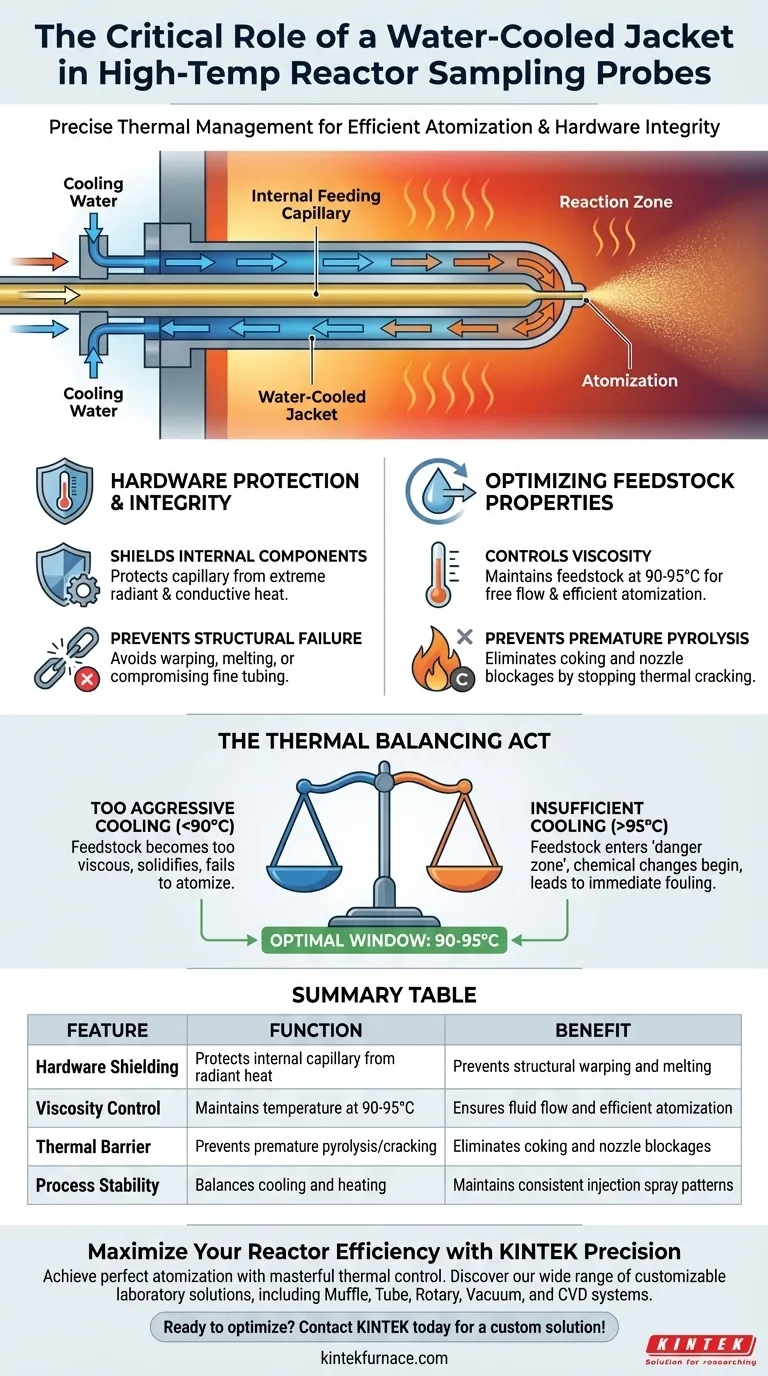
Precise thermal management is the critical function. A water-cooled jacket on a sampling probe serves to protect the internal feeding capillary from structural failure caused by the reactor's extreme heat. Simultaneously, it maintains the feedstock and transport lines at a specific temperature range—typically 90-95°C—to ensure the material remains fluid enough for atomization without triggering chemical reactions before entering the zone.
The water-cooled jacket acts as a thermal barrier that balances two opposing needs: keeping the feedstock hot enough to flow and atomize properly, yet cool enough to prevent premature chemical breakdown and nozzle blockages.
Hardware Protection and Integrity
Shielding Internal Components
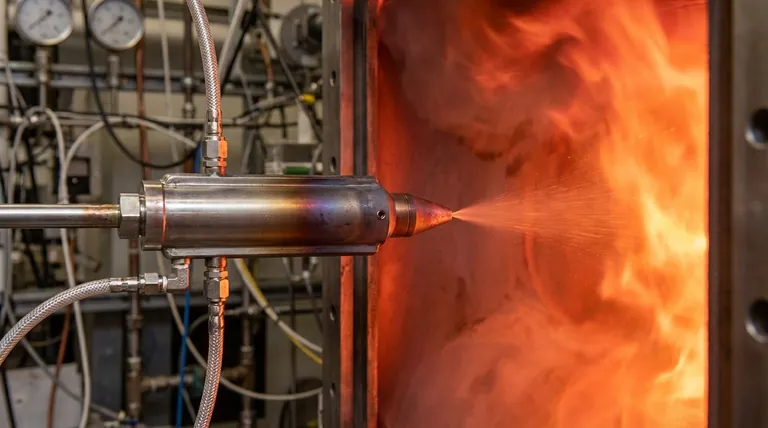
High-temperature reactors create environments hostile to delicate instrumentation. The primary mechanical role of the water-cooled jacket is to shield the internal feeding capillary from radiant and conductive heat.
Without this active cooling barrier, the extreme temperatures of the reaction zone could warp, melt, or structurally compromise the probe's fine tubing.
Optimizing Feedstock Properties
Controlling Viscosity for Atomization
For a feedstock to be injected effectively, it must flow freely. The jacket maintains the material at a controlled temperature (90-95°C) to significantly reduce its viscosity.
This reduction in thickness is essential for efficient atomization. If the feedstock is too viscous, the injection spray pattern degrades, leading to poor mixing and inefficient reactor performance.
Preventing Premature Pyrolysis
While the feedstock must be warm enough to flow, it cannot be allowed to overheat within the probe. If the temperature spikes before the material exits the nozzle, premature pyrolysis or thermal cracking can occur inside the capillary.
This premature reaction often results in coking—the formation of solid carbon deposits.
Avoiding Nozzle Blockages
Coking is a primary cause of system failure in high-temperature injection. By preventing premature pyrolysis, the water-cooled jacket ensures carbon deposits do not accumulate at the nozzle tip.
This keeps the injection path clear, preventing blockages that would otherwise force a shutdown of the reactor for maintenance.
Understanding the Trade-offs
The Thermal Balancing Act
Designing these systems requires a precise understanding of the feedstock's thermal properties.
If the cooling is too aggressive, the feedstock may cool below the 90°C threshold, becoming too viscous to atomize or potentially solidifying in the line.
Conversely, if cooling is insufficient, the feedstock enters the "danger zone" where chemical changes begin inside the hardware, leading to immediate fouling.
Making the Right Choice for Your Goal
Achieving consistent injection relies on maintaining the narrow process window created by the cooling jacket.
- If your primary focus is Equipment Longevity: Ensure the cooling flow rate is sufficient to keep the internal capillary well below its metallurgical failure point, regardless of reactor fluctuations.
- If your primary focus is Process Stability: Prioritize outlet temperature control to hold the feedstock strictly between 90-95°C, ensuring consistent atomization without risking coking.
The success of your injection system depends not just on surviving the heat, but on mastering the temperature of the fluid right up to the millisecond of release.
Summary Table:
| Feature | Function | Benefit |
|---|---|---|
| Hardware Shielding | Protects internal capillary from radiant heat | Prevents structural warping and melting |
| Viscosity Control | Maintains temperature at 90-95°C | Ensures fluid flow and efficient atomization |
| Thermal Barrier | Prevents premature pyrolysis/cracking | Eliminates coking and nozzle blockages |
| Process Stability | Balances cooling and heating | Maintains consistent injection spray patterns |
Maximize Your Reactor Efficiency with KINTEK Precision
Achieving perfect atomization requires masterful thermal control. Backed by expert R&D and manufacturing, KINTEK offers a wide range of laboratory solutions, including Muffle, Tube, Rotary, Vacuum, and CVD systems, all customizable for your unique high-temperature research needs. Whether you are scaling up feedstock injection or refining chemical synthesis, our systems provide the stability and durability your lab demands.
Ready to optimize your thermal management? Contact KINTEK today for a custom solution!
Visual Guide
References
- Tor Sewring, Fredrik Weiland. The Influence of Oxyfuel Combustion Conditions on the Behavior of Inorganic Cooking Chemicals during Black Liquor Conversion. DOI: 10.1021/acs.energyfuels.5c02613
This article is also based on technical information from Kintek Furnace Knowledge Base .
Related Products
- Ultra High Vacuum Observation Window Stainless Steel Flange Sapphire Glass Sight Glass for KF
- High Temperature Muffle Oven Furnace for Laboratory Debinding and Pre Sintering
- Multi Zone Laboratory Quartz Tube Furnace Tubular Furnace
- Multi Heating Zones CVD Tube Furnace Machine for Chemical Vapor Deposition Equipment
- Ultra High Vacuum CF Observation Window Flange with High Borosilicate Glass Sight Glass
People Also Ask
- What is the significance of using a high-temperature tube furnace with observation windows? Real-Time Wettability Analysis
- Why is an Ultra-High Vacuum (UHV) System Required for In2Se3? Achieving Atomic-Level Ferroelectric Clarity
- Why is an environmental laboratory chamber equipped with an optical window required for synthesizing Hafnium Carbide?
- What are the structural functions of the dual-chamber quartz glass container? Optimize Magnesium Alloy Vapor Analysis
- What is the purpose of utilizing a glassy carbon crucible and HCl gas treatment? Ensure Pure Molten Salt Systems