
High-strength graphite molds serve three simultaneous functions during the Field Assisted Sintering Technology (FAST) consolidation of titanium alloys. They act as electrical resistors that convert current into heat, rigid containers that define the shape of the powder, and mechanical media that transmit high axial pressure to fully densify the material.
By functioning as both a heating element and a pressure vessel, high-strength graphite enables solid-state processing. This creates fully dense alloys while avoiding the coarse, inferior microstructures typical of traditional melting and casting.
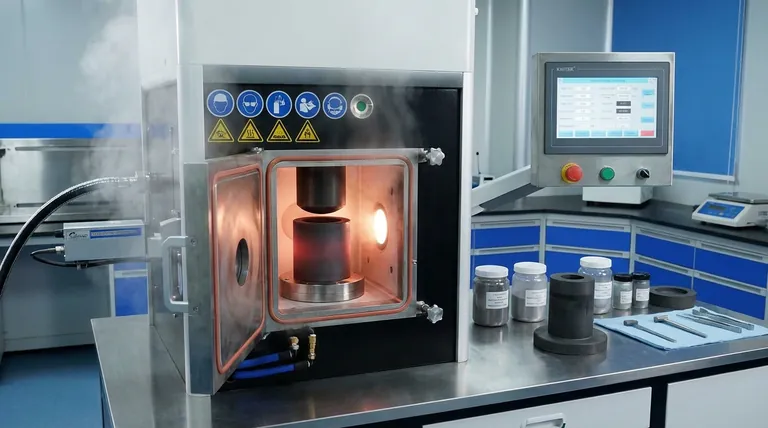
The Mechanics of Graphite in FAST
Electrical Resistance and Heat Generation
In the FAST process, the mold is not a passive container; it is an active component of the electrical circuit.
Graphite serves as an electrical resistor. As current passes through the mold, the graphite converts this electrical energy directly into heat.
This allows the titanium powder to reach the necessary sintering temperatures rapidly and efficiently.
Transmission of Axial Pressure
To turn loose powder into a solid component, immense physical force is required.
The graphite mold acts as the medium for transmitting high axial pressure directly to the titanium powder.
This pressure is critical for closing internal voids and achieving a fully dense final product.
Rigid Containment and Shaping
While subjected to intense heat and pressure, the mold must maintain its geometric integrity.
It functions as a rigid container, holding the titanium powder in the precise shape required for the final part.
This capability is essential for "near-net-shape" manufacturing, reducing the need for subsequent machining.
Critical Material Properties
Enabling Solid-State Processing
The specific combination of graphite's properties allows the titanium to be processed in a solid state.
Because the alloy does not need to melt to achieve density, the process avoids the formation of coarse cast structures.
This results in a microstructure that is generally superior to alloys produced via traditional melting and casting methods.
Thermal Conductivity Requirements
Beyond resisting heat, the mold must move heat effectively.
As noted in similar high-temperature processes, the graphite must possess excellent thermal conductivity.
This ensures that heat is transferred uniformly to the powder samples, preventing uneven sintering or structural defects.
Making the Right Choice for Your Goal
When evaluating the role of graphite molds in your consolidation strategy, consider your specific metallurgical targets:
- If your primary focus is mechanical performance: The graphite mold enables solid-state processing, which preserves a fine microstructure and avoids the coarse grain defects of casting.
- If your primary focus is part density: The mold’s ability to withstand and transmit high axial pressure is the determining factor in achieving 100% densification.
High-strength graphite is not merely tooling; it is the active interface that makes the entire FAST process viable.
Summary Table:
| Function | Role in FAST Process | Impact on Titanium Alloys |
|---|---|---|
| Electrical Resistor | Converts current into rapid heat | Efficient, controlled sintering temperatures |
| Mechanical Media | Transmits high axial pressure | Ensures 100% material densification |
| Rigid Container | Provides geometric shaping | Near-net-shape accuracy, reduced machining |
| Thermal Conductor | Distributes heat uniformly | Prevents defects and ensures structural integrity |
Maximize Your Material Performance with KINTEK
Don't settle for inferior cast microstructures. KINTEK’s high-strength graphite molds and advanced sintering systems are engineered to deliver the precision, heat uniformity, and pressure resistance required for elite titanium alloy consolidation. Backed by expert R&D and world-class manufacturing, we provide customizable Muffle, Tube, Rotary, Vacuum, and CVD systems tailored to your unique lab high-temperature needs.
Ready to achieve 100% densification and superior mechanical performance? Contact our technical experts today to find the perfect solution for your research and production.
References
- Samuel Lister, Martin Jackson. Titanium‐S23: A New Alloy with Ultra‐High Tensile Toughness Directly from the Solid‐State Processing of Recycled Ti–6Al–4V and Ti–5Al–5Mo–5V–3Cr Powders using Field Assisted Sintering Technology. DOI: 10.1002/adem.202500572
This article is also based on technical information from Kintek Furnace Knowledge Base .
Related Products
People Also Ask
- Why are vacuum heat treating furnaces essential for aerospace? Ensure Superior Material Integrity for High-Stakes Applications
- What is the primary application of vacuum heat treating furnaces in aerospace? Enhance Component Performance with Precision
- What is the process of vacuum heat treating? Achieve Superior Metallurgical Properties
- How does vacuum heat treating work in terms of temperature and time control? Master Precise Material Transformations
- How does a vacuum heat treating furnace improve the condition of metal alloys? Achieve Superior Metal Performance

