Precision starts at the surface. Spot-welded K-type thermocouples are indispensable in Dual-Phase (DP) steel experiments because they attach directly to the sample, measuring the material's actual temperature rather than the surrounding environment. This provides the real-time monitoring required to maintain strict heat treatment parameters and eliminate the guesswork associated with ambient furnace sensors.
In the processing of DP steel, even minor temperature fluctuations can drastically alter the final martensite ratio. Direct surface monitoring is the only way to secure the precise feedback needed to guarantee consistent microstructural evolution.
The Mechanics of Accurate Measurement
Direct Surface Attachment
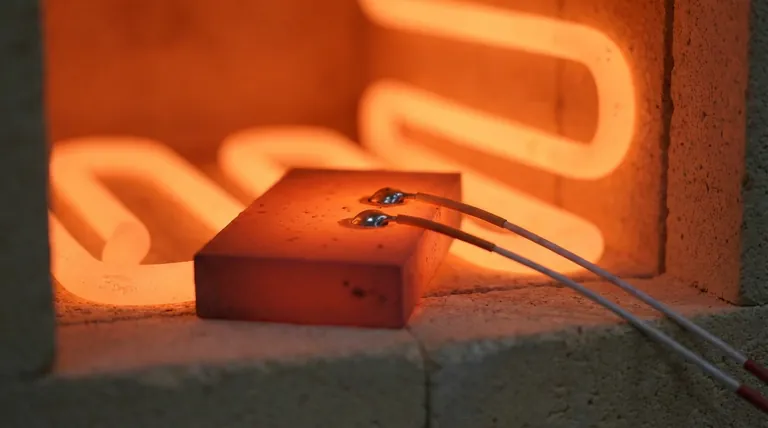
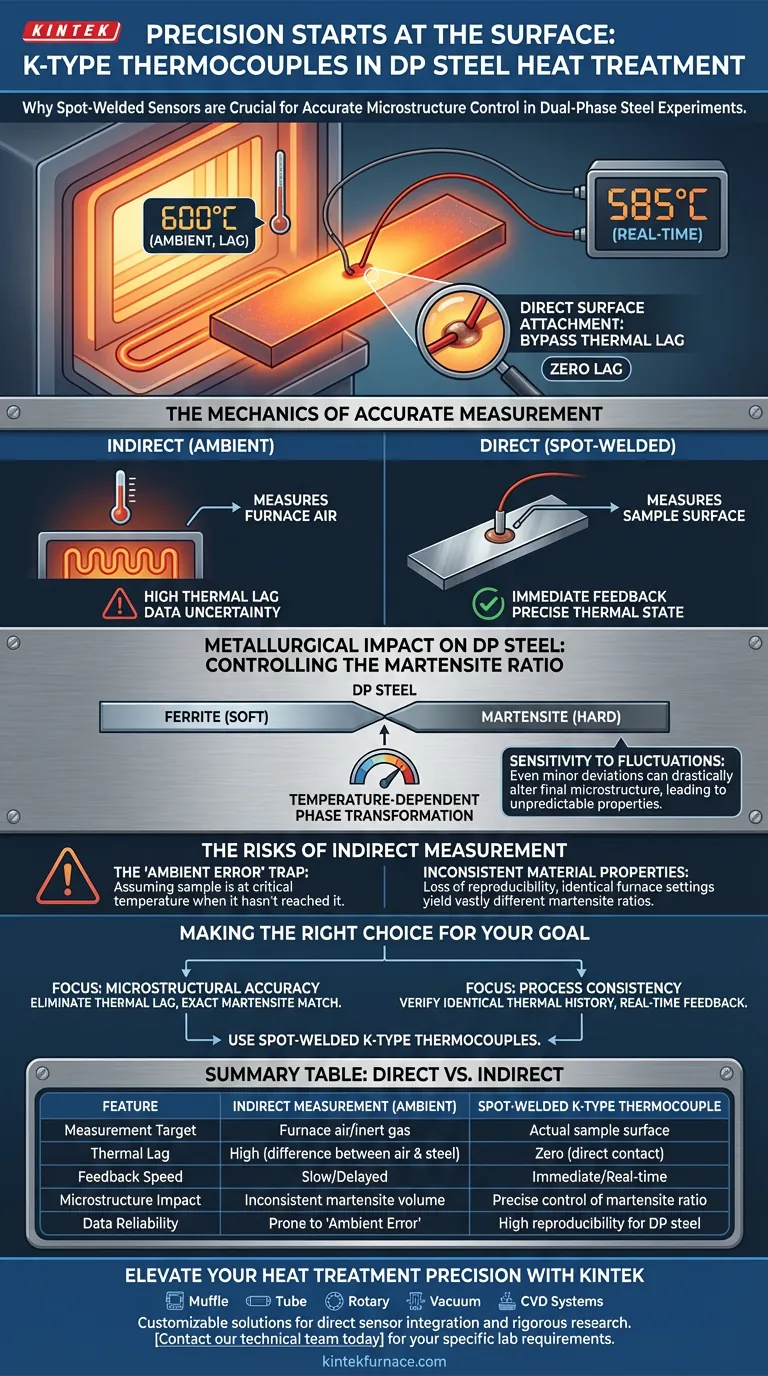
Standard furnace thermocouples measure the air or inert gas inside the chamber, not the sample itself. By using spot-welded K-type thermocouples, you bypass the thermal lag between the heating element and the specimen. This ensures the data reflects the exact thermal state of the steel at any given second.
Real-Time Monitoring
Heat treatment requires adherence to specific heating rates and soak times. Spot-welded sensors provide immediate feedback, allowing for dynamic adjustments during the cycle. This capability is critical for verifying that the programmed parameters align with the physical reality of the sample.
The Metallurgical Impact on DP Steel
Controlling the Martensite Ratio
The mechanical properties of Dual-Phase steel are defined by the balance between soft ferrite and hard martensite. This martensite ratio is established during the annealing phase. Because this phase transformation is temperature-dependent, accurate thermal control is non-negotiable.
Sensitivity to Fluctuations
The primary reference highlights that minor temperature fluctuations can significantly impact the final microstructure. If the temperature deviates even slightly from the target, the volume fraction of martensite will change. This leads to unpredictable mechanical properties and failed experiments.
The Risks of Indirect Measurement
The "Ambient Error" Trap
Relying on indirect temperature measurement (non-contact) introduces uncertainty regarding the sample's core temperature. Without the strict feedback from a spot-welded unit, you risk assuming the sample has reached critical temperature when it has not.
Inconsistent Material Properties
The trade-off for neglecting direct contact monitoring is a loss of reproducibility. Without precise data to confirm that heat treatment parameters are strictly maintained, identical furnace settings may yield samples with vastly different martensite ratios and performance characteristics.
Making the Right Choice for Your Goal
To ensure your DP steel experiments yield valid, reproducible data, you must prioritize direct measurement.
- If your primary focus is Microstructural Accuracy: Use spot-welded thermocouples to eliminate thermal lag, ensuring the martensite ratio exactly matches your theoretical design.
- If your primary focus is Process Consistency: Rely on the real-time feedback from these sensors to verify that every sample experiences the exact same thermal history, regardless of furnace fluctuations.
Direct contact measurement is not just a monitoring tool; it is the control mechanism for material quality.
Summary Table:
| Feature | Indirect Measurement (Ambient) | Spot-Welded K-Type Thermocouple |
|---|---|---|
| Measurement Target | Furnace air/inert gas | Actual sample surface |
| Thermal Lag | High (difference between air & steel) | Zero (direct contact) |
| Feedback Speed | Slow/Delayed | Immediate/Real-time |
| Microstructure Impact | Inconsistent martensite volume | Precise control of martensite ratio |
| Data Reliability | Prone to "Ambient Error" | High reproducibility for DP steel |
Elevate Your Heat Treatment Precision with KINTEK
Don't let minor temperature fluctuations compromise your Dual-Phase steel microstructure. KINTEK provides the high-performance laboratory solutions required for rigorous metallurgical research. Backed by expert R&D and manufacturing, we offer Muffle, Tube, Rotary, Vacuum, and CVD systems, all fully customizable to accommodate direct sensor integration and your unique experimental needs.
Ensure absolute process consistency and microstructural accuracy in every cycle. Contact our technical team today to find the perfect high-temperature furnace for your lab's specific requirements.
Visual Guide
References
- Pedram Dastur, Claire Davis. Development of a High Ductility DP Steel Using a Segregation Neutralization Approach: Benchmarked Against a Commercial Dual Phase Steel. DOI: 10.1007/s11661-024-07427-3
This article is also based on technical information from Kintek Furnace Knowledge Base .
Related Products
- Multi Heating Zones CVD Tube Furnace Machine for Chemical Vapor Deposition Equipment
- High Temperature Muffle Oven Furnace for Laboratory Debinding and Pre Sintering
- Multi Zone Laboratory Quartz Tube Furnace Tubular Furnace
- Vertical Laboratory Quartz Tube Furnace Tubular Furnace
- 1200℃ Muffle Oven Furnace for Laboratory
People Also Ask
- What is the function of a multi-zone tube furnace in CVD synthesis? Master 2D In2Se3 Nanosheet Precision
- What role do multi zone tube furnaces play in new energy research? Unlock Precise Thermal Control for Innovation
- What environmental protection applications utilize multi zone tube furnaces? Unlock Precision in Waste Treatment and Green Tech
- What temperature-related capabilities make multi zone tube furnaces valuable for research? Unlock Precision Thermal Control
- Why are multi zone tube furnaces particularly useful for nanomaterial research? Unlock Precise Thermal Control for Advanced Synthesis