
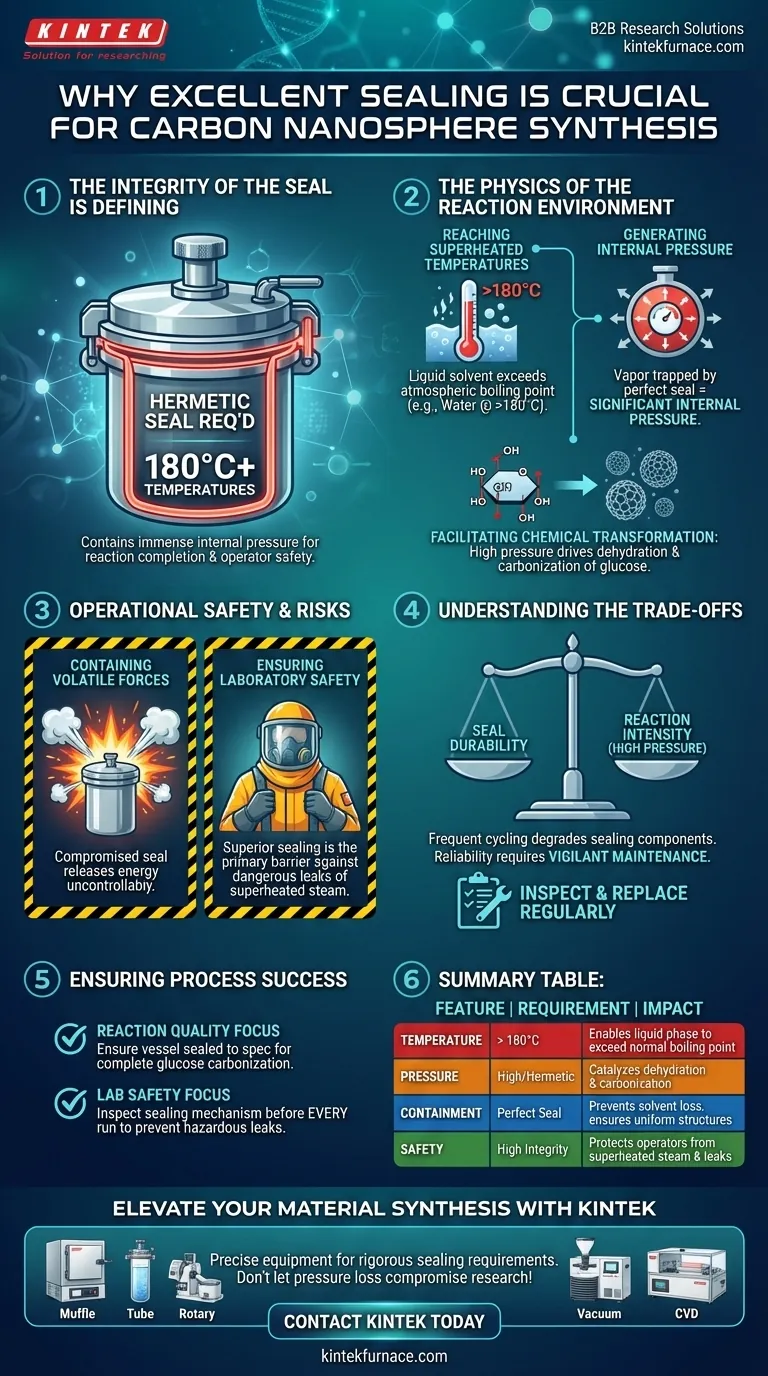
The integrity of the vessel's seal is the defining factor for successful carbon nanosphere synthesis. Because reaction temperatures are frequently set at 180°C or higher, the vessel must withstand and contain the immense internal pressure generated by solvents, such as deionized water, to ensure both reaction completion and operator safety.
A hermetic seal is required to maintain the specific high-temperature, high-pressure environment necessary for the dehydration and carbonization of glucose. Without it, the necessary internal pressure cannot build, rendering the synthesis impossible and the laboratory environment unsafe.
The Physics of the Reaction Environment
Reaching Superheated Temperatures
Synthesis protocols for carbon nanospheres often demand temperatures exceeding 180°C. At atmospheric pressure, water boils at 100°C and cannot get hotter in liquid form.
Generating Internal Pressure
To reach 180°C, the solvent (deionized water) must be prevented from boiling away. A perfect seal traps the vapor, causing significant internal pressure to build within the closed space.
Facilitating Chemical Transformation
This high-pressure environment is not a byproduct; it is a catalyst. It drives the thorough dehydration and carbonization of glucose, forcing the molecules to restructure into the desired spherical carbon nanostructures.
Operational Safety and Risks
Containing Volatile Forces
The internal pressure generated by superheated water is substantial. If the seal is compromised, this energy releases uncontrollably.
Ensuring Laboratory Safety
Superior sealing performance is the primary barrier between the operator and a potential hazard. It prevents dangerous leaks of superheated steam and chemical reactants, ensuring laboratory operational safety is maintained throughout the process.
Understanding the Trade-offs
Seal Durability vs. Reaction Intensity
While high pressure is necessary for synthesis, it places immense stress on the vessel's sealing mechanism. Frequent cycling at these temperatures can degrade gaskets and sealing surfaces over time.
Maintenance Requirements
Reliability comes at the cost of vigilance. To maintain the "superior sealing" mandated by the process, users must regularly inspect and replace sealing components, as even a microscopic failure can lead to pressure loss and a failed synthesis batch.
Ensuring Process Success
To maximize yield and safety during carbon nanosphere synthesis, apply the following principles:
- If your primary focus is Reaction Quality: Ensure the vessel is sealed to specification to maintain the pressure required for complete glucose carbonization.
- If your primary focus is Laboratory Safety: Inspect the sealing mechanism before every run to prevent hazardous leaks caused by the 180°C+ operating environment.
Your ability to produce uniform carbon nanospheres relies entirely on your ability to contain the pressure that creates them.
Summary Table:
| Feature | Requirement | Impact on Synthesis |
|---|---|---|
| Temperature | > 180°C | Enables liquid phase to exceed normal boiling point |
| Pressure | High/Hermetic | Catalyzes dehydration and carbonization of glucose |
| Containment | Perfect Seal | Prevents solvent loss and ensures uniform nanostructures |
| Safety | High Integrity | Protects operators from superheated steam and leaks |
Elevate Your Material Synthesis with KINTEK
Precise carbon nanosphere production demands equipment that never fails under pressure. Backed by expert R&D and world-class manufacturing, KINTEK provides high-performance Muffle, Tube, Rotary, Vacuum, and CVD systems, along with customizable lab high-temperature furnaces designed to meet your most rigorous sealing and thermal requirements.
Don't let pressure loss compromise your research or laboratory safety. Contact KINTEK today to find the perfectly sealed solution tailored to your unique synthesis needs!
Visual Guide
References
- Kaihe Lv, Jinsheng Sun. Microwave-Assisted Synthesis of Carbon Nanospheres and Their Application as Plugging Agents for Oil-Based Drilling Fluids. DOI: 10.3390/molecules30030463
This article is also based on technical information from Kintek Furnace Knowledge Base .
Related Products
- MPCVD Machine System Reactor Bell-jar Resonator for Lab and Diamond Growth
- 915MHz MPCVD Diamond Machine Microwave Plasma Chemical Vapor Deposition System Reactor
- High Pressure Laboratory Vacuum Tube Furnace
- Custom Made Versatile CVD Tube Furnace Chemical Vapor Deposition CVD Equipment Machine
- 9MPa Air Pressure Vacuum Heat Treat and Sintering Furnace
People Also Ask
- What are the essential components of an MPCVD reactor system? Build a Pristine Environment for High-Purity Materials
- How does pressure affect the MPCVD growth process? Master Plasma Control for Superior Film Quality
- How do carbon-containing groups contribute to diamond growth in the MPCVD method? Unlock High-Quality Diamond Synthesis
- Why is temperature control important in the MPCVD growth process? Ensure High-Quality, Reliable Diamond Film Deposition
- What are the key components of an MPCVD system? Unlock High-Purity Crystal Growth






