
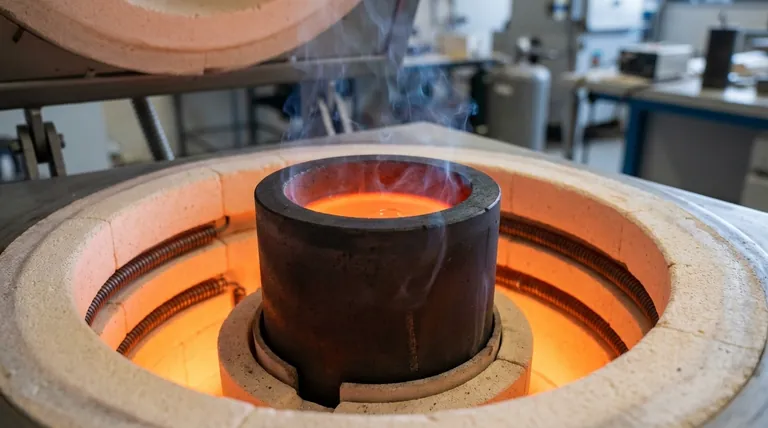
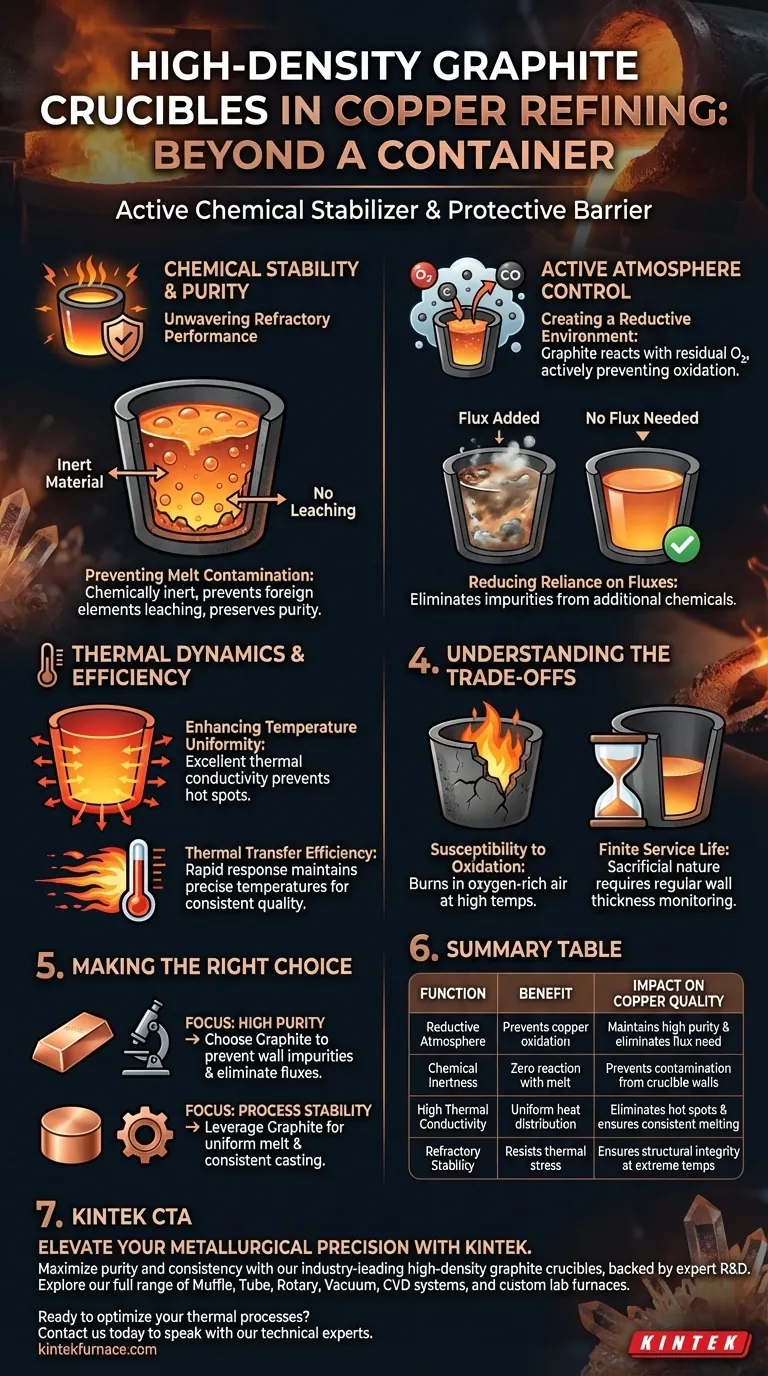
Beyond acting as a robust container, a high-density graphite crucible serves as an active chemical stabilizer and a protective barrier. Its primary functions during pyrometallurgical refining are to ensure refractory stability at high temperatures and to create a localized reductive environment that prevents the molten copper from oxidizing.
While most crucibles are passive vessels, high-density graphite plays an active role in metallurgy. It functions as an inherent deoxidizer, maintaining the chemical integrity of the copper melt without requiring additional protective fluxes.
Chemical Stability and Purity
Unwavering Refractory Performance
High-density graphite possesses exceptional refractory properties. It maintains structural integrity at the extreme temperatures required for copper refining, ensuring the vessel does not degrade or deform under thermal stress.
Preventing Melt Contamination
The chemical stability of this material is a critical operational advantage. Unlike some ceramic or metallic crucibles, high-density graphite is chemically inert regarding molten copper.
It does not react with the copper melt. This ensures that foreign elements from the crucible walls do not leach into the liquid metal, preserving the purity of the final product.
Active Atmosphere Control
Creating a Reductive Environment
The most sophisticated function of a graphite crucible is its ability to influence the local atmosphere. Graphite is essentially carbon. At high temperatures, the crucible material reacts with residual oxygen in the immediate vicinity.
This reaction creates a reductive atmosphere around the melt. By consuming the available oxygen, the crucible actively prevents the copper liquid from undergoing excessive oxidation.
Reducing Reliance on Fluxes
In many refining setups, operators must add chemical fluxes to protect the metal from the air.
Because the graphite crucible itself generates a protective reductive zone, it reduces or effectively eliminates the need for these protective fluxes. This simplifies the process and removes another potential source of impurity.
Thermal Dynamics and Efficiency
Enhancing Temperature Uniformity
Drawing on the material's physical properties, high-density graphite offers excellent thermal conductivity.
This ensures that heat is distributed distinctively and evenly throughout the crucible walls. Uniform heating prevents hot spots that could damage the vessel or cause inconsistent melting within the copper batch.
Thermal Transfer Efficiency
High-density graphite facilitates efficient heat transfer from the furnace source to the melt. This rapid thermal response helps in maintaining precise temperature control, which is vital for the dimensional precision and quality of the cast material.
Understanding the Trade-offs
Susceptibility to Oxidation
While the crucible protects the copper from oxygen, the crucible itself is vulnerable to it.
Graphite oxidizes (burns) in air at high temperatures. If the refining takes place in an oxygen-rich environment without an inert gas cover (like argon or nitrogen) or a vacuum, the crucible walls will gradually erode.
Finite Service Life
The "sacrificial" nature of the reductive effect means the crucible is slowly consumed over time. Users must monitor the wall thickness of the crucible regularly to prevent structural failure during a melt.
Making the Right Choice for Your Goal
Select your crucible strategy based on the specific requirements of your refining process.
- If your primary focus is High Purity: Rely on high-density graphite to prevent wall-reaction impurities and eliminate the need for chemical fluxes.
- If your primary focus is Process Stability: Leverage the high thermal conductivity of graphite to ensure uniform melt temperatures and consistent casting results.
Ultimately, high-density graphite transforms the crucible from a simple holder into a chemical guardian that actively preserves the quality of your copper.
Summary Table:
| Function | Benefit | Impact on Copper Quality |
|---|---|---|
| Reductive Atmosphere | Prevents copper oxidation | Maintains high purity & eliminates flux need |
| Chemical Inertness | Zero reaction with melt | Prevents contamination from crucible walls |
| High Thermal Conductivity | Uniform heat distribution | Eliminates hot spots & ensures consistent melting |
| Refractory Stability | Resists thermal stress | Ensures structural integrity at extreme temps |
Elevate Your Metallurgical Precision with KINTEK
Maximize the purity and consistency of your copper refining with high-performance crucible solutions. KINTEK provides industry-leading high-density graphite crucibles designed for superior thermal dynamics and active chemical protection. Backed by expert R&D and manufacturing, we offer a comprehensive range of Muffle, Tube, Rotary, Vacuum, and CVD systems, as well as other lab high-temp furnaces—all fully customizable to meet your unique processing needs.
Ready to optimize your thermal processes? Contact us today to speak with our technical experts and find the perfect solution for your laboratory or production line.
Visual Guide
References
- Omar Choukri, Souadi Taibi. Achieving industrial-grade purity in recycled copper scrap: Pretreatment and fire refining approach. DOI: 10.46793/tribomat.2025.008
This article is also based on technical information from Kintek Furnace Knowledge Base .
Related Products
People Also Ask
- Why are vacuum heat treating furnaces essential for aerospace? Ensure Superior Material Integrity for High-Stakes Applications
- What is the primary application of vacuum heat treating furnaces in aerospace? Enhance Component Performance with Precision
- How does vacuum heat treating work in terms of temperature and time control? Master Precise Material Transformations
- How does a vacuum heat treating furnace improve the condition of metal alloys? Achieve Superior Metal Performance
- What is the process of vacuum heat treating? Achieve Superior Metallurgical Properties
