
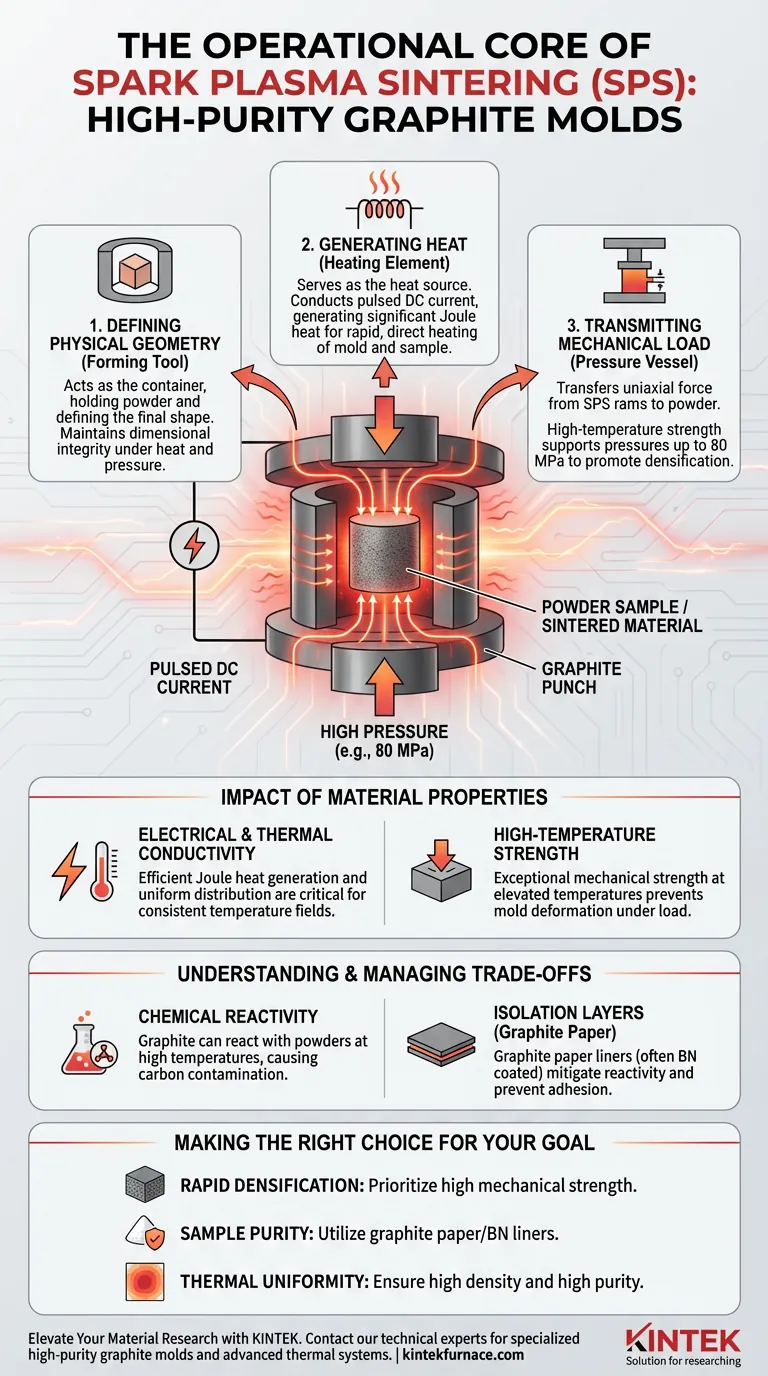
High-purity graphite molds function as the operational core of the Spark Plasma Sintering (SPS) process. They perform three distinct, simultaneous roles: defining the physical geometry of the sample, serving as the electrical heating element to generate Joule heat, and acting as the mechanical vessel to transmit high pressure directly to the powder.
By integrating the roles of a forming die, a resistive heater, and a pressure chamber into a single component, high-purity graphite molds enable the synchronized application of thermal and mechanical energy. This unique multifunctionality is the driving force behind the ability of SPS to achieve rapid densification and precise microstructural control.
The Three Primary Functions
The effectiveness of SPS relies on the mold's ability to multitask under extreme conditions. The graphite mold is not merely a passive container; it is an active participant in the sintering physics.
1. Defining Physical Geometry (The Forming Tool)
At its most basic level, the graphite mold acts as the forming tool or die. It serves as the container that holds the loose powder and defines the final physical shape of the sintered sample.
This function requires the mold to maintain its dimensional integrity throughout the process. It ensures that the loose powder is confined to a specific volume before and during the densification phase.
2. Generating Heat via Conductivity (The Heating Element)
Unlike conventional sintering, where external heaters warm a chamber, the graphite mold in SPS serves as the heat source itself. It acts as a conductive medium that allows thousands of amperes of pulsed DC current to pass through it.
Because graphite is electrically conductive but possesses resistance, this current generates significant Joule heat. This enables direct, rapid heating of both the mold and the sample inside, facilitating the high heating rates characteristic of SPS.
3. Transmitting Mechanical Load (The Pressure Vessel)
The third function is mechanical. The mold serves as a pressure transmission medium, transferring external uniaxial loads from the SPS machine's rams directly to the powder particles.
Graphite's high-temperature mechanical strength allows it to withstand significant pressures (often between 60 MPa and 80 MPa) even at sintering temperatures (e.g., 823 K and above). This pressure promotes plastic flow and atomic diffusion, which are essential for achieving high material density.
The Impact of Material Properties
The performance of the mold is directly tied to the specific properties of the high-purity graphite used.
Electrical and Thermal Conductivity
High electrical conductivity ensures the efficient generation of Joule heat. Simultaneously, high thermal conductivity ensures that this heat is distributed uniformly throughout the mold and the sample.
Variations in graphite density or purity can lead to uneven temperature fields. This non-uniformity can result in defective samples with inconsistent microstructures.
High-Temperature Strength
The graphite must possess exceptional mechanical strength at elevated temperatures. If the graphite is too weak, it will deform or fracture under the mechanical load required to densify the ceramic or metallic powder.
Understanding the Trade-offs
While high-purity graphite is the standard for SPS, it introduces specific challenges that must be managed to ensure sample quality.
Chemical Reactivity and Contamination
At high temperatures, graphite can react chemically with certain powders. This can lead to carbon contamination of the sample surface or the formation of unwanted carbides.
Furthermore, the sample may adhere to the mold walls, making removal difficult and potentially damaging the sample.
The Necessity of Isolation Layers
To mitigate reactivity and adhesion, graphite paper is frequently used as an interface liner.
Typically coated with boron nitride, this paper acts as an isolation layer between the powder and the mold. It prevents chemical reactions and adhesion while maintaining the necessary electrical and thermal continuity.
Making the Right Choice for Your Goal
The selection and setup of your graphite mold should be tailored to your specific sintering objectives.
- If your primary focus is rapid densification: Prioritize graphite with high mechanical strength to maximize the pressure application (up to 80 MPa) without mold failure.
- If your primary focus is sample purity: Always utilize graphite paper liners, potentially with boron nitride coatings, to prevent carbon diffusion and adhesion.
- If your primary focus is thermal uniformity: Ensure the graphite mold has high density and high purity to guarantee consistent electrical resistance and thermal conduction paths.
Ultimately, the graphite mold determines the upper limits of pressure and heating rate your SPS process can achieve.
Summary Table:
| Function | Role in SPS Process | Benefit for Material Production |
|---|---|---|
| Forming Die | Defines physical geometry | Ensures dimensional accuracy and powder confinement |
| Heating Element | Generates Joule heat via pulsed DC | Enables ultra-fast heating rates and energy efficiency |
| Pressure Vessel | Transmits uniaxial mechanical load | Promotes plastic flow and high-density sintering |
| Conductive Medium | Distributes thermal/electrical energy | Ensures uniform microstructures and material consistency |
Elevate Your Material Research with KINTEK
Unlock the full potential of your Spark Plasma Sintering (SPS) applications with high-performance components. Backed by expert R&D and precision manufacturing, KINTEK offers specialized high-purity graphite molds and advanced thermal systems, including Muffle, Tube, Rotary, Vacuum, and CVD furnaces, all fully customizable to your unique research or production needs.
Ready to achieve superior density and microstructural control?
Contact our technical experts today to discuss your project
Visual Guide
References
- Mohamed Salaheldeen, А. Zhukov. Dependence of Magnetic Properties of As-Prepared Nanocrystalline Ni2MnGa Glass-Coated Microwires on the Geometrical Aspect Ratio. DOI: 10.3390/s24113692
This article is also based on technical information from Kintek Furnace Knowledge Base .
Related Products
- Spark Plasma Sintering SPS Furnace
- 2200 ℃ Graphite Vacuum Heat Treat Furnace
- Vacuum Heat Treat Sintering Furnace Molybdenum Wire Vacuum Sintering Furnace
People Also Ask
- How does the heating mechanism of Spark Plasma Sintering (SPS) function? Enhance TiC/SiC Composite Fabrication
- Why is it necessary to maintain a high vacuum environment during the SPS of SiC? Key to High-Density Ceramics
- What are the technical advantages of using an SPS sintering furnace? Elevate Al2O3-TiC Material Performance
- What are the steps in the discharge plasma sintering process? Master Fast, High-Density Material Consolidation
- What are the advantages of spark plasma sintering (SPS) over traditional forging? Precision Microstructural Control


