
In the Spark Plasma Sintering (SPS) of high-entropy alloys, graphite molds serve as far more than simple containers; they function simultaneously as the shaping vessel, the pressure-transmitting medium, and the primary heating element. Because graphite conducts electricity, the pulsed current passes through the mold to generate Joule heat, which is then transferred directly to the alloy powder to facilitate rapid, uniform sintering.
The graphite mold is an active participant in the SPS process, enabling rapid densification through direct electrical heating and mechanical pressure, but it introduces a specific need for post-process machining to remove carbon-contaminated surface layers.
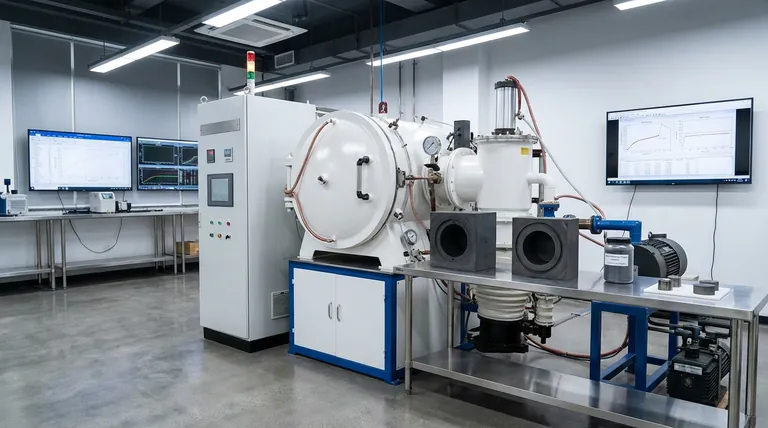
The Triple Function of Graphite Molds
In standard sintering, a mold is often just a passive ceramic vessel. In SPS, the high-strength graphite mold is an integrated part of the machine's electrical and mechanical circuit.
Acting as the Heating Element
Unlike conventional furnaces that heat from the outside in, SPS utilizes the mold itself to generate heat.
As high-amperage current passes through the conductive graphite, Joule heating is generated within the mold walls. This allows for extremely rapid heating rates that characterize the SPS process.
Because graphite possesses excellent thermal conductivity, it ensures that this heat is distributed uniformly across the sample, preventing thermal gradients that could lead to inconsistent alloy properties.
Transmitting Mechanical Pressure
Densification in SPS relies on the simultaneous application of heat and pressure.
The graphite mold must act as a distinct mechanical component, transmitting force from the hydraulic rams to the powder compact.
High-strength graphite is selected because it can withstand significant uniaxial pressures—typically between 30 MPa and 40 MPa—at temperatures exceeding 1200°C without deforming or fracturing.
Defining the Component Geometry
The mold defines the final "near-net" shape of the sintered cake, such as a disc or plate.
By maintaining high dimensional stability even at extreme temperatures (up to 1400°C), the mold ensures the alloy powder is confined to precise dimensions.
This near-net shaping capability significantly reduces the amount of raw material waste and the extent of subsequent machining required to achieve the final part geometry.
Understanding the Trade-offs: Carbon Diffusion
While graphite is the standard for SPS due to its thermal and electrical properties, it introduces a specific chemical challenge when processing high-entropy alloys.
The Risk of Surface Contamination
At high sintering temperatures, carbon atoms from the mold can diffuse into the surface of the alloy.
This carbon penetration can alter the chemical composition of the alloy's outer layer, potentially forming carbides that negatively affect mechanical properties like ductility or hardness.
The Necessity of Surface Machining
To ensure accurate performance data, you cannot test the sintered sample exactly as it comes out of the mold.
The surface layer of the sintered sample must typically be removed via grinding or machining. This eliminates the carbon-contaminated zone and exposes the true, unaffected microstructure of the high-entropy alloy for valid performance testing.
Mechanical Limitations
While graphite is strong, it is brittle compared to metals.
There is a hard limit to the hydraulic pressure a graphite mold can withstand. Pushing pressures beyond the typical 40-50 MPa range risks catastrophic mold failure, meaning graphite is not suitable for processes requiring ultra-high pressures (where cemented carbide molds might be used instead, albeit at lower temperatures).
Optimizing Your SPS Process
To maximize the benefits of graphite molds while mitigating their limitations, consider your specific project goals.
- If your primary focus is material purity: Plan for a larger initial sample size to account for the "machining allowance" needed to grind off the carbon-rich surface layer.
- If your primary focus is densification efficiency: Utilize the high thermal conductivity of graphite to maximize heating rates, but ensure your applied pressure stays within the 30-40 MPa safety margin to prevent mold fracture.
Graphite molds are the engine of efficiency in SPS, provided you proactively manage the carbon diffusion at the interface.
Summary Table:
| Function | Description | Key Performance Benefit |
|---|---|---|
| Heating Element | Generates Joule heat via pulsed current | Enables rapid heating rates and thermal uniformity |
| Pressure Medium | Transmits 30-40 MPa from hydraulic rams | Promotes high-density material consolidation |
| Geometry Mold | Defines near-net shape (discs/plates) | Reduces material waste and post-processing |
| Conductivity | High thermal & electrical conductivity | Facilitates efficient energy transfer to alloy powder |
Elevate Your Materials Research with KINTEK
Unlock the full potential of Spark Plasma Sintering (SPS) with high-performance laboratory solutions. Backed by expert R&D and precision manufacturing, KINTEK offers a comprehensive range of Muffle, Tube, Rotary, Vacuum, and CVD systems, along with customizable high-temp furnaces tailored to your unique research needs.
Whether you are sintering high-entropy alloys or developing next-gen ceramics, our technical team is ready to help you optimize your process parameters for maximum purity and density.
Contact KINTEK Today for a Custom Solution
References
- Guiqun Liu, Xiaoli Zhang. Nano-Structure Evolution and Mechanical Properties of AlxCoCrFeNi2.1 (x = 0, 0.3, 0.7, 1.0, 1.3) High-Entropy Alloy Prepared by Mechanical Alloying and Spark Plasma Sintering. DOI: 10.3390/nano14070641
This article is also based on technical information from Kintek Furnace Knowledge Base .
Related Products
People Also Ask
- How does the heating mechanism of Spark Plasma Sintering (SPS) function? Enhance TiC/SiC Composite Fabrication
- Why is it necessary to maintain a high vacuum environment during the SPS of SiC? Key to High-Density Ceramics
- What are the technical advantages of using an SPS sintering furnace? Elevate Al2O3-TiC Material Performance
- What are the steps in the discharge plasma sintering process? Master Fast, High-Density Material Consolidation
- What are the advantages of spark plasma sintering (SPS) over traditional forging? Precision Microstructural Control

