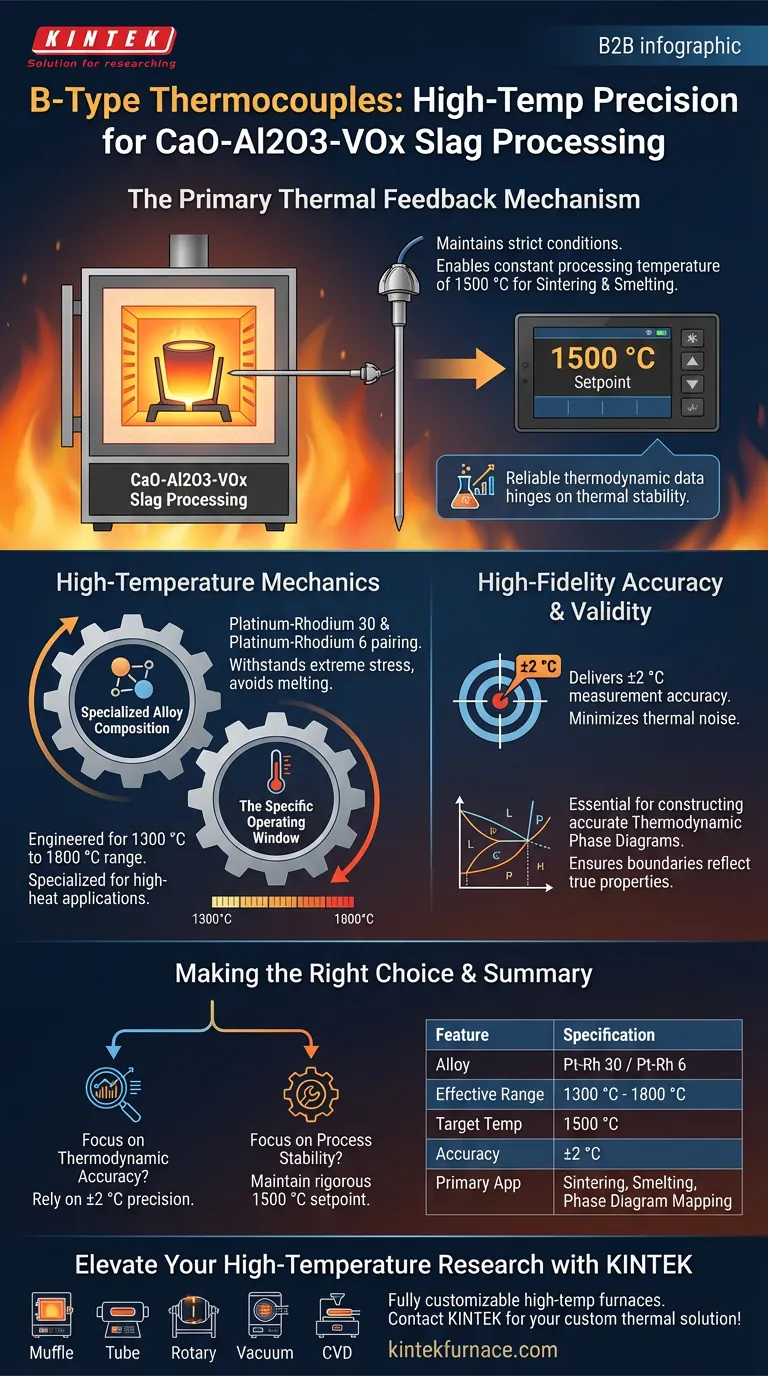
B-type thermocouples function as the primary thermal feedback mechanism for maintaining the strict environmental conditions required during the processing of CaO-Al2O3-VOx slag. Composed of Platinum-Rhodium alloys, these sensors deliver high-precision measurements within the extreme 1300 °C to 1800 °C range, enabling the system to hold a constant processing temperature of 1500 °C.
The reliability of CaO-Al2O3-VOx thermodynamic data hinges entirely on thermal stability; B-type thermocouples provide the ±2 °C accuracy necessary to validate phase diagrams during sintering and smelting.
The Mechanics of High-Temperature Precision
To understand why B-type thermocouples are essential for this specific slag processing, one must look at their material composition and operating range. Standard sensors would degrade or drift under these conditions, but the B-type is engineered specifically for stability.
Specialized Alloy Composition
The B-type thermocouple utilizes a specific pairing of Platinum-Rhodium 30 and Platinum-Rhodium 6.
This specific alloy combination is chosen for its ability to withstand extreme thermal stress without melting or losing calibration. It is the physical foundation that allows for consistent measurement in high-heat metallurgical environments.
The 1500 °C Target
Processing CaO-Al2O3-VOx slag requires distinct stages of sintering and smelting.
To ensure these processes occur correctly, the furnace must maintain a constant temperature of 1500 °C. The B-type thermocouple provides the real-time data required to regulate the heat source and lock in this specific setpoint.
High-Fidelity Accuracy
In scientific processing, an approximate temperature is insufficient; the data must be exact.
B-type thermocouples offer a measurement accuracy of ±2 °C. This tight tolerance minimizes thermal noise, ensuring that the observed physical changes in the slag are a result of chemistry, not temperature fluctuation.
The Role in Experimental Validity
Beyond simple process control, the choice of thermocouple dictates the scientific value of the results. The ultimate goal of these experiments is often the construction of accurate thermodynamic phase diagrams.
Ensuring Diagram Accuracy
Phase diagrams map the stability of different chemical phases at various temperatures.
If the temperature input is inaccurate, the resulting phase boundaries will be incorrect. By guaranteeing precise thermal control, the B-type thermocouple ensures the resulting diagrams truly reflect the thermodynamic properties of the CaO-Al2O3-VOx system.
Operational Constraints and Considerations
While B-type thermocouples are superior for this application, it is important to understand their operational boundaries to ensure data integrity.
The Specific Operating Window
These sensors are designed for a specific high-temperature window of 1300 °C to 1800 °C.
Attempting to use them for precision measurement significantly below this range may result in reduced accuracy or non-linear output. They are specialized tools intended strictly for high-heat applications like slag smelting.
Making the Right Choice for Your Goal
Selecting the correct thermal sensor is about matching the device's capabilities to your specific processing objectives.
- If your primary focus is Thermodynamic Accuracy: Rely on the B-type thermocouple to provide the ±2 °C precision required to construct valid phase diagrams.
- If your primary focus is Process Stability: Utilize this sensor to maintain the rigorous 1500 °C setpoint needed for consistent sintering and smelting of oxide slags.
Precision in measurement is the prerequisite for precision in science.
Summary Table:
| Feature | B-Type Thermocouple Specification |
|---|---|
| Alloy Composition | Platinum-Rhodium 30 / Platinum-Rhodium 6 |
| Effective Range | 1300 °C to 1800 °C |
| Target Processing Temperature | 1500 °C |
| Measurement Accuracy | ±2 °C |
| Primary Application | Sintering, Smelting, and Phase Diagram Mapping |
Elevate Your High-Temperature Research with KINTEK
Precise thermal control is the backbone of metallurgical accuracy. Backed by expert R&D and world-class manufacturing, KINTEK offers a comprehensive range of Muffle, Tube, Rotary, Vacuum, and CVD systems, along with other specialized lab high-temp furnaces—all fully customizable to your unique processing needs. Whether you are constructing complex thermodynamic phase diagrams or perfecting slag smelting, our equipment provides the stability and precision your data demands.
Ready to optimize your lab's performance? Contact KINTEK today to discuss your custom thermal solution!
Visual Guide
References
- Chengjun Liu, Guojie Huo. The Phase Diagram of a CaO-Al2O3-VOx Slag System under Argon Atmosphere at 1500 °C. DOI: 10.3390/met14010108
This article is also based on technical information from Kintek Furnace Knowledge Base .
Related Products
- Multi Zone Laboratory Quartz Tube Furnace Tubular Furnace
- Multi Heating Zones CVD Tube Furnace Machine for Chemical Vapor Deposition Equipment
- High Temperature Muffle Oven Furnace for Laboratory Debinding and Pre Sintering
- Vertical Laboratory Quartz Tube Furnace Tubular Furnace
- 1700℃ High Temperature Laboratory Tube Furnace with Alumina Tube
People Also Ask
- What temperature-related capabilities make multi zone tube furnaces valuable for research? Unlock Precision Thermal Control
- Why are multi zone tube furnaces particularly useful for nanomaterial research? Unlock Precise Thermal Control for Advanced Synthesis
- What role do multi zone tube furnaces play in new energy research? Unlock Precise Thermal Control for Innovation
- What environmental protection applications utilize multi zone tube furnaces? Unlock Precision in Waste Treatment and Green Tech
- What are the main applications of multi zone tube furnaces in university laboratories? Unlock Precision in Material Science and Energy Research