
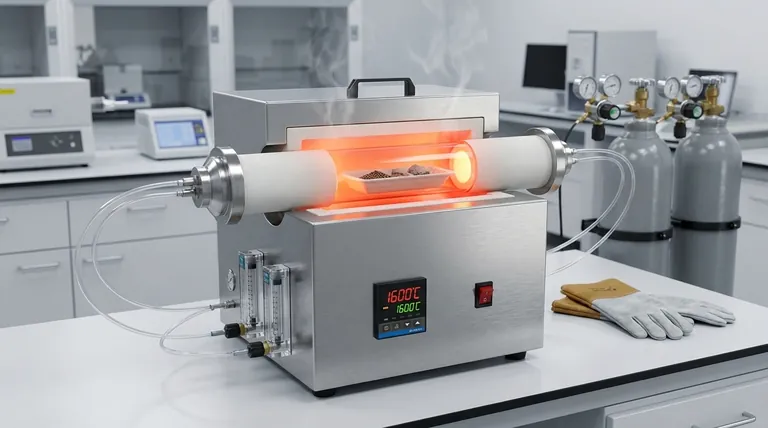
In high-temperature laboratory and industrial processes, the alumina furnace tube is defined by a unique combination of extreme thermal resilience, chemical purity, and structural integrity. With an alumina content exceeding 99.6% and a density of at least 3.80 g/cm², these tubes are engineered to operate continuously at temperatures up to 1600°C (2912°F). This makes them a cornerstone for applications demanding a stable, non-reactive environment, though they require careful handling due to poor thermal shock resistance.
The core value of an alumina tube lies in its ability to provide an exceptionally pure and stable environment at extreme temperatures where other materials fail. However, this high performance comes with a critical trade-off: a brittleness that makes it vulnerable to cracking if heated or cooled too quickly.
Why Alumina is a Standard for High-Temperature Work
The selection of alumina is a deliberate engineering choice driven by the need for performance under extreme conditions. Its properties make it indispensable for advanced materials science, metallurgy, and chemical processing.
Extreme Temperature Stability
Alumina tubes are designed to operate reliably at continuous working temperatures of 1600°C, with some capable of handling temperatures exceeding this for short periods. This allows for processes like sintering, annealing, and crystal growth that are impossible with materials like quartz or most metals.
Unmatched Chemical Purity
With an alumina (Al₂O₃) content of over 99.6%, these tubes are exceptionally pure. This high purity is critical in applications like semiconductor manufacturing or materials research, where even trace contaminants from the furnace tube could compromise the integrity of the sample.
Superior Chemical Inertness
Alumina is highly resistant to chemical attack from corrosive substances and volatile materials at high temperatures. This inertness ensures that the tube itself does not react with the sample or the process atmosphere, preserving the experiment's intended conditions.
The Role of the Tube in a Furnace System
The alumina tube is not a standalone component but the central chamber of a larger tube furnace system. Its characteristics are essential for the furnace's overall function and precision.
The Core Processing Chamber
The tube forms the sealed chamber that holds the sample. It is the heart of the furnace, containing the specific atmosphere—whether vacuum, inert gas, or oxidizing air—required for the process.
Enabling Uniform Heat Distribution
While heating elements (like resistance wire or silicon carbide rods) are arranged around the tube's exterior, the alumina material itself helps distribute that heat evenly. This thermal uniformity along the tube's length is crucial for achieving consistent and repeatable results.
Compatibility with Advanced Control
Modern furnaces use sophisticated PID (Proportional-Integral-Derivative) temperature controllers. The predictable thermal behavior of alumina allows these systems to execute precise heating profiles, maintain target temperatures with high accuracy, and implement safety protocols.
Understanding the Critical Trade-off: Thermal Shock
The single most important limitation of alumina is its susceptibility to thermal shock. Understanding this is key to its successful use.
What is Thermal Shock?
Thermal shock occurs when a material experiences a rapid change in temperature, causing different parts of it to expand or contract at different rates. This generates internal stress that can cause a brittle material like ceramic to fracture.
Alumina's Primary Weakness
The rigid, crystalline structure that gives alumina its strength and high-temperature stability also makes it brittle. Unlike a metal that might warp, alumina will crack or shatter if heated or cooled too aggressively.
How to Mitigate the Risk
The risk of thermal shock is managed through procedural discipline. Always use the furnace's temperature controller to program a slow, controlled ramp-up to the target temperature and, just as importantly, a slow cool-down back to room temperature. Rapidly opening the furnace at high temperatures to cool a sample is a common cause of tube failure.
Making the Right Choice for Your Application
Selecting the right furnace tube material requires balancing performance needs, process conditions, and operational constraints.
- If your primary focus is maximum temperature and purity: Alumina is the definitive choice for processes running above 1200°C or any application where sample contamination is a critical concern.
- If your primary focus is rapid thermal cycling or visibility: Quartz is a better option for temperatures below 1200°C, as it offers superior thermal shock resistance and is transparent.
- If your primary focus is mechanical durability at lower temperatures: A metallic tube may be more suitable for applications that involve physical stress, though it sacrifices temperature range and chemical purity.
Ultimately, understanding the distinct properties of an alumina tube empowers you to harness its incredible performance while respecting its operational limits.
Summary Table:
| Characteristic | Details |
|---|---|
| Max Temperature | Up to 1600°C (2912°F) continuous |
| Alumina Content | Over 99.6% purity |
| Density | At least 3.80 g/cm³ |
| Key Advantage | Extreme thermal resilience and chemical inertness |
| Main Limitation | Poor thermal shock resistance; requires careful handling |
Unlock Precision in Your High-Temperature Processes with KINTEK
Leveraging exceptional R&D and in-house manufacturing, KINTEK provides diverse laboratories with advanced high-temperature furnace solutions. Our product line, including Muffle, Tube, Rotary Furnaces, Vacuum & Atmosphere Furnaces, and CVD/PECVD Systems, is complemented by our strong deep customization capability to precisely meet unique experimental requirements. Whether you need reliable alumina tubes for sintering, annealing, or other demanding applications, we deliver tailored solutions that ensure purity, stability, and efficiency. Contact us today to discuss how our expertise can enhance your lab's performance and achieve superior results!
Visual Guide

Related Products
- 1400℃ High Temperature Laboratory Tube Furnace with Alumina Tube
- 1700℃ High Temperature Laboratory Tube Furnace with Alumina Tube
- Magnesium Extraction and Purification Condensing Tube Furnace
- Vertical Laboratory Quartz Tube Furnace Tubular Furnace
- High Pressure Laboratory Vacuum Tube Furnace
People Also Ask
- How do high-temperature laboratory tube furnaces ensure environmental stability? Precision Thermal Reduction Tips
- How are high-temperature laboratory tube furnaces applied in long-term vacuum homogenization heat treatments for intermetallic samples?
- How are high-temperature tube furnaces applied in testing ceramic-supported alloy membranes? Insights
- What is the mechanism of a high-temperature furnace in Bi-2223 sintering? Achieve Precision Phase Transformation
- How does a laboratory high-temperature tube furnace contribute to the conversion of electrospun fibers? Expert Insights



















