
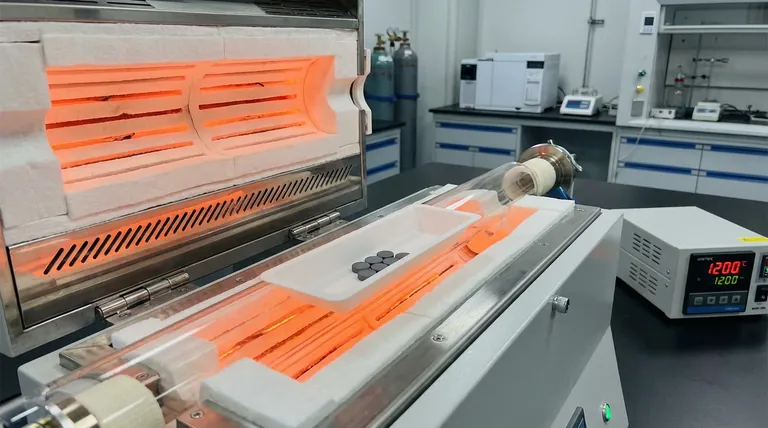
To serve effectively as a carrier for Mn2AlB2, an alumina boat requires a specific balance of high thermal stability and absolute chemical inertness. It must maintain rigid structural integrity at sintering temperatures of 1200 °C while preventing any chemical interaction with the highly active manganese, aluminum, and boron components.
The alumina boat must function strictly as a physical support, ensuring that no impurities from the container walls migrate into the final product and that the sample geometry remains undisturbed by carrier deformation.
Thermal Performance Requirements
Withstanding the High-Temperature Zone
The primary physical requirement is the ability to survive the high-temperature zone of the furnace. The sintering process for Mn2AlB2 requires temperatures reaching 1200 °C.
Maintaining Structural Form
At these elevated temperatures, the boat must not soften, warp, or sag. It is critical that the boat supports the Mn2AlB2 compacts without undergoing deformation, as structural failure could compromise the sample or damage the furnace.
Chemical Compatibility and Purity
Resisting Active Components
Mn2AlB2 contains manganese, aluminum, and boron, all of which are classified as highly active components. The alumina boat must possess sufficient chemical inertness to resist reacting with these elements, even under high heat.
Eliminating Contamination Risks
The definition of a successful carrier in this context is one that does not alter the sample's composition. By remaining chemically inert, the boat prevents the introduction of impurities from the container walls into the sintered product.
Understanding the Risks of Failure
The Consequence of Reactivity
If the alumina boat lacks the necessary inertness, it will not merely hold the sample; it will become part of the reaction. This leads to cross-contamination, where the container degrades the purity of the Mn2AlB2.
The Consequence of Thermal Instability
If the boat meets the chemical requirements but fails thermally, the physical experiment is compromised. Deformation at 1200 °C can lead to sample displacement or inconsistent heating profiles, rendering the sintering process ineffective.
Ensuring Sintering Success
To guarantee the integrity of your Mn2AlB2 samples, you must select labware that meets these dual criteria.
- If your primary focus is Sample Purity: rigorous verification of the boat's chemical inertness against manganese, aluminum, and boron is required to prevent impurity migration.
- If your primary focus is Process Safety: ensure the alumina grade is explicitly rated to maintain rigidity and load-bearing capacity at temperatures exceeding 1200 °C.
Select a carrier that acts as an invisible, non-reactive foundation for your materials science.
Summary Table:
| Requirement Category | Specific Criteria | Importance for Mn2AlB2 |
|---|---|---|
| Thermal Stability | Resilience at 1200°C+ | Prevents warping, sagging, or structural failure |
| Chemical Inertness | Resistance to Mn, Al, and B | Eliminates cross-contamination and impurity migration |
| Physical Integrity | Rigid structural support | Maintains sample geometry and prevents furnace damage |
| Purity Standards | High-grade Alumina | Ensures the carrier acts only as a physical support |
Elevate Your Sintering Precision with KINTEK
Don’t let inferior labware compromise your advanced material synthesis. At KINTEK, we specialize in high-performance alumina carriers designed to withstand the most demanding thermal environments. Backed by expert R&D and world-class manufacturing, we offer a comprehensive range of Muffle, Tube, Rotary, Vacuum, and CVD systems, along with customizable lab high-temp furnaces and boats tailored to your unique research needs.
Ensure the purity and structural integrity of your Mn2AlB2 samples today.
Contact Our Experts for a Custom Solution
References
- Fatma Nur Tuzluca Yesilbag, Ahmad Hüseyin. The effect of Aluminum (Al) ratio on the synthesis of the laminated Mn2AlB2 MAB Phase. DOI: 10.18185/erzifbed.1514470
This article is also based on technical information from Kintek Furnace Knowledge Base .
Related Products
- 1400℃ High Temperature Laboratory Tube Furnace with Alumina Tube
- 1700℃ High Temperature Laboratory Tube Furnace with Alumina Tube
- 2200 ℃ Tungsten Vacuum Heat Treat and Sintering Furnace
- Vacuum Heat Treat Sintering Furnace Molybdenum Wire Vacuum Sintering Furnace
- High Temperature Muffle Oven Furnace for Laboratory Debinding and Pre Sintering
People Also Ask
- How does zone-melting in tube furnaces synthesize bismuth micro-wires? Master Single-Crystal Thermoelectric Growth
- How are high-temp tube furnaces used to measure diffusion coefficients per Fick's law? Master Precision Annealing
- How do high-temperature laboratory tube furnaces ensure environmental stability? Precision Thermal Reduction Tips
- How are high-temperature laboratory tube furnaces applied in long-term vacuum homogenization heat treatments for intermetallic samples?
- How are high-temperature tube furnaces applied in testing ceramic-supported alloy membranes? Insights






