
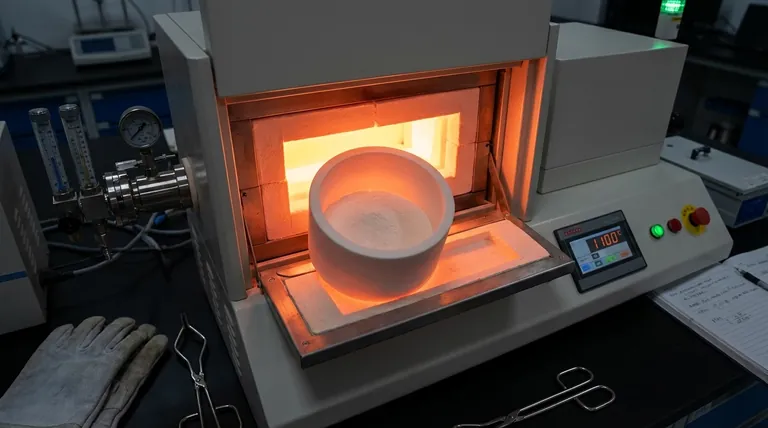
High-purity alumina (corundum) crucibles are selected primarily because they provide a chemically inert environment that withstands the rigorous thermal demands of annealing NaNbO3:Pr3+. Specifically, these crucibles remain stable between 1025 °C and 1100 °C, ensuring the container does not react with the NaNbO3 powder during the sintering process.
The selection of a carrier is not merely about surviving heat; it is about ensuring total chemical isolation. Corundum is chosen to preventing the crucible material from leaching into the NaNbO3 lattice, thereby preserving the material's optical purity and mechanoluminescent performance.
The Critical Role of Chemical Inertness
Preventing Material Reactions
The primary danger during high-temperature annealing is the potential for the carrier vessel to react with the sample.
High-purity alumina possesses excellent chemical stability. During the annealing of NaNbO3:Pr3+, the corundum crucible does not react with the sodium niobate material. This inertness is the baseline requirement for successful synthesis.
Safeguarding Optical Purity
For optical materials like mechanoluminescent powders, even trace impurities can destroy performance.
By preventing the container components from leaching into the sample, the crucible safeguards the material's composition. This ensures the powder remains free from environmental impurities, allowing the correct crystal phase to construct without interference.
Thermal Stability Requirements
Withstanding the Sintering Window
The annealing process for NaNbO3:Pr3+ requires precise thermal control within a specific high-heat window.
The process operates between 1025 °C and 1100 °C. Corundum is a refractory material that maintains its structural integrity well beyond these temperatures, providing a reliable vessel for the reaction.
Durability During Long Durations
Stability must be maintained not just for a moment, but throughout the entire heating cycle.
The annealing process often involves long-duration sintering, such as 4-hour holds. The corundum crucible remains stable throughout this exposure, preventing degradation that could occur with lesser materials over time.
Understanding the Trade-offs
Specificity of Application
While corundum is excellent for NaNbO3, it is not a universal solution for all chemical environments.
Its selection is specific to its inertness against this particular compound and temperature range. While it resists many molten salts, one must always verify compatibility to ensure the specific chemical makeup of the sample does not erode the alumina at higher temperatures.
The Necessity of High Purity
It is critical to distinguish between standard alumina and "high-purity" alumina.
Using a lower-grade crucible with binders or impurities can defeat the purpose of the selection. To achieve the optical results described, the crucible itself must be of sufficiently high purity to prevent cross-contamination.
Making the Right Choice for Your Goal
When setting up your annealing process for optical materials, consider your specific performance targets.
- If your primary focus is Optical Purity: Prioritize high-purity corundum to eliminate the risk of container ions leaching into your phosphor lattice and quenching luminescence.
- If your primary focus is Process Reliability: Ensure your furnace operates strictly within the 1025 °C to 1100 °C window to maximize the known stability profile of the crucible-sample interface.
Selecting the right crucible is the silent foundation of creating high-performance optical ceramics.
Summary Table:
| Feature | Benefit for NaNbO3:Pr3+ Annealing |
|---|---|
| Material | High-purity Alumina (Corundum) |
| Thermal Window | 1025 °C - 1100 °C (Refractory Stability) |
| Chemical Property | High Inertness (No leaching into sample) |
| Performance Impact | Preserves mechanoluminescent properties |
| Durability | High structural integrity during 4h+ sintering |
Elevate Your Research with Precision Thermal Solutions
Don't let crucible contamination compromise your material synthesis. At KINTEK, we understand that high-performance optical ceramics require the highest standards of chemical isolation and thermal control.
Backed by expert R&D and world-class manufacturing, KINTEK offers a wide range of specialized laboratory equipment including Muffle, Tube, Rotary, Vacuum, and CVD systems. Whether you need standard high-purity alumina crucibles or fully customizable lab high-temp furnaces tailored to your unique annealing requirements, our team is ready to support your next breakthrough.
Ready to optimize your high-temperature processes? Contact us today for a professional consultation!
Visual Guide

References
- Zhangnan WANG. Personalized Electronic Signature Technology Based on Stress Luminescent Materials. DOI: 10.5755/j02.ms.39962
This article is also based on technical information from Kintek Furnace Knowledge Base .
Related Products
People Also Ask
- What are the advantages of using a condensing tube furnace for magnesium extraction? Achieve High Purity and Efficient Metal Recovery
- What is a tube furnace and what is its primary use? Achieve Precision High-Temp Processing for Your Lab
- What is the technical significance of the high-temperature environment provided by a tube furnace in the synthesis of Fe3O4@Fe-AC?
- How does the applicability of materials change with advancements in cracking technology? Unlock New Material Processing Possibilities
- How does a tube furnace contribute to the ammonia reduction annealing process for (NiZnMg)MoN catalysts? Optimize Phase Transitions

