
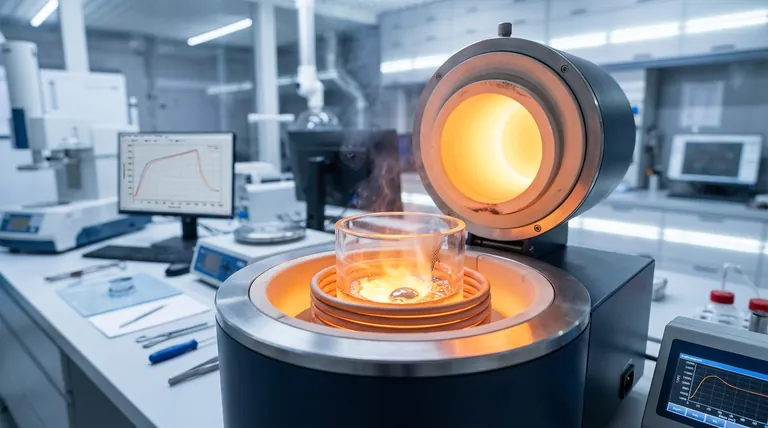
A high-purity quartz crucible functions as an active participant rather than a passive vessel during the induction melting process. By undergoing slight interface reactions with the metal melt at high temperatures, the crucible contributes silica to the system, directly facilitating the formation and evolution of silicate inclusions.
The quartz crucible acts as a reactive component that mimics the chemical environment of industrial steelmaking, allowing researchers to accurately study the thermodynamic stability of high-silica inclusions through controlled trace element exchange.
The Active Role of the Crucible
Beyond Simple Containment
In many melting scenarios, the ideal crucible is inert. However, when preparing silicate inclusions, the high-purity quartz crucible is selected specifically because it serves as a reactive component.
Interface Reactions
At high temperatures, the silica content of the quartz undergoes slight interface reactions with the molten metal. This is not a failure of the material, but a critical mechanism for the experiment.
Trace Element Exchange
These reactions facilitate a transfer of elements—specifically oxygen and silicon—from the crucible to the melt. This exchange provides the necessary chemical building blocks to generate and sustain silicate inclusions.
Simulating Industrial Conditions
Mimicking Refractory Erosion
In industrial steelmaking, molten steel constantly interacts with furnace refractory linings. The reaction between the quartz crucible and the melt effectively simulates this interaction on a laboratory scale.
Realistic Inclusion Evolution
By replicating the influence of furnace lining refractories, the setup provides a realistic physicochemical environment. This ensures that the inclusions observed in the lab closely resemble those found in actual large-scale production.
Thermodynamic Stability
This specific environment allows researchers to analyze the thermodynamic stability of high-silica inclusions. Without the silica-rich environment provided by the crucible, these inclusions might degrade or transform, rendering the study inaccurate.
Understanding the Trade-offs
Intended vs. Unintended Contamination
The use of quartz introduces a form of controlled contamination. While beneficial for simulating silicate inclusions, this reactivity makes quartz unsuitable for applications requiring ultra-high purity melts where silicon uptake must be avoided.
The Role of Atmosphere
While the crucible dictates the chemical interaction regarding silica, it is not the sole factor. The furnace atmosphere must still be carefully managed to control other physical properties like hardness and surface finish, ensuring the data is not skewed by oxidation or other atmospheric variables.
Making the Right Choice for Your Goal
To determine if a high-purity quartz crucible is appropriate for your specific metallurgical study, consider the following:
- If your primary focus is simulating industrial steelmaking: Use a quartz crucible to replicate the chemical effects of refractory lining erosion and stabilize silicate inclusions.
- If your primary focus is absolute melt purity: Avoid quartz, as the interface reactions will inevitably alter the chemical composition of your sample through silicon transfer.
By leveraging the reactivity of the quartz crucible, you turn a potential containment variable into a precise experimental tool.
Summary Table:
| Feature | Role in Silicate Inclusion Preparation |
|---|---|
| Material Property | High-purity quartz (active reactive component) |
| Primary Mechanism | Interface reactions between melt and crucible wall |
| Chemical Impact | Facilitates silicon and oxygen transfer (trace element exchange) |
| Industrial Analog | Mimics refractory erosion in large-scale steelmaking |
| Key Benefit | Ensures thermodynamic stability of high-silica inclusions |
| Trade-off | Not suitable for applications requiring zero silicon uptake |
Optimize Your Metallurgical Research with KINTEK
Ready to achieve precise control over your inclusion studies? KINTEK provides high-performance heating solutions tailored for advanced material science. Backed by expert R&D and manufacturing, we offer a comprehensive range of Muffle, Tube, Rotary, Vacuum, and CVD systems, as well as specialized lab high-temp furnaces—all fully customizable to meet your unique experimental needs.
Turn your containment variables into precise tools with KINTEK expertise. Contact us today to find the perfect furnace for your lab!
References
- Alejandra Slagter, Andreas Mortensen. Nanoindentation Hardness and Modulus of Al2O3–SiO2–CaO and MnO–SiO2–FeO Inclusions in Iron. DOI: 10.1007/s11661-024-07330-x
This article is also based on technical information from Kintek Furnace Knowledge Base .
Related Products
- Vacuum Induction Melting Furnace
- 600T Vacuum Induction Hot Press Vacuum Heat Treat and Sintering Furnace
- Small Vacuum Heat Treat and Tungsten Wire Sintering Furnace
- High Temperature Muffle Oven Furnace for Laboratory Debinding and Pre Sintering
- Vacuum Heat Treat Sintering and Brazing Furnace
People Also Ask
- What are the core functions of the High Vacuum Induction Melting (VIM) furnace? Optimize DD5 Superalloy Purification
- What role does a Vacuum Induction Melting furnace play in the production of high-aluminum nickel-based superalloys?
- What is the role of VIM and directional solidification in aero-engine blade substrates? Engineering Extreme Durability
- What are the technical advantages of using a Vacuum Induction Melting furnace in the development of advanced packaging steel?
- Why is a Vacuum Induction Melting furnace (VIM) used for Cu-Zn-Al-Sn alloys? Achieve Precision Composition Control



















