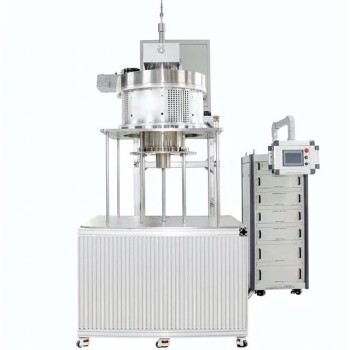
Vacuum Spark Plasma Sintering (SPS) fundamentally outperforms traditional muffle furnaces by utilizing pulsed direct current to heat the mold and sample simultaneously. This technique allows for heating rates of several hundred degrees per minute, drastically reducing the thermal dwell time required for densification. By minimizing exposure to high temperatures, SPS inhibits abnormal grain growth, ensuring the fine-grained microstructure necessary for high optical transparency and superior mechanical strength in large ceramic components.
The Core Insight Traditional radiative heating (muffle furnaces) suffers from thermal inertia, requiring long cycle times that allow grains to coarsen and pores to persist—both of which destroy transparency. SPS solves this via rapid, pressure-assisted densification, locking in a high-density, sub-micron structure before optical defects can form.
The Mechanism: Direct vs. Indirect Heating
Pulsed Current Direct Heating
Unlike muffle furnaces, which rely on external heating elements to radiate heat to the sample, SPS systems pass pulsed electric current directly through the mold and the conducting powder.
This generates heat internally via the Joule effect. It bypasses the slow thermal transfer inherent in traditional methods, ensuring energy is delivered exactly where it is needed.
Eliminating Thermal Inertia
Traditional furnaces struggle to change temperature quickly due to the mass of their insulation and elements.
SPS systems eliminate this lag, achieving heating rates exceeding 100°C per minute (up to several hundred degrees). This capability allows the system to bypass intermediate temperature zones specifically known to cause non-productive grain coarsening.
Impact on Optical and Mechanical Properties
Inhibiting Abnormal Grain Growth
For transparent ceramics, grain size is a critical variable; large, uneven grains scatter light and reduce clarity.
The "fast-firing" characteristic of SPS completes the sintering process rapidly. This effectively inhibits uncontrolled grain growth during the final stages of densification, preserving a fine, uniform microstructure essential for optical transmission.
Achieving Theoretical Density
Transparency requires the near-total elimination of porosity, as even microscopic pores scatter light.
SPS combines thermal energy with synchronous pressurization. The application of mechanical pressure during the heating phase accelerates atomic diffusion and plastic flow, allowing materials to reach relative densities close to theoretical limits at significantly lower temperatures than pressureless sintering.
Plasma Activation and Diffusion
Within the 1800°C to 2300°C range, SPS leverages plasma activation and Joule heating to accelerate atomic diffusion.
This overcomes high lattice energy barriers common in advanced ceramics. It enables the formation of solid-solution single-phase structures rapidly, resulting in materials with superior hardness and fracture toughness alongside their optical qualities.
Understanding the Trade-offs
Complexity of Process Control
While a muffle furnace is often a "set-and-forget" tool, SPS requires precise management of current, pressure, and vacuum simultaneously.
Achieving the perfect balance to prevent thermal gradients in large-sized samples requires rigorous optimization of the mold geometry and pulsing parameters.
Mold Dependencies
SPS relies heavily on the conductivity and strength of the die (usually graphite).
Unlike a muffle furnace where samples sit on simple trays, SPS requires expensive, precision-machined molds that must withstand both massive electrical currents and high mechanical pressure. This adds a layer of logistical complexity to the preparation of large-format ceramics.
Making the Right Choice for Your Goal
If you are evaluating sintering technologies for ceramic production, consider these strategic distinctions:
- If your primary focus is Optical Transparency: SPS is superior because its rapid cycle time prevents the grain coarsening that causes light scattering and opacity.
- If your primary focus is Mechanical Integrity: SPS provides a distinct advantage by producing finer microstructures that yield higher fracture toughness and hardness than prolonged hot-pressing.
Summary: SPS transforms the production of transparent ceramics by substituting the slow, passive heating of traditional furnaces with an active, high-energy process that forces densification without sacrificing microstructural fidelity.
Summary Table:
| Feature | Traditional Muffle Furnace | Vacuum SPS System |
|---|---|---|
| Heating Method | External Radiative (Indirect) | Pulsed Direct Current (Direct Joule Heating) |
| Heating Rate | Slow (Thermal Inertia) | Rapid (>100°C/min) |
| Grain Control | Susceptible to Coarsening | Inhibits Abnormal Growth |
| Pressure | Pressureless Sintering | Synchronous Pressurization |
| Optical Result | Risk of Porosity/Opacity | High Density & Transparency |
| Complexity | Low / Set-and-forget | High / Multi-parameter Control |
Elevate Your Ceramic Research with KINTEK Precision
Unlock the full potential of your materials with our advanced Vacuum Spark Plasma Sintering (SPS) systems. At KINTEK, we bridge the gap between complex engineering and superior results. Backed by expert R&D and world-class manufacturing, we offer Muffle, Tube, Rotary, Vacuum, and CVD systems, along with other lab high-temp furnaces—all fully customizable to meet your unique sintering requirements.
Whether you need to inhibit grain growth or achieve theoretical density in large-format transparent ceramics, our team is ready to assist. Contact us today to find your custom solution and drive your innovation forward.
References
- Siliang Lu, Zhenqiang Chen. Optimal Doping Concentrations of Nd3+ Ions in CYGA Laser Crystals. DOI: 10.3390/cryst14020168
This article is also based on technical information from Kintek Furnace Knowledge Base .
Related Products
- Spark Plasma Sintering SPS Furnace
- Vacuum Heat Treat Sintering Furnace with Pressure for Vacuum Sintering
- 9MPa Air Pressure Vacuum Heat Treat and Sintering Furnace
- 600T Vacuum Induction Hot Press Vacuum Heat Treat and Sintering Furnace
- Vacuum Hot Press Furnace Machine Heated Vacuum Press Tube Furnace
People Also Ask
- Why is it necessary to maintain a high vacuum environment during the SPS of SiC? Key to High-Density Ceramics
- How does the heating mechanism of Spark Plasma Sintering (SPS) function? Enhance TiC/SiC Composite Fabrication
- What are the technical advantages of using an SPS sintering furnace? Elevate Al2O3-TiC Material Performance
- What are the steps in the discharge plasma sintering process? Master Fast, High-Density Material Consolidation
- What are the advantages of spark plasma sintering (SPS) over traditional forging? Precision Microstructural Control