
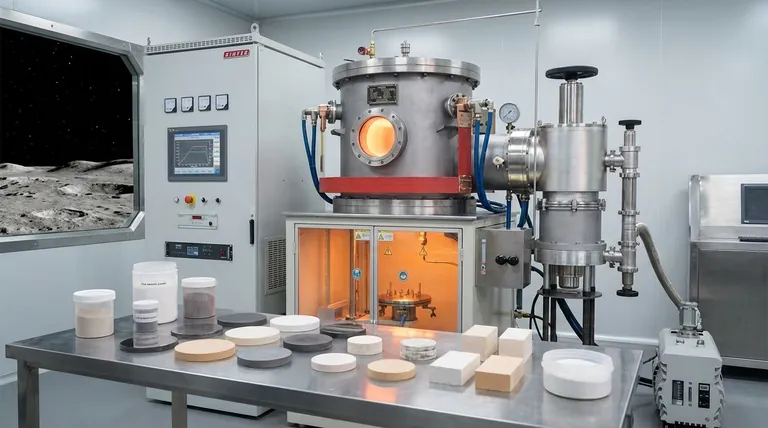
The industrial hot press functions as the critical enabler for processing lunar ceramics by overcoming the material's inherent brittleness and hardness through the simultaneous application of heat and high pressure. This specific combination drives the densification process far beyond what standard heating can achieve, creating the structural integrity required for the harsh lunar environment.
By facilitating pressure-assisted sintering, the hot press forces particle rearrangement and diffusion at lower temperatures. This mechanism systematically eliminates internal defects, resulting in a denser, stronger material capable of withstanding significant physical impact.
Overcoming Material Limitations
The Challenge of Ceramic Processing
Ceramic materials naturally exhibit high brittleness and hardness. While these traits are desirable for protection, they make the materials notoriously difficult to process using conventional methods.
The Power of Simultaneous Pressure
An industrial hot press addresses this processing difficulty by applying high pressure alongside high temperature. This is not merely speeding up the process; it is fundamentally altering how the material consolidates.
Pressure-Assisted Sintering
The core mechanism at work is pressure-assisted sintering. This technique promotes the active diffusion and rearrangement of the ceramic powder particles, forcing them into a cohesive structure.
Achieving Structural Integrity
Eliminating Internal Defects
The primary goal of this process is the reduction of internal pores and micro-cracks. In a standard sintering process, these microscopic voids often remain, creating weak points where fractures can initiate.
High-Density Consolidation
The hot press enables high-density consolidation. By physically compressing the material during the heating phase, the equipment ensures that the ceramic achieves maximum density, leaving little room for structural imperfections.
Impact on Performance
The reduction of porosity directly enhances mechanical strength and impact resistance. For lunar protection structures, which face micrometeoroid impacts and extreme conditions, this enhanced durability is non-negotiable.
Understanding the Trade-offs
Process Intensity vs. Efficiency
While effective, this method requires specialized equipment to generate the necessary forces. However, it allows for effective consolidation at lower temperatures, such as through hydrothermal sintering.
The Necessity of Precision
This is not a passive process. It relies on the precise balance of heat and pressure to succeed. If pressure is not applied correctly during the diffusion phase, the rearrangement of particles will be incomplete, compromising the final density.
Making the Right Choice for Your Project
The use of an industrial hot press is less about preference and more about meeting the strict material property requirements for lunar applications.
- If your primary focus is maximum durability: Prioritize pressure-assisted sintering to minimize micro-cracks and maximize impact resistance for protective structures.
- If your primary focus is processing efficiency: Leverage the hot press to achieve high-density consolidation at significantly lower temperatures compared to pressure-less sintering methods.
This technology is the bridge between raw ceramic powder and a high-performance structural shield.
Summary Table:
| Feature | Pressure-Assisted Sintering (Hot Press) | Conventional Sintering |
|---|---|---|
| Mechanism | Simultaneous Heat + High Pressure | Heat Only |
| Density | Maximum High-Density Consolidation | Lower (Prone to Residual Porosity) |
| Defect Control | Eliminates Internal Pores & Micro-cracks | High Risk of Micro-fractures |
| Temperature | Effective at Lower Temperatures | Requires Extremely High Heat |
| Strength | Superior Impact Resistance | Variable Strength |
Elevate Your Materials Research with KINTEK Precision
For lunar-grade structural integrity, precision is non-negotiable. KINTEK provides industry-leading high-temperature and high-pressure solutions designed to meet the most rigorous scientific demands. Backed by expert R&D and manufacturing, we offer a comprehensive range of Muffle, Tube, Rotary, Vacuum, and CVD systems, as well as customizable Industrial Hot Presses tailored for your unique densification needs.
Whether you are developing ceramic shields for space exploration or high-performance industrial components, our team is ready to provide the specialized equipment you need for success.
Contact KINTEK Experts Today to discuss your custom furnace requirements!
Visual Guide

References
- Alex Ellery. Ceramics—The Forgotten but Essential Ingredients for a Circular Economy on the Moon. DOI: 10.3390/ceramics8030107
This article is also based on technical information from Kintek Furnace Knowledge Base .
Related Products
- Vacuum Hot Press Furnace Machine for Lamination and Heating
- Vacuum Hot Press Furnace Machine Heated Vacuum Press
- 600T Vacuum Induction Hot Press Vacuum Heat Treat and Sintering Furnace
- Vacuum Hot Press Furnace Machine Heated Vacuum Press Tube Furnace
People Also Ask
- What are the primary components of a vacuum hot press furnace? Master the Core Systems for Precise Material Processing
- What safety features are incorporated in vacuum hot press furnaces? Ensure Operator and Equipment Protection
- What are the benefits of the vacuum environment system in a vacuum hot press furnace? Unlock High-Density Sintering
- What industries benefit from the use of vacuum hot press furnaces? Unlock High-Performance Materials for Your Industry
- How does the uniaxial pressure applied by a vacuum hot press furnace affect the microstructure of ZrC-SiC materials?



