
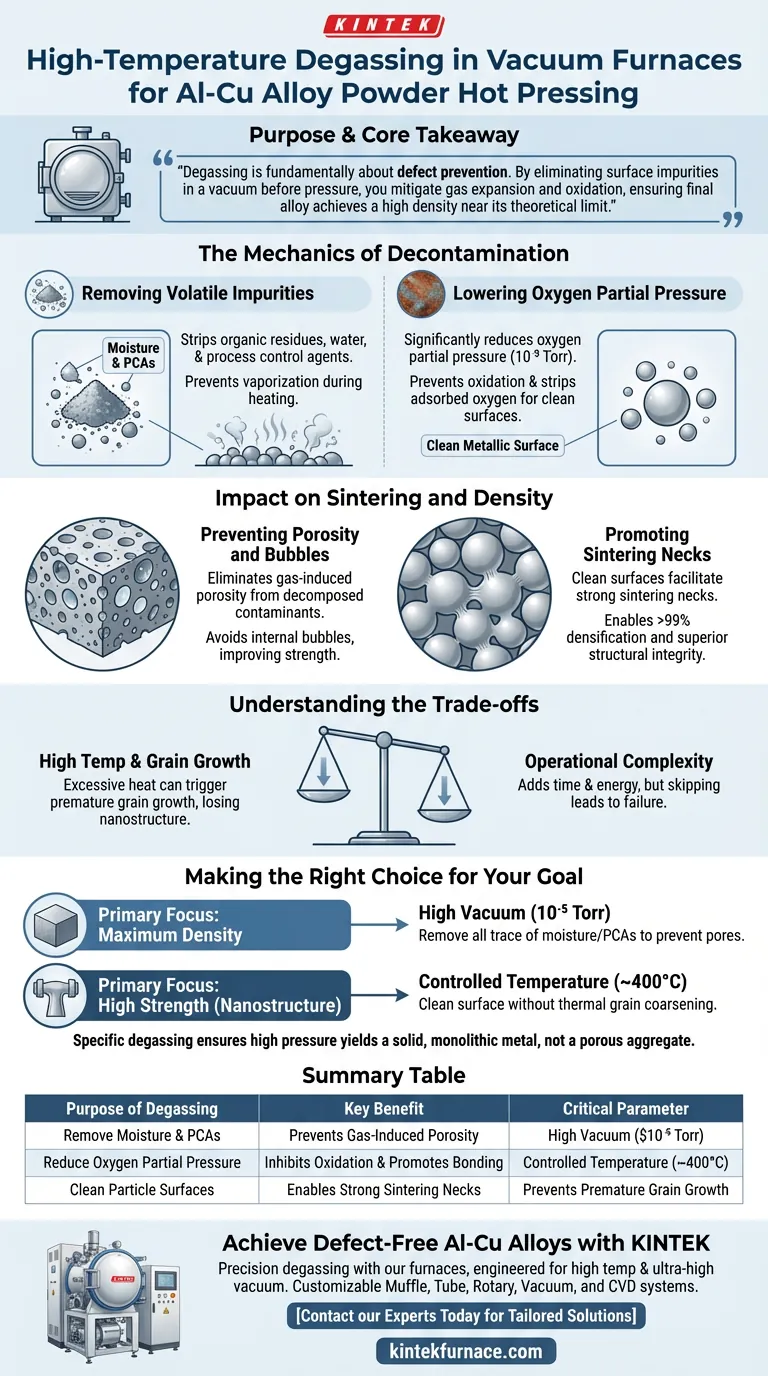
High-temperature degassing is a mandatory purification step designed to strip volatile contaminants from the surface of Al-Cu powder particles prior to consolidation. Its immediate purpose is to remove moisture, adsorbed gases, and residues from process control agents that would otherwise become trapped inside the material.
The Core Takeaway Degassing is fundamentally about defect prevention. By eliminating surface impurities in a vacuum before pressure is applied, you mitigate the risk of gas expansion and oxidation, ensuring the final alloy achieves a high density near its theoretical limit.
The Mechanics of Decontamination
Removing Volatile Impurities
Metal powders, particularly those processed via ball milling, often retain process control agents (PCAs) and environmental moisture on their surfaces.
If these organic residues and water molecules are not removed, they will vaporize during the heating phase of hot pressing.
Degassing at temperatures (e.g., 400°C) allows these volatiles to desorb and be evacuated by the vacuum system before the powder is compacted.
Lowering Oxygen Partial Pressure
Aluminum and copper are susceptible to oxidation, which creates brittle boundary layers between particles.
A vacuum environment (e.g., $10^{-5}$ Torr) significantly reduces the oxygen partial pressure.
This prevents further oxidation of the metal powder and aids in stripping existing adsorbed oxygen, leaving a clean metallic surface ready for bonding.
Impact on Sintering and Density
Preventing Porosity and Bubbles
The most critical deep need addressed by degassing is the prevention of gas-induced porosity.
If contaminants remain on the powder during the high-pressure consolidation phase, they decompose into gases that get trapped inside the solidifying metal.
This results in internal bubbles or pores that drastically reduce the mechanical strength and fatigue life of the final component.
Promoting Sintering Necks
High-density consolidation requires particles to diffuse into one another effectively.
Clean, degassed surfaces facilitate the formation of strong sintering necks between particles.
This direct metal-to-metal contact allows the material to achieve densification levels over 99%, ensuring superior structural integrity.
Understanding the Trade-offs
Balancing Temperature and Grain Growth
While high temperatures are necessary to remove stubborn impurities, excessive heat prior to pressing can be detrimental.
Extended exposure to high heat during degassing can trigger premature grain growth, causing the material to lose its nanocrystalline structure before it is even pressed.
Operational Complexity
Adding a dedicated degassing cycle increases total processing time and energy consumption.
However, skipping this step to save time almost invariably leads to structural failure due to blistering or low density in the final part.
Making the Right Choice for Your Goal
To optimize your Al-Cu alloy production, align your process parameters with your specific performance targets:
- If your primary focus is Maximum Density: Ensure the vacuum level is high ($10^{-5}$ Torr or better) to remove every trace of moisture and PCA residue, preventing pore formation.
- If your primary focus is High Strength (Nanostructure): Keep the degassing temperature strictly controlled (around 400°C) to clean the surface without triggering thermal grain coarsening.
Ultimately, specific degassing ensures that the high pressure applied later yields a solid, monolithic metal rather than a porous, brittle aggregate.
Summary Table:
| Purpose of Degassing | Key Benefit | Critical Parameter |
|---|---|---|
| Remove Moisture & PCAs | Prevents Gas-Induced Porosity | High Vacuum (e.g., 10⁻⁵ Torr) |
| Reduce Oxygen Partial Pressure | Inhibits Oxidation & Promotes Bonding | Controlled Temperature (e.g., 400°C) |
| Clean Particle Surfaces | Enables Strong Sintering Necks | Prevents Premature Grain Growth |
Achieve Defect-Free Al-Cu Alloys with KINTEK
Perfecting your hot pressing process starts with precise degassing. Our vacuum furnaces are engineered to deliver the critical combination of high temperature and ultra-high vacuum necessary to remove volatile contaminants, prevent porosity, and ensure your materials achieve maximum density and strength.
Backed by expert R&D and manufacturing, KINTEK offers Muffle, Tube, Rotary, Vacuum, and CVD systems, all customizable for unique needs like nanostructure preservation in Al-Cu alloys.
Let's optimize your materials process. Contact our experts today for a solution tailored to your research and production goals.
Visual Guide
Related Products
- Molybdenum Vacuum Heat Treat Furnace
- 2200 ℃ Tungsten Vacuum Heat Treat and Sintering Furnace
- Vacuum Heat Treat Sintering Furnace Molybdenum Wire Vacuum Sintering Furnace
- 1700℃ High Temperature Laboratory Tube Furnace with Alumina Tube
- 2200 ℃ Graphite Vacuum Heat Treat Furnace
People Also Ask
- What is the primary application of vacuum heat treating furnaces in aerospace? Enhance Component Performance with Precision
- How does vacuum heat treating work in terms of temperature and time control? Master Precise Material Transformations
- What is the process of vacuum heat treating? Achieve Superior Metallurgical Properties
- How does a vacuum heat treating furnace improve the condition of metal alloys? Achieve Superior Metal Performance
- Why are vacuum heat treating furnaces essential for aerospace? Ensure Superior Material Integrity for High-Stakes Applications



















